 HSA & FSA accepted; best-value for top quality care
 Same-day mental health, weight loss, and primary care appointments available

 Accept major insurances and cash-payHSA & FSA accepted; best-value for top quality careSame-day mental health, weight loss, and primary care appointments availableAccept major insurances and cash-pay
Why Primary Care Reduces Emergency Visits: 2026 Guide
Written by Klarity Editorial Team
Published: Jun 25, 2026

Primary care is defined as the first and continuous point of contact between a patient and the healthcare system, and it is the single most effective strategy for reducing unnecessary emergency room visits. Adults with chronic diseases who have regular primary care are 11% less likely to visit the ER and 20% less likely to be hospitalized. Children with chronic conditions see even sharper results, with 50% fewer avoidable ER visits. Understanding why primary care reduces emergency visits starts with recognizing what primary care actually does: it catches problems early, manages ongoing conditions, and gives patients a trusted provider who knows their full health history.
What does the evidence say about primary care and emergency visits?
The data on primary care’s impact is consistent and striking. Adults with chronic diseases who maintain regular primary care relationships are 11% less likely to visit the ER and 20% less likely to be hospitalized. That gap represents millions of avoided ER trips each year across the United States.
The financial picture is just as clear. Healthcare expenditures are 54% lower for adults with regular primary care and 40% lower for children. Lower costs reflect fewer hospitalizations, fewer specialist referrals, and fewer crisis-driven interventions.
Medicare data reinforces this pattern at the population level. Beneficiaries in the highest continuity group have 4.9%–6.3% lower odds of emergency department use and 5.5%–8.6% lower odds of hospitalization. Total annual healthcare costs for this group are reduced by 7.4%–10.4%. These effects hold across one to five year lookback periods, which means continuity compounds over time.
| Metric | With regular primary care | Without regular primary care |
|---|---|---|
| Adult ER visit likelihood | 11% lower | Baseline |
| Adult hospitalization rate | 20% lower | Baseline |
| Children’s avoidable ER visits | 50% lower | Baseline |
| Adult healthcare expenditures | 54% lower | Baseline |
| Medicare ED use (high continuity) | 4.9%–6.3% lower odds | Baseline |
Pro Tip: If you manage a chronic condition like diabetes, hypertension, or asthma, scheduling quarterly primary care visits rather than waiting for symptoms to worsen is the single most direct way to stay out of the ER.
Primary care vs emergency care: how do costs and roles compare?
Primary care, urgent care, and emergency rooms serve different purposes. Confusing them costs patients time, money, and sometimes their health.

Primary care covers ongoing and preventive care. Your primary care provider (PCP) manages chronic conditions, orders routine screenings, prescribes maintenance medications, and tracks changes in your health over months and years. Urgent care handles same-day, non-life-threatening issues like minor infections, sprains, or a fever when your PCP is unavailable. The ER is reserved for true emergencies: chest pain, stroke symptoms, severe trauma, or difficulty breathing.
The cost difference between these settings is significant. ER visits cost between $1,500 and $5,000, while urgent care visits cost hundreds of dollars. Primary care visits sit at the lowest cost tier and are often fully covered under preventive care plans. Choosing the wrong setting does not just cost more. It also means longer waits, less personalized care, and no follow-up.
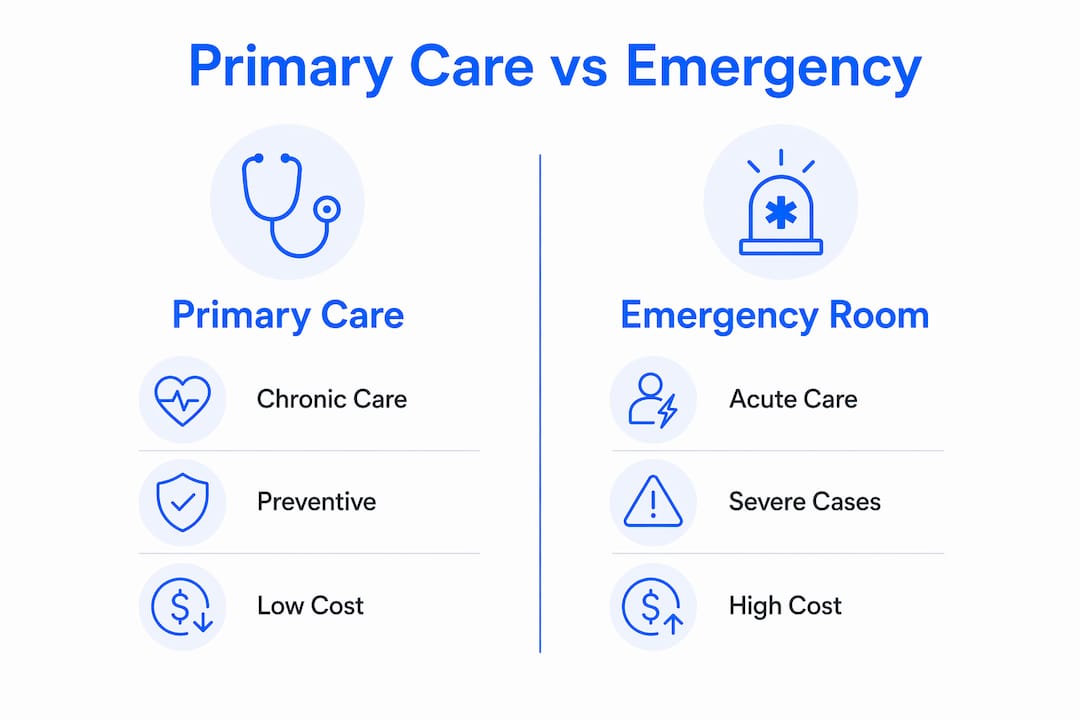
| Setting | Best for | Average cost | Continuity |
|---|---|---|---|
| Primary care | Chronic conditions, prevention, routine care | Lowest (often $0 with insurance) | High |
| Urgent care | Same-day non-emergency issues | Moderate (hundreds of dollars) | None |
| Emergency room | Life-threatening emergencies | $1,500–$5,000 | None |
Patients often assume the ER is the fastest option for any urgent symptom. That assumption is wrong. EDs operate on strict triage, prioritizing critical cases first. Non-urgent patients frequently wait hours. A primary care provider who knows your history can often triage your concern faster, either through a same-day visit or a telehealth call.
Urgent care does play a useful role as a bridge. When your PCP is unavailable and you need same-day attention for a non-emergency issue, urgent care is the right call. Services like walk-in urgent care imaging can handle X-rays and ultrasounds without an ER visit. But urgent care does not replace the longitudinal relationship that primary care builds.
Here is when to use each setting:
- Primary care: Annual physicals, chronic disease management, prescription refills, mental health referrals, preventive screenings
- Urgent care: Minor cuts, ear infections, mild fever, sprains, UTIs when your PCP is unavailable
- Emergency room: Chest pain, stroke symptoms, severe allergic reactions, major trauma, difficulty breathing
Why does continuity of care matter so much?
Continuity of care means seeing the same provider or care team over time, and it is the mechanism behind most of primary care’s benefits. A 4–5% reduction in avoidable ER visits occurs for every 10% increase in a patient’s continuity score. That is not a small effect. It compounds significantly over years.
The reason continuity works is early detection. A provider who has seen you for three years notices when your blood pressure trends upward, when your energy drops, or when a new symptom does not fit your usual pattern. That recognition triggers intervention before a condition becomes a crisis. A provider seeing you for the first time in an ER has none of that context.
Team-based primary care extends these benefits further. Team-based models involving nurses, pharmacists, and physicians working together improve access, reduce ER pressure, and meet specific patient needs better than a hospital ED can. A pharmacist on the team catches dangerous drug interactions. A nurse follows up after a hospital discharge. A care coordinator schedules the specialist referral before a condition worsens.
Remote monitoring and telehealth add another layer of protection. Remote counseling and ECG analysis now allow primary care teams to manage “gray case” symptoms, those that are concerning but not clearly emergencies, without sending patients to the ER. This is especially valuable for patients with heart conditions, diabetes, or respiratory disease who experience frequent ambiguous symptoms.
Pro Tip: When choosing a primary care provider, ask specifically whether the practice offers same-day telehealth appointments and team-based care. These two features are the strongest predictors of whether your provider can keep you out of the ER during an acute flare.
The benefits of managing chronic conditions via telehealth are now well-documented. Patients who use remote monitoring and virtual check-ins between in-person visits show lower rates of unplanned hospitalizations compared to those who only engage with their care team during scheduled office visits.
What practical steps reduce your ER visits through primary care?
Establishing a regular primary care relationship is the most direct action you can take. Choose a provider you can see consistently, not just when you are sick. Schedule at least one annual wellness visit even when you feel fine. That visit creates a baseline your provider can compare against in future appointments.
For acute but non-emergency issues, call your PCP’s office before heading to the ER. Many practices now offer telehealth and same-day visits to manage urgent concerns remotely. A telehealth call takes 15 minutes and can resolve most questions that would otherwise send patients to urgent care or the ER. Understanding your primary care visit options before a health issue arises means you make better decisions under pressure.
Knowing when to go to the ER is equally important. These symptoms require immediate emergency care:
- Chest pain or pressure
- Sudden numbness or weakness on one side of the body
- Difficulty breathing or shortness of breath at rest
- Severe allergic reaction (throat swelling, hives with dizziness)
- High fever with stiff neck or confusion
- Uncontrolled bleeding
Everything else, including worsening chronic symptoms, mild infections, and medication questions, belongs in primary care or urgent care first.
Pro Tip: Save your primary care provider’s telehealth link in your phone contacts. When a symptom appears at 9 p.m., you will reach for the right resource instead of defaulting to the ER.
Primary care access is also linked to longer life. Primary care access is associated with a median life expectancy increase of 2.1 years for older adults. Fewer ER visits are one part of that equation, but the broader benefit is a healthcare relationship that actively manages your health rather than reacting to crises.
Key takeaways
Regular primary care reduces emergency visits by catching problems early, managing chronic conditions continuously, and giving patients faster, cheaper alternatives to the ER.
| Point | Details |
|---|---|
| Primary care cuts ER visits | Adults with regular primary care are 11% less likely to visit the ER and 20% less likely to be hospitalized. |
| Continuity compounds over time | Every 10% increase in continuity score reduces avoidable ER visits by 4–5%. |
| Cost gap is significant | ER visits cost $1,500–$5,000; primary care visits are the lowest cost tier and often fully covered. |
| Team-based care adds protection | Nurses, pharmacists, and physicians working together catch problems before they become emergencies. |
| Telehealth closes access gaps | Same-day virtual visits let primary care teams manage urgent symptoms without sending patients to the ER. |
What I have learned watching patients choose the wrong door
The most common mistake I see is patients treating the ER as a default. They feel something wrong, they do not have a PCP they trust, and they drive to the nearest hospital. The ER fixes the immediate crisis. It does not fix the underlying condition that caused it. Three months later, the same patient is back.
What the data shows, and what I find genuinely underappreciated, is that continuity is not just a quality metric. It is a clinical tool. A provider who knows you can act on subtle changes that a stranger in an ER will miss entirely. That is not a soft benefit. It is the mechanism behind the 20% hospitalization reduction the AAFP documented.
The life expectancy finding is the one that should get more attention. A 2.1-year median increase linked to primary care access is not a small effect for a non-pharmacological intervention. Most people do not connect “having a regular doctor” with “living longer.” They should.
Modern primary care is also not what it was a decade ago. Telehealth, asynchronous messaging, and remote monitoring have removed most of the friction that kept patients away. The barrier is no longer access. It is habit. Patients who build the habit of calling their PCP first, before the ER, before urgent care, before a Google search, get better outcomes at lower cost. That is the shift worth making.
— Guorui
Helloklarity makes primary care accessible before the ER becomes necessary
Helloklarity connects patients with licensed primary care providers through a telehealth platform designed for same-day access. Appointments are available within 24 hours, self-pay options start at $49, and the platform accepts major insurance and health savings accounts.
For patients managing chronic conditions or trying to avoid unnecessary ER trips, Helloklarity’s network of over 1,000 licensed providers offers a practical alternative to waiting rooms and emergency department bills. You can browse telehealth services to find primary care, mental health, and weight management options in one place. If you want to find a provider in your state, Helloklarity also lets you search providers by location to get started quickly.
FAQ
Why does primary care reduce emergency visits?
Primary care reduces ER visits by managing chronic conditions continuously and catching health problems before they become crises. Adults with regular primary care are 11% less likely to visit the ER compared to those without a consistent provider.
How much cheaper is primary care than the ER?
ER visits cost between $1,500 and $5,000, while primary care visits are the lowest cost tier and are often fully covered under preventive care plans. The cost difference makes primary care the clear financial choice for non-emergency issues.
What is continuity of care and why does it matter?
Continuity of care means seeing the same provider over time, and it directly reduces avoidable ER visits. Research shows a 4–5% reduction in preventable ER visits for every 10% increase in a patient’s continuity score.
When should I go to the ER instead of my primary care provider?
Go to the ER for chest pain, stroke symptoms, severe allergic reactions, major trauma, or difficulty breathing at rest. For everything else, including worsening chronic symptoms and mild infections, contact your primary care provider first.
Can telehealth primary care help me avoid the ER?
Yes. Telehealth and remote monitoring allow primary care teams to assess and manage urgent symptoms virtually, reducing avoidable ER visits. Same-day telehealth visits are now widely available through platforms like Helloklarity.
Recommended
- Common Primary Care Conditions Treated Online: 2026 Guide
- What Does A Primary Care Visit Include?
- Types Of Primary Care Telehealth Services In 2026
- Online Primary Care Visit Best Practices In 2026
Get expert care from top-rated providers
Find the right provider for your needs — select your state to find expert care near you.
Related posts






— Monday to Friday, 7:00 AM to 4:00 PM PST
Join our mailing list for exclusive healthcare updates and tips.

— Monday to Friday, 7:00 AM to 4:00 PM PST



