 HSA & FSA accepted; best-value for top quality care
 Same-day mental health, weight loss, and primary care appointments available

 Accept major insurances and cash-payHSA & FSA accepted; best-value for top quality careSame-day mental health, weight loss, and primary care appointments availableAccept major insurances and cash-pay
What Is a Same-Day Sick Visit? Your Guide
Written by Klarity Editorial Team
Published: May 30, 2026
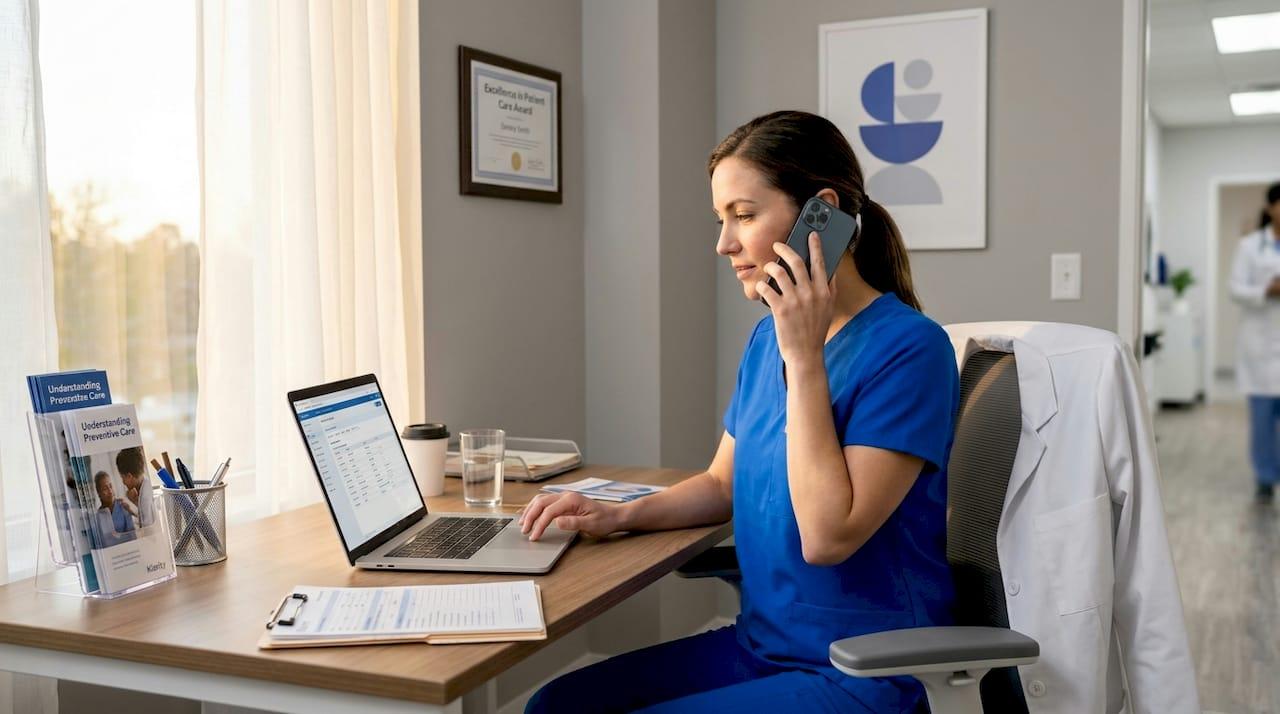
If you woke up with a sore throat that wasn’t there yesterday, or your child’s ear pain has gone from annoying to unbearable, you need answers today — not in three weeks. A same-day sick visit is exactly what it sounds like: a scheduled appointment with a licensed provider for a sudden, non-emergency illness that needs evaluation within 12 to 24 hours. Many people confuse this option with a walk-in urgent care visit or a full emergency room trip. They are different in cost, scope, and convenience. This guide covers what qualifies, how to schedule, and what to expect.
Table of Contents
- Key takeaways
- What is a same-day sick visit, exactly
- How to schedule a sick visit and what happens
- Same-day visits vs. urgent care vs. the ER
- Benefits of same-day visits and how to use them well
- My take on same-day sick visits (and what most patients miss)
- Get same-day care through Helloklarity
- FAQ
Key takeaways
| Point | Details |
|---|---|
| Defined appointment type | A same-day sick visit is a scheduled slot for acute, non-emergency illness, not a walk-in or ER trip. |
| Slots fill fast | Call your provider early in the morning because reserved same-day slots are limited and fill quickly. |
| Lower cost than ER | Same-day visits are typically billed as primary or urgent care copays, costing far less than an emergency room. |
| Continuity of care | Seeing your own provider means your medical history guides treatment, reducing errors and repeat testing. |
| Telehealth counts | A same-day telehealth appointment delivers the same evaluation and prescribing rights without leaving home. |
What is a same-day sick visit, exactly
A same-day sick visit is the clinical term most providers use for a focused, scheduled appointment reserved for new or worsening acute symptoms that cannot safely wait for a routine slot. Think of it as your primary care safety valve. According to Complete Health, same-day sick visits cover sudden, non-emergency illnesses like minor infections, cold and flu symptoms, sore throats, UTIs, and ear infections.
This is not urgent care. Urgent care centers are walk-in facilities with no prior relationship to your health history. A same-day visit at your regular practice means your provider already knows your medications, allergies, and chronic conditions. That context changes the care you receive.
Conditions that typically qualify
Most qualifying issues share two characteristics: they appeared recently and they are not life-threatening. Common examples include:
- Sore throat or strep symptoms
- Ear pain or suspected ear infection
- Cold, flu, or sinus symptoms
- Mild urinary tract infection symptoms
- Pink eye (conjunctivitis)
- Skin rashes or mild allergic reactions
- Fever without severe accompanying symptoms
- Minor sprains or soft-tissue injuries
- Nausea, vomiting, or diarrhea lasting less than 48 hours
- Mild asthma flares or worsening seasonal allergies
What does not qualify? Chest pain, stroke symptoms, severe shortness of breath, loss of consciousness, or uncontrolled bleeding belong in the emergency room. As Harvard Health explains, life-threatening symptoms always require emergency department care, regardless of how inconvenient that is. When in doubt, go to the ER.
How to schedule a sick visit and what happens
Getting a same-day doctor appointment is mostly about timing and communication. Here is how the process typically works:
Call as early as possible. Practices maintain a fixed number of reserved daily slots, and early calling is the single most reliable way to secure one. By mid-morning, many clinics are already directing patients to next-day availability.
Describe your symptoms clearly. The scheduling team performs phone triage before your appointment is confirmed. Tell them when symptoms started, how severe they are (a fever of 101°F versus 104°F matters), and whether they are getting worse. Describing fever range, onset timing, and worsened status helps direct you to the right appointment type faster.
Provide your health history details. Expect to be asked about current medications, known allergies, recent exposures (like a sick household member), and vaccination status. This is not bureaucracy. It helps your provider prepare before you walk in the door.
Arrive with documentation. Bring a photo ID, your insurance card, a written list of current medications with dosages, and any recent relevant test results.
Expect a focused exam. Your visit will not be a comprehensive physical. The clinician performs targeted exams and rapid tests such as a strep swab or flu test, checks vital signs, and zeroes in on the presenting problem.
Walk out with a plan. Outcomes typically include a diagnosis, a prescription if needed, a referral to a specialist or imaging center, or guidance to monitor symptoms at home. You leave knowing what is wrong and what to do next.
Pro Tip: Write down your top three symptoms, when they started, and anything that makes them better or worse before you call. Scheduling staff use that information to triage you correctly, and it shortens your call by several minutes.
Same-day visits vs. urgent care vs. the ER

Choosing the wrong care setting wastes time and money. Here is a direct comparison:
| Feature | Same-day sick visit | Urgent care center | Emergency room |
|---|---|---|---|
| Appointment required | Yes | No (walk-in) | No (walk-in) |
| Relationship with provider | Your own provider | New provider each visit | New provider each visit |
| Conditions treated | Non-emergency acute illness | Non-emergency illness and injury | All including life-threatening |
| Typical wait time | Short to moderate | Moderate to long | Often very long |
| Relative cost | Lowest | Moderate | Highest |
| Access to your medical history | Full | Limited or none | Limited or none |
| Prescribing accuracy | High (based on full history) | Moderate | Moderate |
The cost difference is not trivial. Same-day visits are typically billed at a primary care or urgent care copay rate, which is substantially less than an emergency department bill. An ER visit for a sore throat can cost ten times what a same-day primary care visit costs, even with insurance.
The continuity advantage deserves more attention than it usually gets. Seeing your regular provider gives them access to your full medical history, which leads to more accurate diagnosis and safer prescribing. An urgent care doctor who has never met you does not know that the antibiotic they are about to prescribe interacts with your current blood pressure medication. Your primary care provider does.
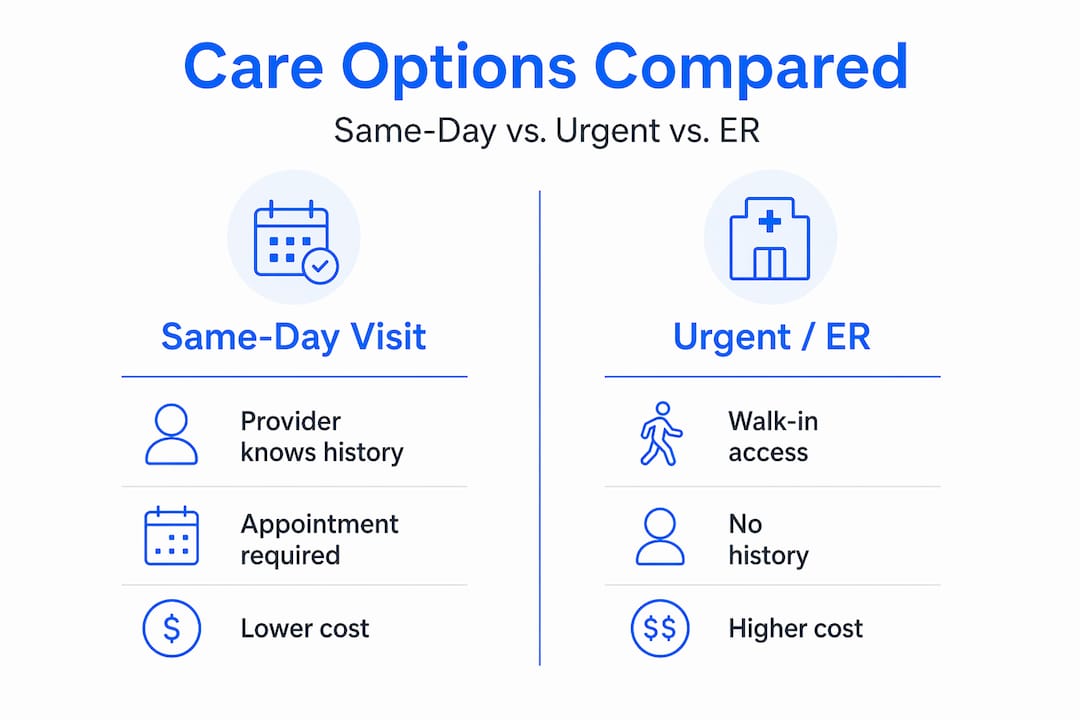
Harvard Health also notes that urgent care and same-day settings fill a critical gap for non-life-threatening ailments needing prompt attention, and they genuinely reduce inappropriate ER visits. That is good for you, good for the healthcare system, and good for people with true emergencies who need ER resources.
Benefits of same-day visits and how to use them well
The most underrated benefit is early treatment. Strep throat caught and treated on day two does not become a week of misery plus a potential complication. A UTI addressed at first symptoms does not progress to a kidney infection. Speed matters in ways that compound.
Here are the core benefits worth knowing:
- Faster relief. You get answers and a treatment plan the same day instead of toughing it out for a week.
- Lower cost. A same-day health check at your primary care office is less expensive than urgent care and dramatically less than the ER.
- Continuity. Your provider knows your history, which means fewer redundant tests and smarter prescribing.
- ER load reduction. Every appropriately handled same-day visit keeps the emergency room available for people who genuinely need it.
- Telehealth option. If your clinic offers virtual visits, you can get a same-day evaluation without leaving home or potentially exposing others.
To actually get access to these benefits, preparation matters. Being specific when you call is the single biggest factor in how quickly you get care. Vague descriptions like “I feel bad” lead to scheduling delays. Specific descriptions like “I have had a 102°F fever for 18 hours, my throat hurts when I swallow, and I have had a known strep exposure” get you triaged to the right slot immediately.
Pro Tip: Use a telehealth option when available for respiratory illnesses. You avoid sitting in a waiting room while genuinely contagious, your provider can still evaluate most symptoms visually and through your reported history, and you can get prescriptions sent to your pharmacy electronically. Check out what to expect from an online doctor visit before your appointment so nothing catches you off guard.
My take on same-day sick visits (and what most patients miss)
I have spent years watching how patients navigate the healthcare system, and the single most consistent mistake I see is defaulting to urgent care or the ER simply because people do not know their primary care office offers same-day slots. They assume their doctor is too booked or that same-day access is some premium service. It is not. Most practices reserve daily spots for exactly this reason.
The second mistake is calling too late. I have seen patients call at 3 p.m. and then complain that same-day care is a myth. The slots are gone by then. Call when the office opens. That single habit change will transform how you access care.
What I find most valuable about same-day primary care specifically is the prescribing piece. Urgent care centers are convenient, but I have seen unnecessary antibiotic prescriptions and missed drug interactions that would never have happened with a provider who knew the patient. The continuity advantage is not just a theoretical benefit. It is a practical safety feature.
My honest advice: call your own provider first. Most people skip that step out of habit. Do not skip it.
— Guorui
Get same-day care through Helloklarity
When your own provider’s slots are full or you need care outside regular hours, Helloklarity offers an alternative that preserves everything that matters about good same-day care.
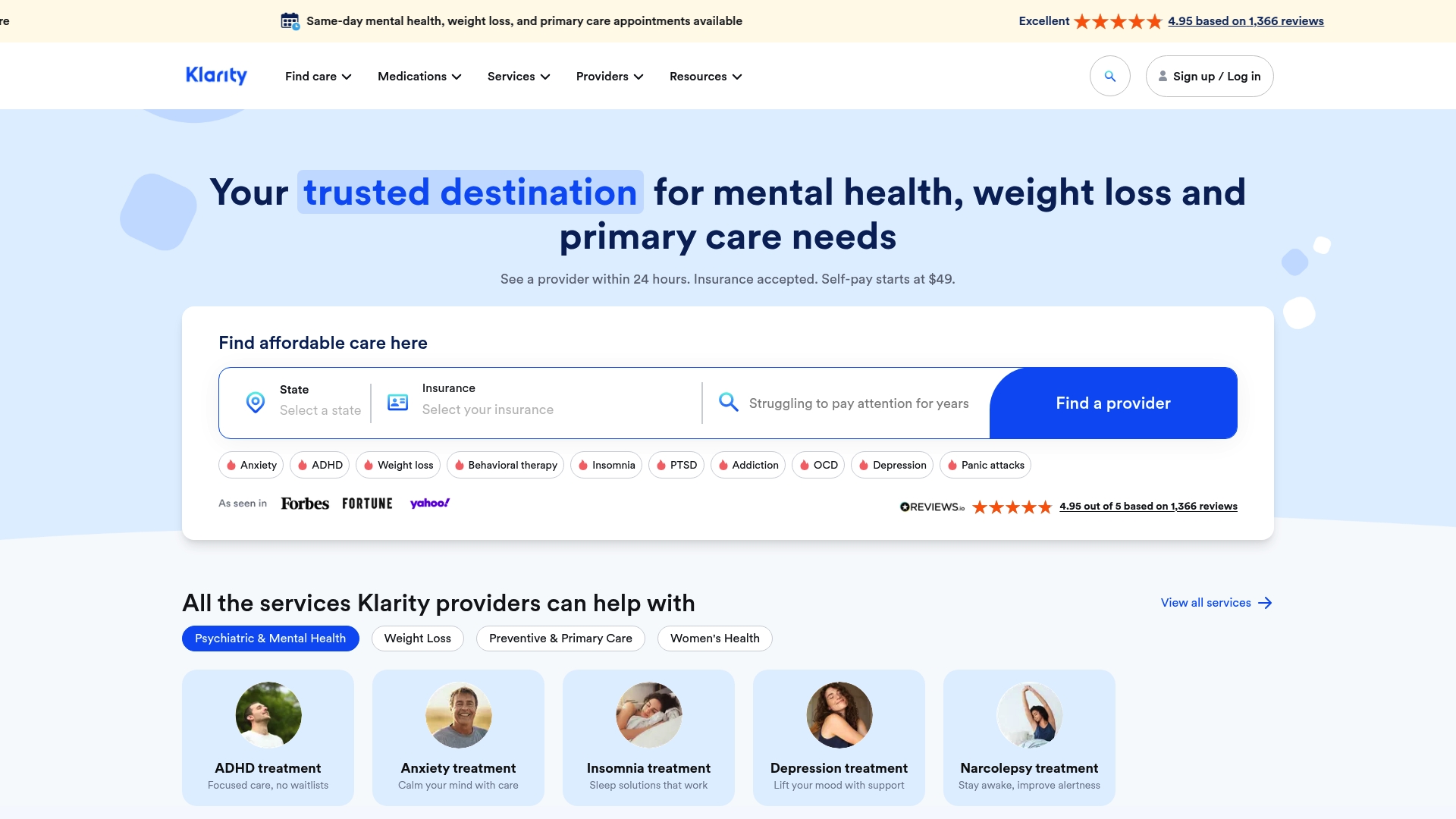
Helloklarity connects you with licensed providers through a telehealth platform designed for fast access. You can book a same-day telehealth appointment and be seen within 24 hours, often the same day. Providers can evaluate acute non-emergency conditions, order prescriptions, and refer you for further care when needed. Self-pay visits start at $49, and Helloklarity accepts major insurance and HSA funds. Browse the full list of treatable conditions to see if your symptoms qualify. For an affordable first visit, the Starter Pass at $109 gets you in the door without a traditional practice relationship.
FAQ
What is a same-day sick visit used for?
A same-day sick visit is a scheduled appointment for sudden, non-emergency illness that cannot wait for a routine slot. Common examples include sore throats, ear infections, UTIs, flu symptoms, and mild rashes.
How is a same-day visit different from urgent care?
A same-day visit is with your regular provider who has your full medical history, while urgent care is a walk-in setting with a provider who does not know you. Same-day visits typically cost less and result in safer, more personalized treatment.
How do I schedule a sick visit on the same day?
Call your provider’s office as early as possible when it opens. Have your symptoms, their start date, and severity ready to describe. Reserved daily slots fill quickly, so timing your call is the most important step.
Can a telehealth appointment count as a same-day sick visit?
Yes. A telehealth appointment with a licensed provider covers most acute non-emergency conditions. Providers can evaluate symptoms, order prescriptions, and refer for in-person testing when needed, all without requiring you to leave home.
When should I go to the ER instead?
Go directly to the emergency room for chest pain, severe shortness of breath, stroke symptoms, loss of consciousness, or any symptom that feels life-threatening. Same-day and urgent care visits are not equipped for emergencies.
Recommended
- Same-Day Telehealth Appointment: How To See A Doctor Online Today | Klarity Health, Inc
- Same Day Psychiatrist Appointment Explained Simply
- Same Day Therapist Appointment Online: 2026 Guide
- What Telehealth Services Can I Get Online? Medical Guide
Get expert care from top-rated providers
Find the right provider for your needs — select your state to find expert care near you.
Related posts





— Monday to Friday, 7:00 AM to 4:00 PM PST
Join our mailing list for exclusive healthcare updates and tips.

— Monday to Friday, 7:00 AM to 4:00 PM PST



