 HSA & FSA accepted; best-value for top quality care
 Same-day mental health, weight loss, and primary care appointments available

 Accept major insurances and cash-payHSA & FSA accepted; best-value for top quality careSame-day mental health, weight loss, and primary care appointments availableAccept major insurances and cash-pay
How Virtual Mental Health Appointments Work in 2026
Written by Klarity Editorial Team
Published: Jun 19, 2026

Last updated: August 8, 2026
Virtual mental health appointments are secure, real-time sessions with licensed mental health professionals conducted via video or phone, without requiring an in-person visit. Telehealth mental services have expanded rapidly, and over 70% of U.S. physicians now offer some form of virtual care. Understanding how virtual mental health appointments work helps you make faster, more confident decisions about your own care. This guide walks through the full process, from booking to follow-up, and explains what makes remote mental health care a clinically sound choice.
Ready to get care online? Klarity connects you with 2,000+ licensed providers for online anxiety treatment, online depression treatment, online ADHD treatment, and more. Browse conditions and see if you may qualify →
How do virtual mental health appointments work from start to finish?
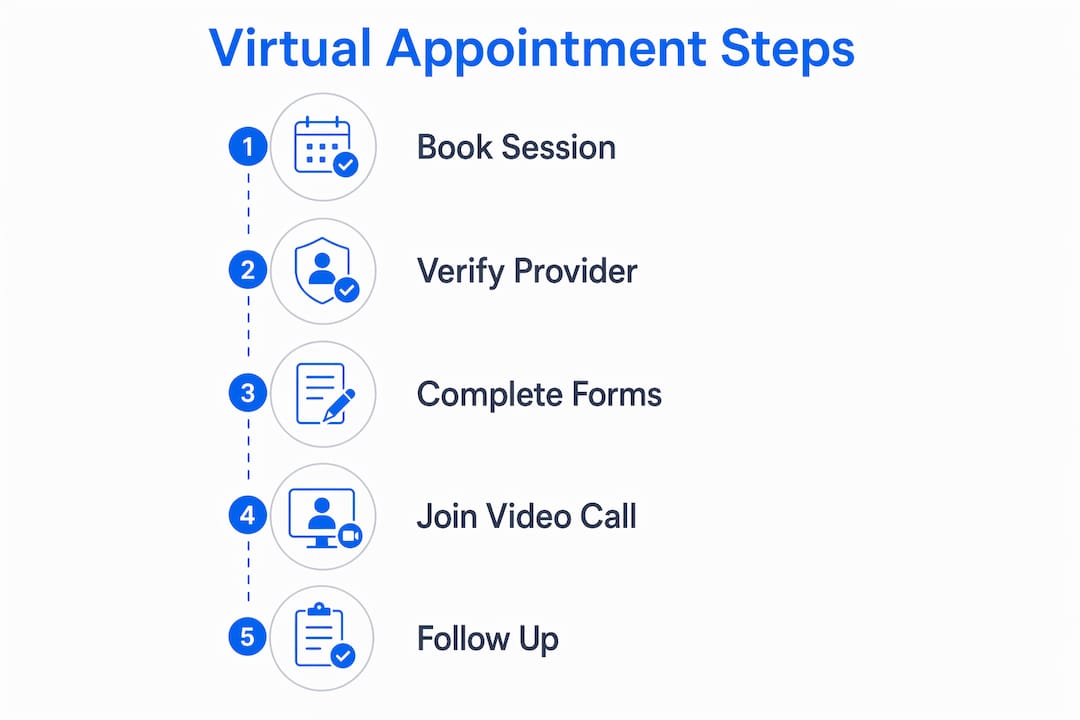
Virtual mental health appointments follow a clear, step-by-step process that mirrors in-person care in every clinically meaningful way. The technology is straightforward. The clinical standards are identical.
Here is what the full patient journey looks like:
Schedule online or through an app. You book through a telehealth platform’s website or mobile app, selecting a provider, date, and time. Many platforms, including Helloklarity, offer same-day or next-day availability.
Verify your provider’s state license. Providers must be licensed in the state where you are located at the time of the appointment. This is a legal requirement, not a formality. It determines whether your provider can legally prescribe medication or issue referrals.
Complete pre-appointment intake forms. Most platforms send digital questionnaires covering your symptoms, medical history, current medications, and mental health goals. Completing these thoroughly saves time during the visit and gives your provider a clearer starting point.
Join the secure video or phone session. At your appointment time, you click a link or join through the app. Sessions use encrypted, HIPAA-compliant platforms. No special software is usually required beyond a smartphone or computer with a camera.
Participate in the clinical consultation. During virtual appointments, providers conduct a full assessment via video, including symptom discussion, medical history review, and visual observation. For mental health visits, this typically covers mood, sleep, concentration, anxiety levels, and any prior diagnoses.
Receive your treatment plan. After the assessment, your provider may prescribe medication, recommend therapy, order lab tests, or refer you to a specialist. All of this happens within the same session. Follow-up instructions and prescriptions are sent electronically.
Pro Tip: Log in five minutes early to test your camera and microphone. A technical issue at the start of a session eats into your clinical time and increases stress before you have even said a word.
Virtual mental health appointments generally last 40–60 minutes, with first-time psychiatric evaluations typically scheduled for 45 minutes. That is enough time for a thorough assessment and a concrete treatment plan.
What are the benefits of virtual mental health care vs. in-person visits?
The benefits of virtual therapy go beyond convenience. The clinical case for remote mental health care is strong, and the patient experience data backs it up.
- Lower emotional barriers. Patients report greater comfort opening up during virtual video therapy sessions from their own space. Being at home reduces the anxiety many people feel in clinical settings, which means more honest conversations and better assessments.
- Earlier help-seeking. Virtual care reduces the stigma associated with walking into a mental health clinic. People who would delay or avoid in-person care are more likely to book a virtual session, which leads to earlier intervention and fewer crises.
- Scheduling flexibility. You can book evening or weekend appointments without taking time off work or arranging transportation. This matters especially for people managing anxiety, depression, or ADHD, where daily disruption compounds the condition.
- Continuity of care. Advanced virtual care models allow patients to see the same provider across multiple visits, whether virtual or in-person, maintaining a consistent therapeutic relationship. That continuity builds trust and improves treatment adherence.
- Insurance parity. Most major insurance plans cover virtual mental health visits at the same rate as in-person care, including Medicare. Copays are often identical, and self-pay options on platforms like Helloklarity start as low as $49.
“Virtual care is not a lower-tier alternative. It is a fully integrated part of modern medical records, enabling real coordination of patient care across providers and settings.” — AdventHealth Primary Care+
The benefits of continuous virtual primary care are especially clear for chronic mental health conditions. Seeing the same provider over time, even virtually, produces outcomes comparable to traditional in-person therapy.
What types of providers and services are available virtually?
Virtual mental health care is not a single service. It covers a range of providers with different scopes of practice and different treatment capabilities.
| Provider type | Scope of practice | Common services |
|---|---|---|
| Therapist / Counselor | Talk therapy, behavioral interventions | CBT, DBT, trauma therapy, couples counseling |
| Psychiatrist | Medical diagnosis, prescribing | Medication evaluation, dosage adjustment, PTSD and ADHD management |
| Nurse Practitioner (NP) | Prescribing, assessment, follow-up | Medication management, depression and anxiety treatment |
| Primary Care Provider | Broad medical care | Mental health screening, referrals, integrated care coordination |
Psychiatrists, therapists, and nurse practitioners all provide virtual mental health services, including therapy, medication management, and specialist referrals. Conditions effectively treated through online therapy include anxiety disorders, major depressive disorder, ADHD, PTSD, and bipolar disorder.
The key distinction is prescribing authority. Therapists and counselors provide talk-based care but cannot prescribe medication. Psychiatrists and nurse practitioners can evaluate, prescribe, and adjust dosages remotely. For many patients managing conditions like depression or ADHD, this means a single virtual platform can handle both their therapy and their medication without requiring separate appointments at separate locations.
Platforms like Helloklarity coordinate care across provider types, with records shared within the platform so your psychiatrist and therapist are working from the same clinical picture. You can learn more about telehealth prescribing for depression to understand exactly what psychiatrists can do in a virtual setting.
How to prepare for a successful virtual mental health appointment
Preparation makes a measurable difference in how much you get from a virtual session. A few practical steps before your appointment improve both the clinical quality of the visit and your own comfort.
- Choose a private, well-lit space. Facing a natural light source like a window helps your provider read your facial expressions accurately. This matters more than most patients realize. Facial cues are a core part of mental health assessment, and poor lighting genuinely reduces diagnostic accuracy.
- Have your medication list ready. Write down every medication you currently take, including dosages and how long you have been taking them. This prevents gaps in your provider’s clinical picture and speeds up the consultation.
- Prepare a brief symptom summary. Note when your symptoms started, what triggers them, and how they affect your daily life. Providers work faster and more accurately when you can describe your experience specifically rather than generally.
- Use headphones. They improve audio clarity and add a layer of privacy if others are nearby.
- Be honest about what is not working. Virtual sessions can feel less formal than in-person visits, which is an advantage. Use that comfort to be direct about what you are experiencing, including things you might feel awkward saying face-to-face.
Pro Tip: Sit at a desk or table rather than lying on a couch or bed. A seated position signals engagement to your provider and keeps you mentally focused during the session. Small environmental cues affect both your performance and theirs.
For a broader look at how to get the most from remote visits, the online primary care visit best practices guide covers preparation strategies that apply directly to mental health appointments.

Key takeaways
Virtual mental health appointments deliver real, clinically sound care through secure video or phone sessions with licensed professionals, and proper preparation directly improves the quality of every visit.
| Point | Details |
|---|---|
| Step-by-step process | Book online, verify provider licensing, complete intake forms, join the secure session, and receive a treatment plan. |
| Provider licensing matters | Providers must be licensed in your state to legally prescribe medication or issue referrals. |
| Benefits beyond convenience | Virtual care reduces stigma, encourages earlier help-seeking, and produces outcomes comparable to in-person therapy. |
| Provider types vary | Therapists offer talk therapy; psychiatrists and nurse practitioners can prescribe and adjust medication remotely. |
| Preparation improves outcomes | A private, well-lit space, a medication list, and honest symptom descriptions all improve clinical accuracy. |
Why virtual mental health care is changing who gets help
I have spent years watching people delay mental health care for reasons that have nothing to do with their actual condition. The commute is too long. The waiting room feels exposed. The appointment slot does not fit around work. These are not excuses. They are real friction points that push people away from care they genuinely need.
What strikes me most about virtual mental health appointments is not the technology. It is the behavioral shift they produce. When the barrier to entry drops, people seek help earlier. Earlier intervention means less severe episodes, fewer medication adjustments, and shorter treatment timelines overall. That is not a minor efficiency gain. It is a fundamentally different health outcome.
The continuity argument is equally underappreciated. Seeing the same provider over time, even through a screen, builds the kind of therapeutic relationship that makes treatment work. Trust is not a soft metric. It directly predicts whether a patient follows through on a treatment plan.
My honest view is that hybrid models, where patients move between virtual and in-person visits with the same provider, represent the future of mental health care. The seamless transition between virtual and in-person visits is already possible on advanced platforms. The question is not whether virtual care is legitimate. It is whether more people will use it before their condition becomes a crisis.
If you have been sitting on the fence about trying a virtual session, the friction you are imagining is almost certainly larger than the reality.
— Guorui
Start your virtual mental health care with Helloklarity
Helloklarity connects you with licensed mental health providers across the United States, with appointments available as soon as the same day. The platform covers anxiety, depression, ADHD, PTSD, and a range of other conditions through a network of over 2,000+ licensed providers.
Self-pay options start at $49, and Helloklarity accepts major insurance plans and health savings accounts. You can browse all treatable conditions on the platform or find a licensed provider in your state before booking. For a full overview of available services, visit the Helloklarity telehealth services page and see what care is available to you today.
FAQ
How long does a virtual mental health appointment last?
Virtual mental health appointments typically last 40–60 minutes. First-time psychiatric evaluations are usually scheduled for 45 minutes to allow time for a full assessment.
Can a virtual provider prescribe mental health medication?
Yes. Psychiatrists and nurse practitioners can prescribe and adjust medication during virtual visits, provided they are licensed in your state. Therapists and counselors cannot prescribe.
Does insurance cover virtual mental health visits?
Most major insurance plans, including Medicare, cover virtual mental health visits at rates comparable to in-person care. Copays are often identical, and self-pay options are available on platforms like Helloklarity starting at $49.
What conditions can be treated through online therapy?
Anxiety disorders, major depressive disorder, ADHD, PTSD, and bipolar disorder are all commonly and effectively treated through virtual mental health appointments. Providers can offer therapy, medication management, and referrals within the same platform.
What do I need for a virtual mental health appointment?
You need a smartphone or computer with a camera and microphone, a stable internet connection, and a private space. Completing your intake forms before the session and having your medication list ready will make the visit more productive.
Related care
Next step: See if you may qualify for online mental health care →
Recommended
- Mental Health Awareness Month 2026: Why More Americans Are Turning To Telehealth For Anxiety And Depression | Klarity Health, Inc
- Online Primary Care Visit Best Practices In 2026
- Wellbutrin Alternatives If Not Eligible | Klarity Health, Inc
- What Is Telehealth Mental Health? Your 2026 Guide
Get expert care from top-rated providers
Find the right provider for your needs — select your state to find expert care near you.
Related posts






— Monday to Friday, 7:00 AM to 4:00 PM PST
Join our mailing list for exclusive healthcare updates and tips.

— Monday to Friday, 7:00 AM to 4:00 PM PST



