 HSA & FSA accepted; best-value for top quality care
 Same-day mental health, weight loss, and primary care appointments available

 Accept major insurances and cash-payHSA & FSA accepted; best-value for top quality careSame-day mental health, weight loss, and primary care appointments availableAccept major insurances and cash-pay
What Does a Mental Health Provider Do: 2026 Guide
Written by Klarity Editorial Team
Published: Jul 3, 2026

A mental health provider is a licensed professional trained to assess, diagnose, and treat mental and emotional conditions through therapy, medication management, or both. Understanding what does a mental health provider do is the first step toward getting the right care. These professionals range from psychiatrists with full prescribing authority to licensed counselors who specialize in talk therapy. Each credential signals a different scope of practice, training level, and treatment approach. Knowing the difference helps you choose the right fit rather than simply the first available appointment.
What does a mental health provider do, exactly?
Mental health providers perform core functions including assessing symptoms, diagnosing conditions, creating treatment plans, delivering therapy, and managing medications. That range is wider than most people expect. A single visit can involve structured screening tools, a formal diagnosis under the DSM-5, and the start of a therapy plan, all in one session.
The industry term for these professionals is “licensed mental health provider,” a category that covers several distinct credential types. Psychiatrists hold an MD or DO and carry full prescribing authority in all U.S. states. Psychologists hold a PhD or PsyD and focus on assessment and therapy. Licensed Clinical Social Workers (LCSWs), Licensed Professional Counselors (LPCs), and Marriage and Family Therapists (LMFTs) specialize in talk therapy and case management. Psychiatric Mental Health Nurse Practitioners (PMHNPs) can prescribe in most states under collaborative protocols.
The distinction between prescribers and therapists matters practically. If you need medication for depression or ADHD, you need a psychiatrist or PMHNP. If you need Cognitive Behavioral Therapy (CBT) or Dialectical Behavior Therapy (DBT), a psychologist, LPC, or LCSW is the right starting point.

What types of licensed mental health providers are there?
The five main credential types differ by education, licensure, and what they are legally allowed to do with patients.
Psychiatrists (MD/DO) complete medical school plus a four-year psychiatric residency. They diagnose complex conditions, prescribe and monitor medications, and sometimes provide therapy. They are the only providers who can manage drug interactions with other medical conditions.
Psychologists (PhD/PsyD) complete doctoral programs averaging five to seven years. They specialize in psychological testing, formal assessment, and evidence-based therapy. Most states do not grant psychologists prescribing authority, though a small number do under specific legislation.
Licensed Clinical Social Workers (LCSWs) hold a master’s degree in social work plus approximately 3,000 hours of supervised clinical experience before earning independent licensure. They provide therapy and connect patients to community resources such as housing support, disability services, and crisis intervention.
Licensed Professional Counselors (LPCs) and Marriage and Family Therapists (LMFTs) also require a master’s degree and similar supervised hours. LPCs focus on individual mental health counseling. LMFTs specialize in relational dynamics, couples work, and family systems.
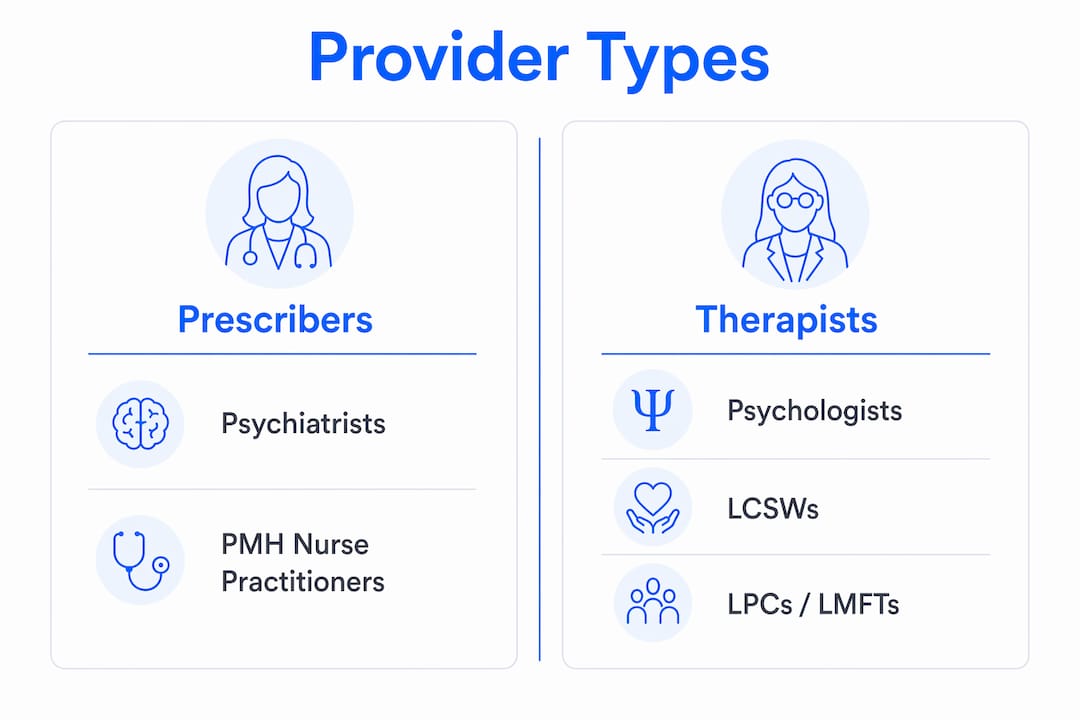
Psychiatric Mental Health Nurse Practitioners (PMHNPs) hold advanced nursing degrees with psychiatric specialization. They can prescribe medications in most states, often under a collaborative agreement with a supervising physician.
A key point that surprises many people: a state license qualifies a provider to practice but does not guarantee training in specific therapy modalities. A licensed LPC may or may not have formal CBT or EMDR certification. Certification for specialized therapies is voluntary and not mandated by licensing boards.
| Provider type | Degree | Prescribing authority | Primary focus |
|---|---|---|---|
| Psychiatrist | MD/DO | Yes, all states | Medication management, complex diagnosis |
| Psychologist | PhD/PsyD | Rarely | Assessment, therapy |
| LCSW | MSW | No | Therapy, case management |
| LPC/LMFT | Master’s | No | Counseling, relational therapy |
| PMHNP | MSN/DNP | Most states | Medication, psychiatric care |
What services do mental health providers offer?
The services offered by therapists and other licensed providers cover a wider range than most people realize before their first appointment.
Assessment and diagnosis form the foundation of every treatment relationship. Providers use structured screening tools, clinical interviews, and in some cases psychological testing to identify conditions such as major depressive disorder, generalized anxiety disorder, ADHD, PTSD, and bipolar disorder. A formal diagnosis is required before any treatment plan can begin.
Therapy modalities represent the core of most outpatient mental health care. Common approaches include:
- Cognitive Behavioral Therapy (CBT): Targets thought patterns that drive anxiety and depression
- Dialectical Behavior Therapy (DBT): Builds distress tolerance and emotional regulation skills
- EMDR (Eye Movement Desensitization and Reprocessing): Processes trauma through bilateral stimulation
- Systemic therapy: Addresses relational and family dynamics affecting mental health
- Psychodynamic therapy: Explores how past experiences shape current behavior
Effective treatment requires tailoring modalities to each individual’s cultural context and lived experience rather than applying a rigid clinical model. That customization is what separates a good provider from a great one.
Medication management is available only through psychiatrists, PMHNPs, and in some cases physician assistants with psychiatric training. These appointments involve prescribing, monitoring side effects, adjusting dosages, and checking for interactions with other medications.
Case management and resource connection round out the picture. LCSWs in particular help patients navigate systems outside the therapy room, including insurance appeals, community mental health programs, and crisis services. Under collaborative care models, a psychiatrist or PMHNP handles medication while a therapist handles talk therapy, and both providers coordinate on the patient’s progress.
How do providers collaborate and what does treatment look like?
Collaborative care involving a psychiatrist or PMHNP for medication and a therapist for talk therapy is the most common model for treating conditions with both biological and behavioral components. This approach addresses both sides of a condition simultaneously rather than treating them in isolation.
A typical treatment journey moves through four phases:
- Initial evaluation: A provider conducts a full clinical interview, reviews medical history, and administers screening tools. This session produces a working diagnosis and the first draft of a treatment plan.
- Treatment planning: The provider outlines specific goals, selects therapy modalities, and determines whether medication is appropriate. The patient participates in setting priorities.
- Ongoing therapy sessions: Weekly or biweekly appointments with a counselor or social worker build skills, process experiences, and track symptom changes over time.
- Medication management appointments: Scheduled with a psychiatrist or PMHNP, these visits review how medications are working, adjust dosages, and monitor for side effects. Learn more about what to expect at these appointments.
Providers adjust plans based on patient feedback and measurable progress. A treatment plan that works in month one may need revision by month three as symptoms shift or life circumstances change.
Culturally competent care is a mandatory clinical standard in 2026. Therapeutic alliances built on understanding a patient’s cultural identity increase treatment adherence and improve outcomes. Providers who integrate cultural context into their approach produce measurably better results than those who apply a one-size-fits-all model.
Pro Tip: Ask your provider directly how they incorporate cultural background into treatment. A provider who cannot answer that question clearly may not be the right fit for you.
What should you consider when choosing a mental health provider?
Choosing the right provider starts with understanding what type of care you actually need. If your symptoms are severe or you suspect a biological component, start with a psychiatrist or PMHNP who can evaluate both medication and therapy options. If you want to work through anxiety, relationship issues, or life transitions, an LPC, LCSW, or psychologist is the right starting point.
The responsibilities of mental health professionals include being transparent about their training. When evaluating a provider, ask these questions directly:
- What licenses and certifications do you hold?
- Are you trained in CBT, DBT, EMDR, or other specific modalities?
- Do you have experience treating my specific condition?
- Do you accept my insurance, and what are the out-of-pocket costs?
- Do you offer telehealth sessions?
The 2026 Mental Health Parity and Addiction Equity Act requires health plans to cover psychiatric services on par with medical care, prohibiting higher copays or stricter authorizations for mental health visits. That law means your insurance plan cannot legally charge you more for a therapy session than for a standard doctor’s visit.
Therapist credentials signal different focus areas. A marriage therapist trained in relational dynamics is not the same as a social worker trained to address systemic stressors. Matching the provider’s specialty to your specific need produces better outcomes than choosing based on availability alone.
Pro Tip: Verify a provider’s license through your state’s licensing board website before booking. The search takes under two minutes and confirms the credential is current and in good standing.
Understanding the difference between psychotherapy and psychiatry helps you decide which type of provider to contact first. Many people benefit from both, working with a therapist weekly and a prescriber monthly.
Key Takeaways
Mental health providers are licensed professionals with distinct credentials, scopes of practice, and treatment tools. Matching the right provider type to your specific need is the single most important factor in getting effective care.
| Point | Details |
|---|---|
| Provider types vary by credential | Psychiatrists prescribe; psychologists assess; LCSWs, LPCs, and LMFTs deliver therapy. |
| Licensure does not equal modality training | Ask specifically about CBT, DBT, or EMDR certification beyond the state license. |
| Collaborative care improves outcomes | Combining medication management with talk therapy addresses both biological and behavioral factors. |
| Cultural competence is a clinical standard | Providers who integrate cultural identity into treatment produce better adherence and results. |
| Insurance must cover mental health equally | The 2026 Mental Health Parity Act prohibits higher copays for mental health visits than medical visits. |
Why I think most people choose providers the wrong way
Most people pick a mental health provider the same way they pick a dentist: whoever is in-network and has an opening. That approach works fine for a cleaning. It fails badly for mental health care.
What I have seen consistently is that the mismatch between provider type and patient need is the primary reason people quit therapy after two or three sessions. Someone dealing with trauma books an appointment with a general counselor who has no EMDR training. Someone who needs medication management spends months in talk therapy alone and wonders why nothing is changing. The problem is not the provider. The problem is the match.
The distinction between prescribers and therapists is not a technicality. It reflects fundamentally different training, tools, and treatment goals. A psychiatrist and an LCSW are both excellent at what they do. They are not interchangeable. Knowing which one you need before you book is the most useful thing you can do for your own care.
Collaborative care models exist precisely because most conditions require both approaches. The biology of depression does not respond to insight alone. The behavioral patterns driving anxiety do not disappear with medication alone. The providers who get the best outcomes are the ones who communicate across disciplines and adjust the plan together.
My honest advice: before you search for a provider, write down your primary goal. Is it a diagnosis? Medication? A specific therapy technique? That answer tells you which credential to look for first.
— Guorui
Finding licensed mental health providers through Helloklarity
Helloklarity connects patients with over 1,000 licensed mental health providers across the country, with same-day appointments available and most patients seen within 24 hours. Self-pay options start at $49, and the platform accepts major insurance plans and health savings accounts.
You can browse providers by state to find licensed psychiatrists, nurse practitioners, and therapists practicing in your area. Helloklarity’s telehealth platform covers conditions including anxiety, depression, and ADHD through online mental health services designed for people who cannot wait weeks for a traditional appointment. If you are ready to match with the right provider for your specific needs, Helloklarity makes that process straightforward and fast.
FAQ
What is a licensed mental health provider?
A licensed mental health provider is a credentialed professional authorized by a state licensing board to assess, diagnose, and treat mental health conditions. Common license types include MD, PhD, PsyD, LCSW, LPC, LMFT, and PMHNP.
Can a therapist prescribe medication?
Most therapists cannot prescribe medication. Only psychiatrists (MD/DO) and, in most states, Psychiatric Mental Health Nurse Practitioners (PMHNPs) have prescribing authority for mental health conditions.
How do I know which type of provider I need?
If you need a diagnosis or medication, start with a psychiatrist or PMHNP. If you need talk therapy for anxiety, depression, or relationship issues, an LPC, LCSW, or psychologist is the right fit. Many people work with both simultaneously.
Does insurance cover mental health provider visits?
Under the 2026 Mental Health Parity and Addiction Equity Act, health plans must cover mental health services on the same terms as medical care, meaning copays and authorization requirements cannot be stricter for mental health visits.
What questions should I ask a new mental health provider?
Ask about their specific license, any modality certifications such as CBT or EMDR, experience with your condition, telehealth availability, and whether they accept your insurance. A provider who cannot answer these questions directly is a red flag.
Recommended
- Mental Health Awareness Month 2026: Why More Americans Are Turning To Telehealth For Anxiety And Depression | Klarity Health, Inc
- How Virtual Mental Health Appointments Work In 2026
- What Is Telehealth Mental Health? Your 2026 Guide
- Psychiatric NP Scope Of Practice For Depression | Klarity Health, Inc
Get expert care from top-rated providers
Find the right provider for your needs — select your state to find expert care near you.
Related posts


— Monday to Friday, 7:00 AM to 4:00 PM PST
Join our mailing list for exclusive healthcare updates and tips.

— Monday to Friday, 7:00 AM to 4:00 PM PST



