 HSA & FSA accepted; best-value for top quality care
 Same-day mental health, weight loss, and primary care appointments available

 Accept major insurances and cash-payHSA & FSA accepted; best-value for top quality careSame-day mental health, weight loss, and primary care appointments availableAccept major insurances and cash-pay
How Insurance Covers Mental Health Visits in 2026
Written by Klarity Editorial Team
Published: Jun 30, 2026

Health insurance is legally required to cover mental health visits on the same terms as physical health care under federal parity law. The Mental Health Parity and Addiction Equity Act (MHPAEA) and the Affordable Care Act (ACA) together prohibit insurers from placing more restrictive limits on mental health benefits than on comparable medical benefits. That means no higher deductibles, no stricter prior authorization rules, and no lifetime dollar limits on mental health services. Understanding how insurance covers mental health visits gives you the leverage to use your benefits fully instead of paying out of pocket by default.
How insurance covers mental health visits: what the law requires
Federal law sets the floor for mental health coverage insurance. Most ACA-compliant, employer-sponsored, Medicare, and Medicaid plans must include mental health and substance use disorder services as essential health benefits in 2026. That coverage must be comparable to medical and surgical benefits in every measurable way, including cost sharing, visit limits, and prior authorization requirements.
The MHPAEA applies to group health plans with more than 50 employees and to individual market plans sold through ACA exchanges. Medicaid managed care plans are also covered. The ACA extended parity protections to small group and individual plans. Together, these laws mean that if your plan covers 30 physical therapy visits per year, it cannot cap mental health visits at a lower number without a comparable restriction on medical care.
One critical detail most people miss: parity applies to both quantitative limits (visit counts, dollar caps) and nonquantitative limits (prior authorization criteria, network composition standards). Insurers must apply the same logic to mental health that they apply to medical care. If they require prior authorization for a psychiatric hospitalization but not for a medical hospitalization, that is a parity violation.
What mental health services does insurance typically cover?
Insurance plans generally cover the following mental health services when they are deemed medically necessary:
- Licensed therapy and counseling (individual, group, and family sessions with a licensed therapist, psychologist, or licensed clinical social worker)
- Psychiatric evaluation (initial assessment by a psychiatrist or psychiatric nurse practitioner)
- Medication management (follow-up visits to monitor and adjust psychiatric medications)
- Intensive outpatient programs (IOP) and partial hospitalization programs (PHP)
- Inpatient psychiatric hospitalization
- Teletherapy and telehealth mental health visits (covered under Medicare and most ACA plans)
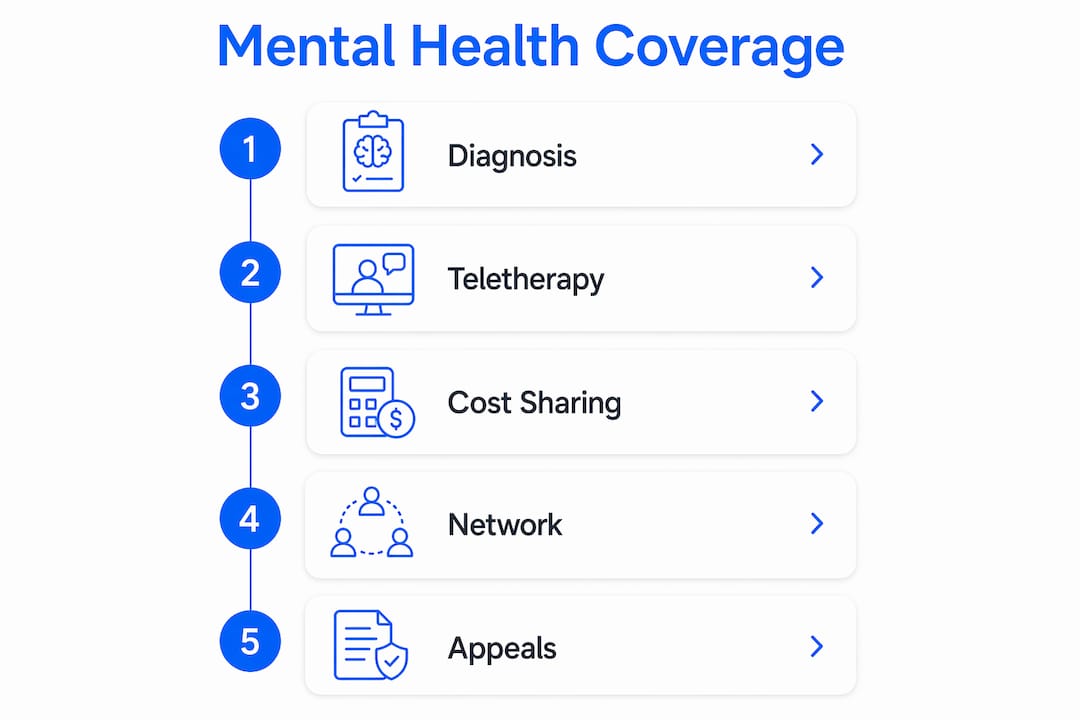
The phrase “medically necessary” is the key gatekeeper. Insurers require a formal diagnosis and the correct CPT billing codes to approve a claim. Sessions without a formal mental health diagnosis or proper CPT code billing are classified as elective and not reimbursed. Life coaching, stress management without a diagnosis, and general wellness counseling fall outside covered services under virtually every insurance policy for mental health.
Teletherapy is now a standard covered service. Medicare and most major ACA plans cover telehealth mental health visits at the same cost-sharing rates as in-person visits, which significantly expands access for people in rural areas or those with scheduling barriers.

Pro Tip: Ask your therapist or psychiatrist to confirm they will bill with a DSM-5 diagnosis code before your first session. Without it, your insurer will likely deny the claim regardless of your coverage.
What are the deductibles, copays, and coinsurance for mental health visits?
Parity law requires that cost sharing for mental health services be no greater than for comparable medical services. In practice, that means your copay for a therapy session should not exceed your copay for a primary care or specialist visit under the same plan.
Typical cost-sharing structures
| Cost type | What to expect |
|---|---|
| Deductible | Mental health visits apply to the same deductible as medical visits; once met, cost sharing kicks in |
| Copay | Typically $20–$60 per session for in-network providers on employer or ACA plans |
| Coinsurance | Usually 20% after deductible for in-network; 40–50% for out-of-network |
| Medicare Part B | $283 deductible in 2026, then 20% coinsurance with no session cap if clinically documented |
Medicare Part B covers outpatient mental health services including therapy, psychiatric evaluation, and medication management. The $283 annual deductible applies, followed by 20% coinsurance. There is no hard limit on the number of sessions as long as the treating clinician documents medical necessity at each visit.
The in-network versus out-of-network distinction matters more for mental health than for most medical specialties. Patients often focus on premiums and overlook the fact that a low-premium plan may carry high per-session copays or a narrow network that forces out-of-network use. A plan with a $30 monthly premium savings can easily cost $100 more per therapy session if your preferred provider is out-of-network.
Pro Tip: Before enrolling in a plan, call the insurer and ask specifically how many in-network therapists and psychiatrists are accepting new patients in your zip code. A large provider directory does not mean those providers have open slots.
What are common limits on mental health coverage and how does parity regulate them?
Federal law prohibits annual and lifetime dollar limits on mental health benefits. However, other types of restrictions remain common and are frequently the source of coverage disputes.
Parity violations often involve higher copays, visit limits, prior authorization requirements applied only to mental health, and restricted networks. A Department of Labor audit found that many plans imposed visit caps on autism therapy and enforced prior authorizations exclusively on mental health services, not on comparable medical care.
Common restrictions you may encounter include:
- Prior authorization requirements for inpatient psychiatric stays, IOPs, or PHPs, even when no comparable requirement exists for medical hospitalizations
- Step therapy protocols requiring patients to try lower-cost treatments before approving a specific medication or therapy type
- Network adequacy failures where the insurer lists providers who are not accepting new patients or are located hours away
- Visit limits on specific therapy types that are not applied to equivalent medical services
The network adequacy problem is the most persistent barrier. Out-of-network providers are used 9 times more often for mental health care than for physical health care. That gap reflects a real shortage of in-network mental health providers, not simply patient preference. Federal parity rules require insurers to maintain adequate networks, but enforcement has lagged behind the law’s intent.
Recognizing a parity violation requires comparing your mental health benefits directly against your medical benefits. If your plan requires prior authorization for a psychiatric hospitalization but not for a medical hospitalization, that is a violation. If your copay for a therapy visit is higher than for a specialist visit, that is also a violation. Document the discrepancy in writing before filing a complaint.
How can you verify your coverage and handle denials?
Verifying your mental health benefits before your first appointment prevents the most common and costly surprises. Follow these steps:
- Call the member services number on your insurance card. Ask specifically: Has my deductible been met? What is my copay or coinsurance for outpatient mental health visits? Is prior authorization required? How many sessions are covered per year?
- Confirm your provider is in-network. Call the provider’s office directly, not just the insurer’s online directory. Directories are often outdated.
- Request a benefits verification letter in writing. Verbal confirmations are not binding. A written summary protects you if the insurer later disputes coverage.
- Obtain a letter of medical necessity from your clinician. A clinician’s letter of medical necessity is the most effective tool for reversing “not medically necessary” denials. It should include your diagnosis, treatment plan, and clinical rationale for the recommended service.
- File a formal appeal if denied. Every insurer must provide an internal appeals process. Submit the letter of medical necessity, your treatment records, and a written explanation of why the denial violates parity.
- Request a network adequacy appeal if no in-network providers are available. Patients can file network adequacy appeals asking the insurer to cover an out-of-network provider at in-network rates. This requires documentation that no timely in-network option exists.
- File a complaint with your state insurance regulator. If the insurer denies your appeal without justification, formal complaints to state regulators can force compliance. Document every phone call, email, and letter throughout the process.
Pro Tip: If your insurer denies a claim as “not medically necessary,” ask for the specific clinical criteria they used to make that determination. Insurers are legally required to provide it, and the answer often reveals a parity violation.
If your insurer denies coverage after an appeal, you also have the right to an independent external review. An independent reviewer, not affiliated with your insurer, evaluates the denial. External reviews overturn insurer decisions at a meaningful rate, particularly for mental health claims. Learn more about appealing a denied claim to understand each step in the process.
Key takeaways
Insurance plans must cover mental health visits on the same terms as physical health care under the MHPAEA and ACA, but patients must verify benefits, document medical necessity, and appeal violations to access those protections in practice.
| Point | Details |
|---|---|
| Federal parity law applies broadly | MHPAEA and ACA require comparable mental health coverage across most employer, ACA, Medicare, and Medicaid plans. |
| Medical necessity drives reimbursement | A formal diagnosis and correct CPT codes are required for insurance to pay for any mental health session. |
| Cost sharing must match medical benefits | Copays, deductibles, and coinsurance for mental health visits cannot exceed those for comparable medical services. |
| Network gaps are the biggest access barrier | Out-of-network use for mental health is 9 times higher than for physical care, often due to provider shortages. |
| Documentation wins appeals | A clinician’s letter of medical necessity is the single most effective tool for reversing coverage denials. |
My honest read on mental health insurance in 2026
Coverage on paper and access in practice are two different things. I have seen patients with solid employer plans spend months trying to find an in-network therapist who is actually accepting new patients. The law says their coverage is comparable to medical care. The reality is a directory full of providers who stopped taking new patients two years ago.
The biggest mistake I see is treating insurance verification as a one-time checkbox. Your benefits can change at renewal, your provider’s network status can change mid-year, and prior authorization requirements can shift without much notice. Checking once at enrollment is not enough.
Low premiums are a trap for mental health care specifically. A plan with a $200 lower monthly premium often has a narrower mental health network and higher per-session costs. Over a year of weekly therapy, that math flips quickly. Run the numbers on total out-of-pocket cost, not just the premium.
Persistence matters more than most people expect. Insurers deny claims knowing that a significant share of patients will not appeal. A well-documented appeal with a letter of medical necessity and a clear parity argument overturns denials far more often than patients realize. The process is frustrating, but it works.
— Guorui
Mental health care without the insurance maze
Navigating insurance for mental health visits takes time and patience. Helloklarity offers a direct path to licensed mental health providers, with same-day appointments available and a network of over 1,000 licensed providers across the country.
Helloklarity accepts major insurance plans and health savings accounts, and self-pay options start at $49. Whether you are managing anxiety, depression, or ADHD, you can find a licensed provider in your state and book within 24 hours. For a full overview of available mental health and medical services, visit the Helloklarity services page.
FAQ
Does insurance cover therapy without a diagnosis?
No. Insurance requires a formal diagnosis and CPT billing codes to reimburse therapy sessions. Life coaching or wellness counseling without a clinical diagnosis is not covered.
What is the Mental Health Parity and Addiction Equity Act?
The MHPAEA is a federal law requiring health plans to cover mental health and substance use disorder services on terms no more restrictive than medical or surgical benefits. It applies to most employer-sponsored and ACA plans.
How many therapy sessions does insurance cover per year?
Most plans do not set a hard session limit, but some impose visit caps that must be comparable to limits on medical services under parity law. Medicare Part B covers unlimited outpatient sessions when medical necessity is documented.
What should I do if my mental health claim is denied?
Request the specific clinical criteria used for the denial, then submit a formal appeal with a letter of medical necessity from your clinician. If the internal appeal fails, request an independent external review.
Does insurance cover teletherapy in 2026?
Yes. Medicare and most ACA-compliant plans cover telehealth mental health visits at the same cost-sharing rates as in-person sessions, making virtual therapy a fully covered option under most major plans.
Recommended
- Blue Cross Blue Shield Texas Anxiety Treatment Online: What Your Plan May Cover In 2026 | Klarity Health, Inc
- Does Insurance Cover Telehealth? What Every Major Plan Actually Covers In 2026 | Klarity Health, Inc
- Does Insurance Cover Depression Medication? What To Know In 2026 | Klarity Health, Inc
- Mental Health Awareness Month 2026: Why More Americans Are Turning To Telehealth For Anxiety And Depression | Klarity Health, Inc
Get expert care from top-rated providers
Find the right provider for your needs — select your state to find expert care near you.
Related posts






— Monday to Friday, 7:00 AM to 4:00 PM PST
Join our mailing list for exclusive healthcare updates and tips.

— Monday to Friday, 7:00 AM to 4:00 PM PST



