 HSA & FSA accepted; best-value for top quality care
 Same-day mental health, weight loss, and primary care appointments available

 Accept major insurances and cash-payHSA & FSA accepted; best-value for top quality careSame-day mental health, weight loss, and primary care appointments availableAccept major insurances and cash-pay
Why Prescription Discount Cards Save Money in 2026
Written by Klarity Editorial Team
Published: Jun 2, 2026

Prescription discount cards save money by giving you access to negotiated cash-pay prices at participating pharmacies, completely outside your insurance billing. These prices often beat what your insurance plan charges in copays, especially on generic medications. Programs like GoodRx, SingleCare, and Optum Perks operate through separate pharmacy network agreements, not through your insurer or pharmacy benefit manager. For anyone paying too much at the counter, understanding how these cards work mechanically is the fastest path to real savings.
Why prescription discount cards save money: the core mechanism
Prescription discount cards are not insurance. They function like coupons that apply negotiated discounts for specific drugs at pharmacies that have agreed to honor them. When you hand a pharmacist your GoodRx or SingleCare card, the pharmacy processes that transaction on a separate cash-pay track, not through your insurance claim.
This distinction matters because your insurance copay reflects pricing negotiated between your insurer and a pharmacy benefit manager (PBM). That PBM pricing is designed around benefit structures, tiers, and formularies. The cash-pay price on a discount card comes from a completely different set of agreements, and for many generics, that cash-pay price is substantially lower.

The savings are medication-specific. Discount card prices vary drug by drug depending on what the card provider has negotiated with each pharmacy. There is no guaranteed percentage off across the board. A 30-day supply of metformin might cost $4 with GoodRx at one pharmacy and $12 at another. This is why comparing prices before you fill is not optional. It is the whole strategy.
Pro Tip: Before your next refill, look up your medication on GoodRx or SingleCare and compare the cash price at two or three nearby pharmacies. The difference can be $30 or more for the same drug.
When do discount cards offer the biggest savings?
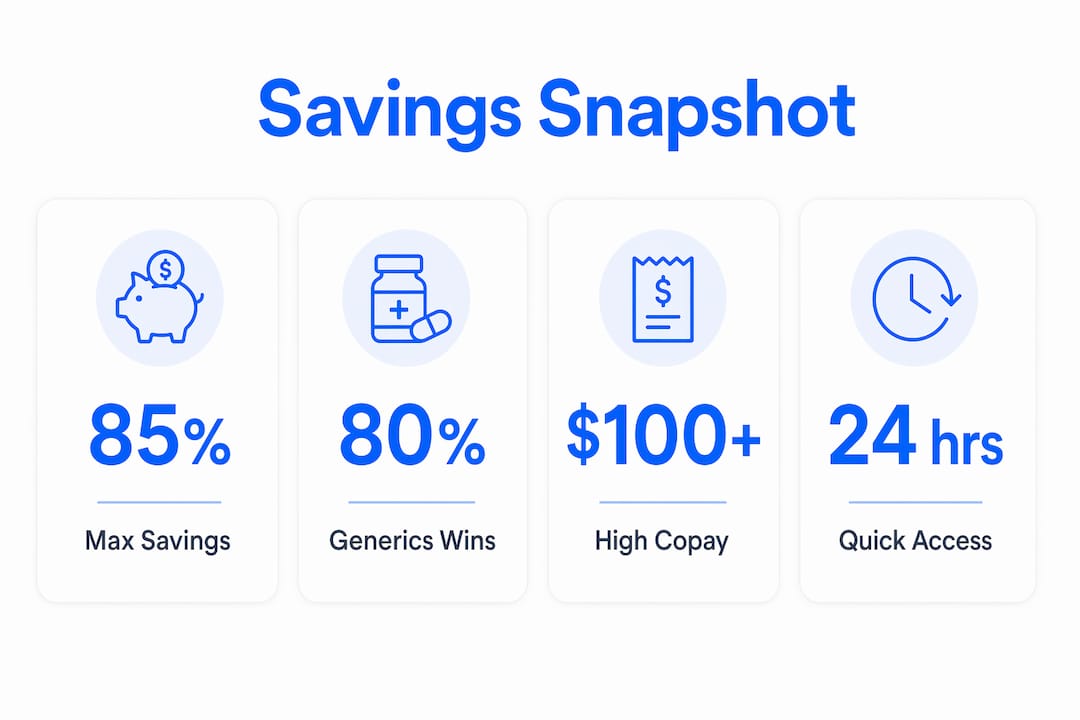
The savings from prescription discount cards concentrate heavily on specific situations. Research published in AJMC found that cash-pay programs beat insurance copays nearly 80% of the time when a generic drug’s cost-sharing exceeded $15. That is a meaningful threshold. When your insurance copay on a generic is $10 or less, a discount card rarely beats it.
The numbers get more striking at higher cost tiers. For generics where insurance cost-sharing exceeded $100, median out-of-pocket costs dropped to $25 with cash-pay discount programs compared to $140 through insurance. That is an 85% relative savings. This is where programs like GoodRx and Cost Plus Drugs create the most value.
The table below shows where discount cards tend to win versus where insurance typically holds the advantage:
| Scenario | Better option |
|---|---|
| Generic with insurance copay above $15 | Discount card (wins ~80% of the time) |
| Generic with insurance copay under $10 | Insurance copay usually wins |
| Brand-name drug with high list price | Manufacturer copay card or insurance |
| Uninsured patient, any generic | Discount card almost always wins |
| Close to meeting annual deductible | Insurance (protects out-of-pocket progress) |
One critical limitation: discount card purchases do not count toward your insurance deductible or out-of-pocket maximum. If you are three months into the year and $800 away from hitting your deductible, paying $25 cash for a prescription instead of $60 through insurance feels like a win. But that $60 insurance payment would have moved you closer to a threshold where your plan covers 100% of costs. The $25 cash payment saves you $35 today and costs you more later.
Medicare Part D beneficiaries face a sharper version of this problem. Using discount cards at the pharmacy counter can delay reaching annual spending caps, which can increase total spending across the plan year. The relevant comparison is always total annual spending, not just what you pay today.
Pro Tip: If you take multiple medications for a chronic condition, map out your expected annual drug costs under both scenarios before defaulting to a discount card. The upfront savings can be real, but so can the downstream cost of a delayed deductible.
How do discount cards compare with manufacturer copay cards and insurance?
These three tools operate on completely different tracks, and confusing them is one of the most common reasons people overpay.
Prescription discount cards are third-party cash-pay tools. GoodRx, SingleCare, and Optum Perks negotiate directly with pharmacies. No insurance claim is filed. No deductible credit is earned. The price you pay is the price you pay, full stop.
Manufacturer copay cards work differently. Drug manufacturers like Pfizer, AbbVie, and Eli Lilly offer these cards to reduce your out-of-pocket cost on specific brand-name drugs when you use insurance. The manufacturer covers part of your copay, but the transaction still runs through your insurance. This means the payment can count toward your deductible and out-of-pocket maximum, depending on your plan. The list price of the drug is not reduced. The manufacturer is simply subsidizing your share.
Insurance coverage, when it applies, provides the most financial protection over time because payments accumulate toward your annual thresholds. The tradeoff is that copays and coinsurance can be high, particularly for brand-name drugs on higher formulary tiers.
Here is how the three tools stack up on key dimensions:
- Discount cards (GoodRx, SingleCare, Optum Perks): Work on generics and some brands, no insurance required, no deductible credit, prices vary by pharmacy and drug.
- Manufacturer copay cards: Work only on specific brand-name drugs, require insurance, can count toward deductible, do not lower the drug’s list price.
- Insurance coverage: Applies to most covered drugs, payments count toward deductible and out-of-pocket max, copays can be high for non-preferred or brand drugs.
For brand-name medications with high list prices, the best outcome often comes from stacking a manufacturer copay card with insurance coverage. For generics with high insurance copays, a discount card from GoodRx or SingleCare is usually the right call.
Practical steps to use discount cards effectively
Knowing why prescription discount cards save money is only useful if you act on it correctly. The process is straightforward, but most people skip the most important step.
- Check the cash price before the pharmacist bills insurance. Once a prescription is processed through insurance, pharmacies typically cannot reverse the claim to apply a discount card price in the same transaction. Ask before they start.
- Compare prices across pharmacies using GoodRx or SingleCare. The same drug at CVS and Costco can differ by $40 or more. Apps from GoodRx and SingleCare show real-time prices at nearby locations.
- Use discount cards primarily for generics with high insurance copays. This is where the savings concentrate. For drugs with low copays, the math rarely favors the discount card.
- Track your deductible and out-of-pocket progress throughout the year. If you are close to a threshold, paying through insurance protects your annual spending position even if the copay is higher today.
- For brand-name drugs, check whether a manufacturer copay card is available. Combining that card with insurance often beats any discount card price on brands.
- Revisit your comparison each time you refill. Negotiated cash prices change. A drug that was cheaper with GoodRx six months ago may now be cheaper through insurance, or vice versa.
Pro Tip: For patients managing chronic conditions like hypertension, diabetes, or depression, the GLP-1 medication cost guide from Helloklarity breaks down specific cost-saving strategies by drug class, including when discount cards beat insurance for maintenance medications.
Key takeaways
Prescription discount cards save money reliably on generics with high insurance copays, but they require active price comparison and careful attention to your annual deductible and out-of-pocket progress.
| Point | Details |
|---|---|
| Core savings mechanism | Discount cards access negotiated cash-pay prices outside insurance billing, often lower for generics. |
| Best use case | Generics where insurance cost-sharing exceeds $15; savings reach up to 85% at higher tiers. |
| Critical limitation | Discount card purchases do not count toward your deductible or out-of-pocket maximum. |
| Medicare caution | Part D beneficiaries may increase total annual spending by delaying cap thresholds with discount cards. |
| Essential habit | Always ask for the cash price before the pharmacist processes your insurance claim. |
What I’ve learned from watching people overpay at the pharmacy
The most consistent mistake I see is treating prescription discount cards as a default rather than a tool. People download GoodRx, feel good about saving $8 on a $12 copay, and never think about whether that $12 copay was moving them toward a $3,000 deductible they would have hit by October.
The math on discount cards is genuinely compelling for the right drugs in the right situations. An 85% reduction on a high-cost generic is not a rounding error. But the framing of “always use a discount card” misses the point entirely. The correct framing is “always check the cash price, then decide.”
What I find underappreciated is how much pharmacist communication matters here. Many pharmacists will proactively check both prices if you ask. Some will not, either because they are busy or because their system defaults to insurance billing. The burden is on you to ask before the transaction starts, because reversing it afterward is often not possible.
The other thing worth saying plainly: the discount card market is not neutral. GoodRx and similar platforms earn fees from pharmacies on each transaction. That does not make them bad tools. It means their incentives are aligned with you using the card, not necessarily with you making the optimal financial decision for your full year of healthcare spending. Knowing that keeps you in the driver’s seat.
— Guorui
How Helloklarity helps you reduce prescription costs
Managing prescription costs is not just about finding the right card. It starts with having a provider who understands your medications and your financial situation.
Helloklarity connects you with licensed providers within 24 hours through a telehealth platform built for people who need affordable, fast access to care. Providers on the Helloklarity network can help you identify generic alternatives, review whether your current prescriptions are the most cost-effective options, and guide you through discount programs that fit your situation. For patients managing chronic conditions, the Helloklarity Care Commitment Card offers additional savings on maintenance medications. You can also explore the full range of telehealth services available to find the right care path at a price that works for you.
FAQ
What are prescription discount cards?
Prescription discount cards are third-party tools that provide access to negotiated cash-pay prices at participating pharmacies. They are not insurance and do not file claims with your health plan.
Do discount cards always save more than insurance?
No. Discount cards save money most reliably when your insurance copay on a generic exceeds $15. When copays are low or you are close to your deductible, insurance is often the better financial choice.
Can I use a discount card and insurance at the same time?
No. A prescription is processed either through insurance or through a discount card, not both simultaneously. For brand-name drugs, combining insurance with a manufacturer copay card is a separate strategy that can work together.
Do discount card purchases count toward my deductible?
Discount card purchases do not count toward your insurance deductible or out-of-pocket maximum. This is one of the most important limitations to understand before deciding which payment method to use.
Which discount card saves the most money?
GoodRx, SingleCare, and Optum Perks each negotiate different rates with different pharmacies. The best card depends on your specific medication and your local pharmacy. Comparing prices across all three before filling is the most reliable way to find the lowest price.
Recommended
- GLP-1 Medication Cost Guide: How To Save On Wegovy, Ozempic, And Zepbound In 2026 | Klarity Health, Inc
- Klarity Care Commitment Cards: Saving Big for Chronic Care
- Online Prescription Refill: Can A Telehealth Doctor Renew Your Medication? | Klarity Health, Inc
- Klarity Health Promotions | Telehealth Discounts & Savings
Get expert care from top-rated providers
Find the right provider for your needs — select your state to find expert care near you.
Related posts






— Monday to Friday, 7:00 AM to 4:00 PM PST
Join our mailing list for exclusive healthcare updates and tips.

— Monday to Friday, 7:00 AM to 4:00 PM PST



