 HSA & FSA accepted; best-value for top quality care
 Same-day mental health, weight loss, and primary care appointments available

 Accept major insurances and cash-payHSA & FSA accepted; best-value for top quality careSame-day mental health, weight loss, and primary care appointments availableAccept major insurances and cash-pay
Types of Insurance Accepted by Telehealth in 2026
Written by Klarity Editorial Team
Published: Jul 24, 2026

Last updated: August 10, 2026
Medicare, Medicaid, and most commercial health plans cover telehealth services in the United States as of 2026. Coverage is broad but not uniform. What you actually pay, and which services qualify, depends on your plan type, the state you live in, and the specific modality your provider uses (live video, audio-only, or remote monitoring). Here is a quick snapshot of where each major insurance category stands:
Looking for online care that may work with your insurance? Klarity Health connects you with 2,000+ licensed providers for online anxiety treatment, online depression treatment, online ADHD treatment, online weight loss treatment, and online prescriptions. Coverage varies by plan. Browse conditions and verify your benefits →
- Medicare (Original Part B): Covers a wide range of telehealth services through December 31, 2027, with 20% coinsurance after the Part B deductible.
- Medicare Advantage: May offer expanded telehealth benefits beyond Original Medicare, depending on the plan.
- Medicaid: Reimburses live video telehealth in all 50 states plus D.C.; audio-only and store-and-forward coverage varies by state.
- Commercial/private insurance: Most plans cover telehealth, with 43 states and D.C. having enacted private insurance telehealth laws, though coverage scope differs.
- Employer-sponsored plans: Generally follow commercial insurance rules; telehealth benefits vary by employer contract.
- Self-pay: Available at most telehealth platforms for those without coverage or with out-of-network concerns.
Table of Contents
- 1. What does Medicare cover for telehealth in 2026?
- 2. How does Medicaid cover telehealth, and why does your state matter?
- 3. What do commercial and private insurance plans actually cover?
- 4. What will telehealth actually cost you, with or without insurance?
- 5. How Helloklarity handles insurance and helps you avoid coverage surprises
- Helloklarity makes telehealth coverage less confusing
- Key Takeaways
1. What does Medicare cover for telehealth in 2026?
Original Medicare Part B covers a broad range of telehealth services through December 31, 2027, including office visits, outpatient psychotherapy, cardiac rehabilitation, diabetes self-management training, depression screenings, cognitive assessments, and speech therapy. You can receive these services from anywhere in the U.S., including your home. That geographic flexibility was a pandemic-era expansion that Congress has since extended.
Cost-sharing under Part B is straightforward. After you meet the Part B deductible, you pay 20% coinsurance for telehealth visits, the same rate as an in-person appointment. There are no surprise telehealth surcharges built into Original Medicare.
Medicare Advantage plans can go further. They may offer additional telehealth services, lower copays for virtual visits, or access to services from home regardless of geographic location. The specifics are plan-dependent, so checking your Summary of Benefits each year is the only reliable way to know what your Advantage plan actually covers.
| Service category | Covered under Part B? | Patient cost (after deductible) |
|---|---|---|
| Office visits (primary care) | Yes | 20% coinsurance |
| Outpatient psychotherapy | Yes | 20% coinsurance |
| Cardiac rehabilitation | Yes | 20% coinsurance |
| Diabetes self-management | Yes | 20% coinsurance |
| Depression screenings | Yes | 20% coinsurance |
| Cognitive assessments | Yes | 20% coinsurance |
| Speech therapy | Yes | 20% coinsurance |
| Additional Advantage services | Plan-specific | Varies by plan |
Coverage note: Medicare telehealth patients pay the same 20% coinsurance for virtual visits as they would for in-person care, once the Part B deductible is met. Coverage for this expanded telehealth access runs through December 31, 2027.
2. How does Medicaid cover telehealth, and why does your state matter?
Medicaid reimburses live video telehealth in all 50 states plus D.C. That is the floor. Everything else, including store-and-forward technology, remote patient monitoring, and audio-only visits, varies considerably from state to state.
Audio-only telehealth reimbursement is available in many states but is often limited to behavioral health services. Store-and-forward (where a provider reviews recorded data asynchronously) is covered in some states for dermatology and radiology but not universally. Remote patient monitoring coverage is expanding but remains inconsistent.
Commonly covered Medicaid telehealth modalities:
- Live video visits for primary care, behavioral health, and specialty consultations
- Audio-only visits for behavioral health (in many states)
- Remote patient monitoring (in select states, often for chronic disease management)
- Store-and-forward for dermatology and radiology (state-specific)
State Medicaid programs also differ on payment parity. Some states require Medicaid to reimburse telehealth at the same rate as in-person care; others pay less for virtual visits, which affects which providers are willing to accept Medicaid for telehealth.
| State example | Live video | Audio-only | Store-and-forward | Payment parity |
|---|---|---|---|---|
| California | Yes | Yes (behavioral health) | Yes (select specialties) | Yes |
| Texas | Yes | Limited | Limited | No |
| New York | Yes | Yes | Yes (select) | Yes |
| Florida | Yes | Limited | No | No |
| Washington | Yes | Yes | Yes | Yes |
Pro Tip: Call your state Medicaid office or your provider’s billing department before your first telehealth visit. State rules change frequently, and what was covered last year may have been modified by your state legislature.
3. What do commercial and private insurance plans actually cover?
Private insurance plans broadly cover telehealth for primary care, mental health, and select specialties, but the details depend on your carrier, your specific plan, and your state. Many states and D.C. have enacted private insurance telehealth laws, though their scope varies. About half of those states also have payment parity laws, meaning insurers must reimburse telehealth at the same rate as in-person visits.

Coverage parity (the requirement to cover telehealth at all) and payment parity (equal reimbursement rates) are different standards. A state can require your insurer to cover telehealth without requiring equal pay for providers, which affects provider participation in virtual care networks.
Typical features of commercial telehealth coverage:
- Primary care visits via live video, often at the same copay as an office visit
- Behavioral health and therapy sessions, frequently with strong coverage parity
- Specialty consultations (varies widely by plan and specialty)
- Prescription management visits for ongoing conditions
- Exclusions for certain elective or cosmetic services
Network restrictions are where many patients get caught off guard. Your insurer may cover telehealth broadly, but only through specific platforms or providers in their network. Using an out-of-network telehealth provider can result in denied claims or much higher out-of-pocket costs, even when the service itself is a covered benefit.
Pro Tip: Before booking any telehealth appointment, verify that both the platform and the individual clinician are in-network with your plan. Checking the platform alone is not enough. A provider can be listed on an approved app but still be out-of-network for your specific insurance plan.
Employer-sponsored plans follow the same commercial insurance framework. Your employer’s HR department or benefits portal is the fastest way to confirm telehealth benefits, since large employers often negotiate custom telehealth packages that differ from standard marketplace plans.
4. What will telehealth actually cost you, with or without insurance?
Telehealth costs vary more than most patients expect, and the type of insurance you carry makes a real difference. Under Medicare Part B, you pay 20% coinsurance after the deductible, the same as an in-person visit. Under commercial plans, copays for telehealth visits typically mirror in-person primary care copays, though some plans charge a separate, lower telehealth copay.

High-deductible health plans (HDHPs) paired with health savings accounts (HSAs) add a layer of complexity. If you have not met your deductible, you pay the full negotiated rate for telehealth visits out of pocket, just as you would for any other covered service. HSA funds can be used to cover those costs, which softens the impact. Once your deductible is met, standard coinsurance applies.
Cost considerations by coverage type:
- Medicare Part B: 20% coinsurance after deductible; no separate telehealth surcharge
- Medicaid: Often $0 to low copay, depending on state and income level
- Commercial insurance (in-network): Copay typically mirrors in-person primary care; behavioral health may differ
- HDHP before deductible: Full negotiated rate applies; HSA funds are eligible
- Out-of-network telehealth: May result in no coverage or significantly higher costs
- Self-pay: Uninsured telehealth visits typically cost $40 to $99 or more per session, depending on the service and platform
Cost snapshot: Uninsured or self-pay telehealth visits typically run $40 to $99 or more per session. That range shifts based on the type of service, the provider’s specialty, and the platform you use.
Out-of-network situations are the most common source of surprise bills. Telehealth coverage does not automatically mean the platform you are using is in your network. Patients frequently check whether their insurer covers telehealth in general, then skip the step of confirming whether their specific provider is contracted with their plan. That gap is where unexpected charges appear.
For patients without insurance, community health centers and federally qualified health centers (FQHCs) often provide telehealth at reduced or sliding-scale fees. These are worth exploring before paying full self-pay rates at a commercial platform.
5. How Helloklarity handles insurance and helps you avoid coverage surprises
Helloklarity accepts major insurance plans and health savings accounts, which covers a large share of patients looking for mental health, primary care, or weight loss support via telehealth. For patients whose plans do not cover a specific service, self-pay options start at $49, making it one of the more accessible price points in the space.
The platform’s network includes over 2,000+ licensed providers, and same-day appointments are typically available within 24 hours. That speed matters when you are dealing with anxiety, ADHD, or depression and cannot wait weeks for an in-person slot.
Steps to verify your coverage before booking through Helloklarity:
- Check whether your insurance plan is listed as accepted on the Helloklarity website before scheduling
- Confirm that the individual provider you are matched with is in-network, not just the platform
- Ask your insurer whether your specific condition and service type (e.g., therapy vs. medication management) are covered under your telehealth benefit
- If you have an HSA, confirm eligibility for the service type before your visit
- For self-pay visits, ask about the exact cost upfront so there are no billing surprises
Pro Tip: If your insurer’s telehealth coverage is unclear, ask Helloklarity’s support team directly. They can confirm which plans they accept and help you understand what your out-of-pocket responsibility will be before you book.
Helloklarity’s self-pay pricing is particularly useful for patients in states where their insurer’s telehealth benefit is narrow, or where the specific service they need falls outside covered categories. Knowing the flat self-pay rate in advance is often simpler than navigating a partial reimbursement claim.
Helloklarity makes telehealth coverage less confusing
Figuring out which insurance plans cover which telehealth services is genuinely complicated. Helloklarity cuts through that by accepting major insurance plans, HSA payments, and offering transparent self-pay pricing from $49 per visit.
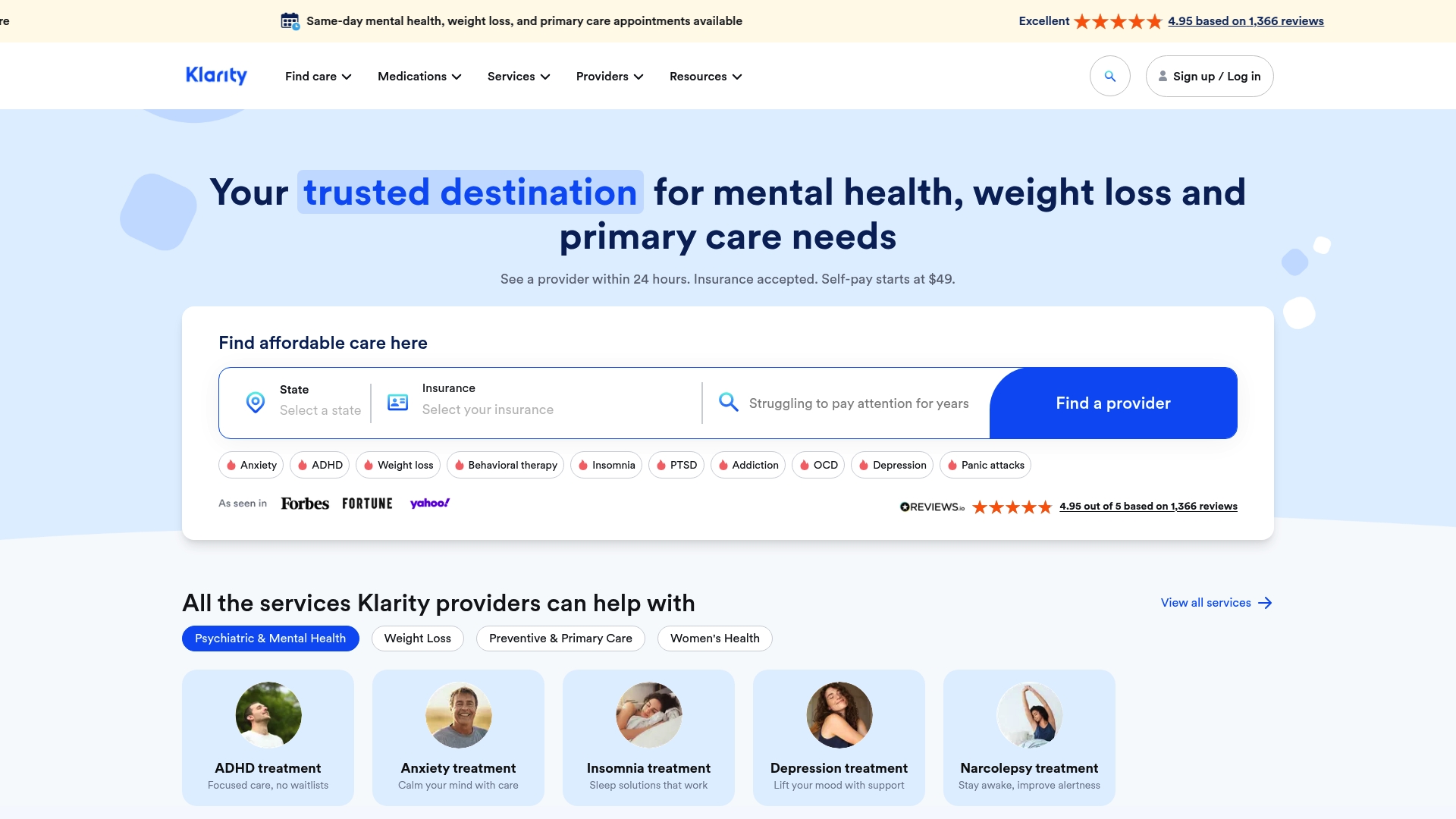
Where most telehealth platforms leave you to sort out network status on your own, Helloklarity’s team can walk you through coverage before you book. With over 2,000+ licensed providers and same-day access for mental health, weight loss, and primary care, you are not waiting weeks to find out if your plan works. You can browse available services to see what is covered, or find a licensed provider in your state right now.
Related care
Explore Klarity Health services that patients often pair with insurance-covered telehealth visits:
- Online anxiety treatment
- Online depression treatment
- Online ADHD treatment
- Online weight loss treatment
- Online doctor prescriptions
- Browse all conditions
Key Takeaways
Medicare, Medicaid, and most commercial insurance plans cover telehealth in 2026, but coverage scope, payment parity, and out-of-pocket costs vary significantly by plan type and state.
| Point | Details |
|---|---|
| Medicare Part B coverage | Covers telehealth through December 31, 2027, with 20% coinsurance after the Part B deductible. |
| Medicaid state variation | Live video is covered in all states; audio-only and store-and-forward coverage depends on your state. |
| Commercial insurance parity | 43 states and D.C. have private insurance telehealth laws; about half also require payment parity. |
| Self-pay cost range | Uninsured telehealth visits typically cost $40 to $99 or more per session depending on service type. |
| Helloklarity | Accepts major insurance and HSA payments, with self-pay options starting at $49 and same-day provider access. |
Ready to check coverage for online care? Klarity works with many commercial plans and can help you understand what may be covered before you book. Network includes 2,000+ licensed providers. See conditions and verify your benefits →
Insurance coverage varies by plan, insurer, and state. This article is educational and is not a guarantee of coverage. Verify benefits with your insurer before booking.
Recommended
- Does Insurance Cover Telehealth? What Every Major Plan Actually Covers In 2026 | Klarity Health, Inc
- Does Blue Cross Blue Shield Cover Telehealth? What Patients Need To Know In 2026 | Klarity Health, Inc
- How Telehealth Cuts Your Out-of-Pocket Healthcare Costs
- How To Use Insurance For Telehealth Family Visits
Get expert care from top-rated providers
Find the right provider for your needs — select your state to find expert care near you.
Related posts






— Monday to Friday, 7:00 AM to 4:00 PM PST
Join our mailing list for exclusive healthcare updates and tips.

— Monday to Friday, 7:00 AM to 4:00 PM PST



