 HSA & FSA accepted; best-value for top quality care
 Same-day mental health, weight loss, and primary care appointments available

 Accept major insurances and cash-payHSA & FSA accepted; best-value for top quality careSame-day mental health, weight loss, and primary care appointments availableAccept major insurances and cash-pay
Why Rural Patients Lack Primary Care Access
Written by Klarity Editorial Team
Published: Jul 20, 2026

Last updated: August 10, 2026
Rural primary care access is defined by a structural gap: geographic isolation, clinician shortages, financial hardship, and systemic policy failures combine to deny millions of Americans timely, affordable care. The Health Resources and Services Administration (HRSA) designates thousands of rural counties as Health Professional Shortage Areas, a formal recognition that supply has never matched demand. The National Academies of Sciences, Engineering, and Medicine (NASEM) has documented how these shortages compound over time, pushing rural populations toward worse chronic disease outcomes and higher preventable mortality. Understanding why rural patients lack primary care access is the first step toward reversing a decades-long decline.
Need primary care or mental health support without a long drive? Klarity connects you with 2,000+ licensed providers for same-day telehealth, including online prescriptions, anxiety treatment, ADHD care, depression treatment, and weight management. Coverage varies by plan; verify benefits before booking. Explore conditions →
Why rural patients lack primary care access: the core barriers
The barriers to primary care in rural America are not isolated problems. They form an interlocking system where each gap makes the others worse.
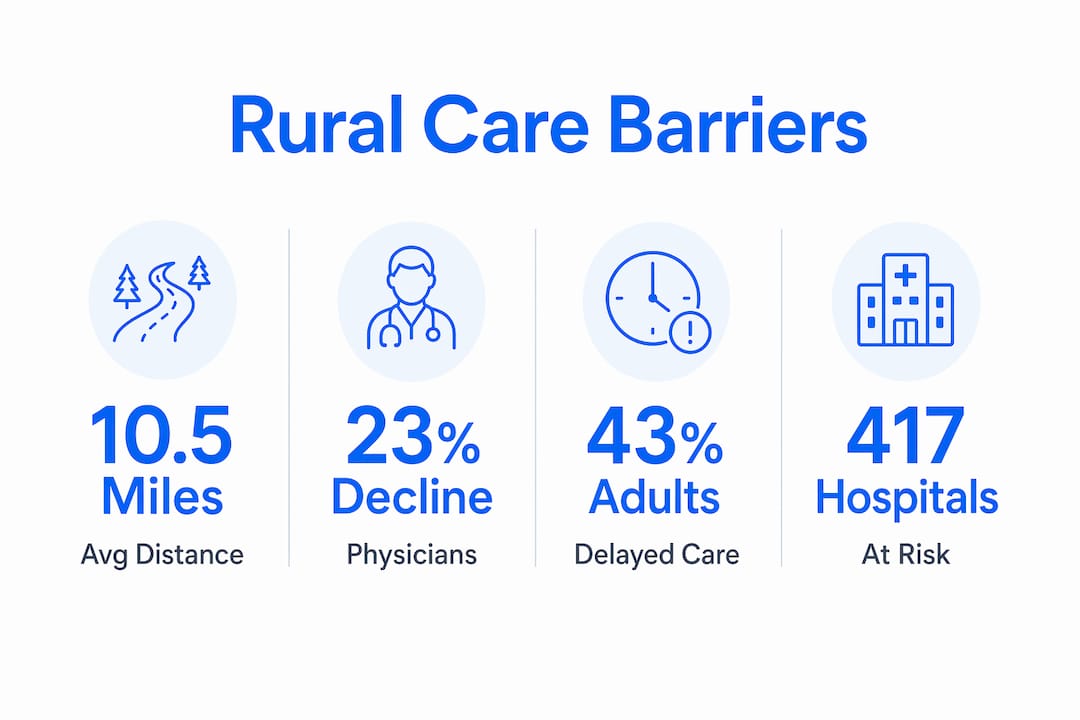
Geographic distance sits at the center. Rural residents live an average of 10.5 miles from the nearest hospital, with specialty care averaging 26.8 to 50.6 miles away. That distance translates directly into delayed diagnoses, skipped follow-ups, and untreated chronic conditions.

Clinician shortages compound the distance problem. A 23% decline in primary care physicians accepting new patients between 2013 and 2021 was not offset by a 91% rise in advanced practice providers, resulting in an overall 5% decrease in clinicians available to new patients. Rural communities absorb the sharpest end of that shortage.
Financial barriers then block the patients who do manage to reach a provider. 43% of adults postponed medical care due to cost, and rural adults report difficulty paying medical bills at a higher rate than their urban counterparts. These three forces, distance, shortage, and cost, define the access crisis for rural populations.
How does geographic isolation limit rural primary care?
Physical distance is the most visible obstacle to care, but transportation infrastructure is the mechanism that makes it impassable for many rural patients.
Rural public transit is sparse or absent in most counties. Patients without personal vehicles face a genuine choice between missing work for an hours-long round trip or skipping care entirely. Long distances and inadequate transportation cause delayed or forgone care, directly worsening health outcomes in rural populations. A missed annual physical becomes an undetected hypertension diagnosis. An undetected diagnosis becomes a preventable stroke.
The concept of geographic fragility captures something important here. Geographic fragility means that minor disruptions, a single clinic closure, a road washed out, a provider retirement, can collapse local care access entirely. Urban systems absorb those shocks. Rural systems often cannot.
Key transportation and geography barriers include:
- No reliable public transit in the majority of rural counties
- Personal vehicle dependency that excludes elderly and low-income patients
- Weather and road conditions that make travel dangerous or impossible seasonally
- Inability to take unpaid time off work for multi-hour care trips
- Lack of childcare during long travel days
Pro Tip: When assessing a rural community’s care access, map the nearest primary care clinic against local transit routes, not just road miles. A 15-mile trip with no bus service is functionally farther than a 40-mile trip with reliable transport.
What role do workforce shortages play in rural health deserts?
The rural clinician shortage is not a pipeline problem alone. It is a retention and system design problem that policy has consistently underestimated.
The 23% drop in primary care physicians accepting new patients between 2013 and 2021 reflects a profession under pressure. Administrative burden and low reimbursement cause clinician burnout, reduced capacity, and early retirements at rates that rural communities cannot absorb. A physician who leaves a rural practice at 58 instead of 65 removes years of irreplaceable local knowledge and patient relationships.
Advanced practice providers, including nurse practitioners and physician assistants, have grown rapidly in number. But integrating physicians and advanced practice providers into cohesive care teams is what actually expands capacity. Headcount alone does not fix access when the system design forces each provider to operate in isolation.
Underfunding and undervaluing of primary care leads to workforce shortages and low job satisfaction. Without structural change to how primary care is reimbursed and supported, adding providers to rural areas produces short-term gains that erode within years.
Summit to Revitalize Primary Care, 2026
Systemic factors reducing effective workforce capacity include:
- Prior authorization requirements consuming hours of clinical time weekly
- Electronic health record documentation burdens that extend workdays
- Low Medicare and Medicaid reimbursement rates relative to administrative costs
- Loan repayment programs that are insufficient to offset urban earning differentials
- Isolation and limited peer support driving early career departures from rural posts
Pro Tip: Workforce recruitment programs that ignore retention conditions fail within five years. Policymakers should fund rural practice support infrastructure, locum coverage, peer networks, and administrative relief, alongside recruitment incentives.
What financial and administrative obstacles block rural primary care?
Cost is not just a personal barrier. It is a structural one that the rural healthcare system amplifies at every level.
Rural adults report difficulty paying medical bills at a higher rate than urban adults, and 43% of adults across the country have delayed care due to cost. Rural populations rely more heavily on Medicaid and Medicare than urban populations, making them acutely vulnerable to reimbursement policy changes. When federal Medicaid funding tightens, rural patients feel it first and hardest.
Administrative burden functions as a hidden tax on both patients and providers. Complex eligibility rules, confusing prior authorization processes, and inconsistent insurance communications deter patients from seeking preventive care. A rural patient who cannot decode their coverage is a patient who waits until the emergency room becomes unavoidable.
Key financial and administrative barriers include:
- High out-of-pocket costs relative to rural median incomes
- Insurance coverage gaps in counties with limited marketplace competition
- Complex Medicaid eligibility rules that create enrollment gaps
- Prior authorization delays that postpone time-sensitive care
- Lack of financial counselors at small rural practices to help patients navigate costs
Telehealth offers a partial answer to cost barriers. Telehealth can reduce out-of-pocket costs by eliminating travel expenses and reducing time away from work, two costs that fall disproportionately on rural patients.
How do structural healthcare system failures worsen rural access issues?
System-level failures amplify every individual barrier rural patients face. The most visible sign is hospital closures.
Over 40% of rural hospitals operate at a financial loss, with 417 facilities at risk of closure. When a rural hospital closes, it does not just remove inpatient beds. It eliminates obstetrics, chemotherapy, surgical services, and the emergency department that serves as a safety net for the entire region. Communities that lose their hospital see measurable increases in maternal mortality and delayed cancer diagnoses within years.
Sizable Medicaid cuts threaten the financial stability of rural hospitals that rely on Medicaid for roughly 10% of net revenue. That margin is the difference between a hospital staying open and closing its doors. Policy decisions made in Washington translate directly into obstetric unit closures in rural Mississippi or Wyoming.
| Service category | Status in rural hospitals at risk |
|---|---|
| Obstetrics and labor/delivery | Eliminated in majority of closures |
| Chemotherapy and oncology | Reduced or removed as financially unviable |
| Surgical services | Scaled back to outpatient only or eliminated |
| Emergency departments | Converted to urgent care or closed |
| Mental health inpatient | Among first services cut in financial distress |
Rural health access suffers from systemic policy failures and uneven funding despite promising incremental telehealth and mobile health programs. Telehealth and mobile clinics are real tools, but they require broadband infrastructure and digital literacy that many rural communities still lack. A telehealth platform cannot serve a patient without reliable internet. Telehealth adoption in rural areas is limited by digital literacy gaps and broadband infrastructure deficits in the communities that need it most.
What strategies show promise for improving rural primary care?
Evidence points to a combination of workforce reform, infrastructure investment, and policy redesign as the path forward. No single intervention closes the gap alone.
Integrated care teams that pair physicians with nurse practitioners, physician assistants, and community health workers expand capacity without requiring a proportional increase in physician supply. The future of rural primary care depends on these integrated models, not on recruiting solo physicians to isolated practices. Team-based care also reduces burnout by distributing administrative and clinical load.
Telehealth, when paired with broadband investment, extends the reach of every provider in the network. Rural patients managing chronic conditions via telehealth can maintain consistent contact with their care team without the travel burden that causes so many to disengage. Mobile health clinics bring screenings and preventive services directly to communities that cannot reach a fixed facility.
Practical actions for policymakers and advocates include:
- Fund rural broadband as health infrastructure, not optional technology
- Reform Medicaid and Medicare reimbursement to reflect rural cost structures
- Expand loan forgiveness and practice support for rural primary care providers
- Reduce prior authorization requirements for primary and preventive care
- Invest in community health worker programs that bridge clinical and social needs
- Support rural hospital sustainability through targeted federal grants
Pro Tip: Telehealth is a force multiplier, not a replacement. Policymakers who fund telehealth without funding broadband access and digital literacy programs will see adoption rates stall in the communities with the greatest need.
Key Takeaways
Rural patients lack primary care access because geographic isolation, clinician shortages, financial barriers, and structural system failures reinforce each other, and no single policy lever addresses all four simultaneously.
| Point | Details |
|---|---|
| Geographic distance is the first barrier | Rural residents average 10.5 miles to the nearest hospital, with specialty care up to 50.6 miles away. |
| Workforce shortages are structural, not just numerical | A 5% net decline in clinicians accepting new patients hits rural areas hardest and requires team-based care models to address. |
| Financial barriers delay and deter care | 43% of adults delayed care due to cost; rural adults face higher medical bill difficulty than urban peers. |
| Hospital closures remove entire service lines | Over 40% of rural hospitals operate at a loss, putting obstetrics, oncology, and emergency services at risk. |
| Telehealth requires infrastructure to work | Broadband gaps and digital literacy deficits limit telehealth’s reach in the rural communities that need it most. |
The uncomfortable truth about rural health policy
I have spent years reviewing rural health data, and the pattern that stands out most is not the scale of the problem. It is the predictability of the failures.
Every major rural health report from HRSA, NASEM, and the Milbank Memorial Fund points to the same root causes: underinvestment in primary care, reimbursement structures that punish rural providers, and policy cycles that fund pilots without sustaining them. The Milbank Memorial Fund’s 2026 analysis puts it plainly: the current political and economic environment undermines rural health safety nets and requires more radical policy responses than incremental program expansions.
What I find most frustrating is the tendency to treat telehealth as a complete solution. Telehealth is genuinely valuable. Helloklarity’s model of same-day access to licensed providers is exactly the kind of tool that can help rural patients who have a device and a connection. But a third of rural households still lack reliable broadband. Deploying telehealth without fixing that is like building a road that stops at the county line.
The communities that make real progress share one trait: they treat primary care access as infrastructure, not as a healthcare benefit. When a county commissioner fights for a rural clinic the same way they fight for a highway, outcomes change. That shift in framing is what advocates should be pushing for in every policy conversation.
— Guorui
Helloklarity’s telehealth services for rural patients
Rural patients who have internet access now have a practical option for primary care that does not require a 50-mile drive.
Klarity connects patients with over 2,000+ licensed providers, with appointments available the same day and self-pay options starting at $49. The platform may accept major insurance and health savings accounts, which matters for rural patients navigating coverage gaps (coverage varies by plan; verify benefits before booking). You can explore online prescriptions, anxiety treatment, ADHD treatment, depression treatment, and weight management without leaving your home. For rural advocates, Klarity represents the kind of immediate, low-barrier access point that complements longer-term policy work. Start from the condition hub to identify care paths that fit your needs.
Related telehealth care options
If distance or clinic shortages are delaying care, these Klarity paths may help you get started online:
- Online doctor prescriptions, evaluations and e-prescriptions when clinically appropriate
- Online anxiety treatment, licensed providers for anxiety care via telehealth
- Online ADHD treatment, assessment and medication management options
- Online depression treatment, support for depression without a long drive
- Online weight loss treatment, medical weight management when appropriate
- Browse all conditions, find the care path that fits your needs
FAQ
Why do rural patients lack primary care access?
Rural patients face a combination of geographic distance, clinician shortages, financial barriers, and hospital closures that collectively limit access to timely primary care. These barriers reinforce each other, making the problem harder to solve with any single intervention.
How far do rural residents typically travel for healthcare?
Rural residents live an average of 10.5 miles from the nearest hospital, with specialty care distances ranging from 26.8 to 50.6 miles. That travel burden causes many patients to delay or skip care entirely.
What is a rural health desert?
A rural health desert is a geographic area where primary care providers are so scarce that residents have no realistic access to routine medical services. These areas often overlap with HRSA-designated Health Professional Shortage Areas.
Can telehealth solve rural primary care access issues?
Telehealth reduces travel barriers and expands provider reach, but broadband infrastructure gaps and digital literacy deficits limit its effectiveness in the most underserved rural communities. It works best as part of a broader access strategy that includes infrastructure investment.
What policy changes would most improve rural primary care access?
Reimbursement reform for rural Medicaid and Medicare, loan forgiveness for rural providers, rural broadband investment, and reduced administrative burden for primary care practices are the interventions with the strongest evidence base for improving rural health disparities.
Recommended
- Why Primary Care Is Your First Line Of Defense
- Telehealth’s Role In Rural Family Healthcare: 2026 Guide
- Why Primary Care Reduces Emergency Visits: 2026 Guide
- Primary Care Explained: Benefits, Roles, And Services
Get expert care from top-rated providers
Find the right provider for your needs — select your state to find expert care near you.
Related posts






— Monday to Friday, 7:00 AM to 4:00 PM PST
Join our mailing list for exclusive healthcare updates and tips.

— Monday to Friday, 7:00 AM to 4:00 PM PST



