 HSA & FSA accepted; best-value for top quality care
 Same-day mental health, weight loss, and primary care appointments available

 Accept major insurances and cash-payHSA & FSA accepted; best-value for top quality careSame-day mental health, weight loss, and primary care appointments availableAccept major insurances and cash-pay
Medical History in Primary Care: A Clinical Guide
Written by Klarity Editorial Team
Published: Jul 22, 2026

Last updated: August 10, 2026
Why medical history drives diagnosis in primary care
A comprehensive medical history is the single most powerful diagnostic tool that a primary care provider has. Research from StatPearls shows it contributes to accurate diagnosis in 74–80% of cases, outperforming physical examination and diagnostic testing in most clinical encounters. That figure alone should reframe how you think about the first ten minutes of any patient visit.
The role of medical history in primary care extends well beyond gathering background data. It shapes the entire diagnostic pathway, determines which tests are worth ordering, and sets the tone for the patient-provider relationship. A thorough history collected early reduces the need for costly or invasive workups later.
Here is what a well-collected medical history does in practice:
- Establishes the clinical context that guides physical examination findings
- Identifies hereditary and chronic disease risk before symptoms become acute
- Surfaces social determinants of health that affect treatment adherence and outcomes
- Reduces diagnostic uncertainty by narrowing the differential before any test is run
- Builds patient trust through active listening and individualized engagement
- Supports continuity of care across the interprofessional team
- Creates a legal and clinical record that protects both patient and provider
The patient’s narrative is not just background. It is clinical data, and treating it that way from the first encounter changes what you find.
Need care that starts with a real conversation about your history? Klarity connects you with 2,000+ licensed providers for online prescriptions, online anxiety treatment, online ADHD treatment, online depression treatment, and broader telehealth condition care. Coverage varies by plan; verify benefits before booking.
What goes into a complete patient history?
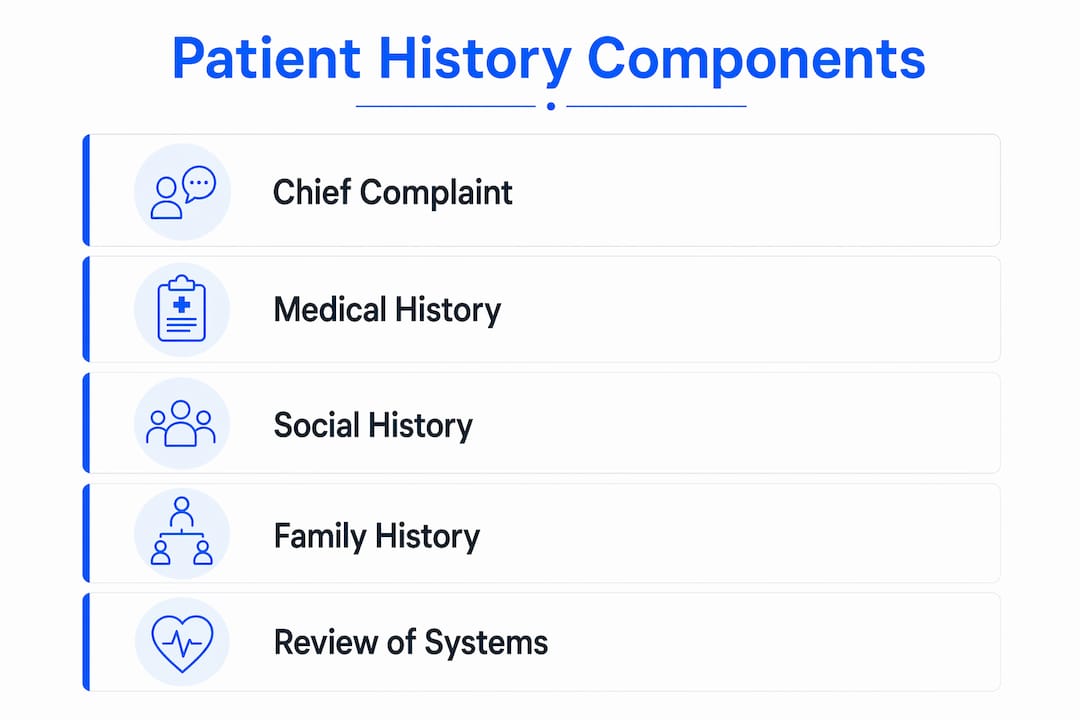
A standardized medical history covers six core components, each serving a distinct clinical function. Experienced clinicians often adapt the structure to the visit type, but the framework itself keeps critical data from falling through the cracks.
The components of a comprehensive history intake are:
- Chief Complaint (CC): The patient’s primary reason for the visit, stated in their own words
- History of Present Illness (HPI): A detailed account of the current problem, including onset, duration, character, severity, and modifying factors
- Past Medical History (PMH): Diagnosed conditions, prior hospitalizations, surgeries, and relevant procedures
- Medications and allergies: Current prescriptions, over-the-counter drugs, supplements, and documented adverse reactions
- Family History (FH): Conditions in biological relatives that signal hereditary risk
- Social History (SH): Occupation, housing, substance use, sexual history, and social support
- Review of Systems (ROS): A systematic survey of symptoms across organ systems to catch issues the patient did not volunteer
- Travel history: Recent international or domestic travel that may affect infectious disease risk and public health surveillance
The social history component deserves particular attention. Integrating social determinants of health into the clinical record, including socioeconomic status, education level, and housing stability, gives providers the context to build treatment plans patients can actually follow. A medication regimen that ignores a patient’s financial situation or work schedule is a plan that will fail.
Pro Tip: For annual wellness visits, collect all components in full. For urgent or problem-focused visits, tailor the history to the chief complaint and note what was deferred, so the next provider knows what is still outstanding.

One distinction worth keeping clear: a medical history is the patient’s narrative as gathered during the encounter. A medical record is the formal documentation that follows. Conflating the two leads to gaps in clinical reasoning and missed opportunities to build rapport.
How family history shapes risk assessment and preventive care
Family history is one of the most underused tools in primary care. Collecting it thoroughly lets you identify hereditary risk for conditions that may not yet be symptomatic, and that early signal changes everything about your screening and prevention strategy.
Primary care providers should inquire specifically about histories of myocardial infarction, cancers, psychiatric disorders, and neurological conditions in biological parents, siblings, and grandparents. The CDC’s family health history resources reinforce that this information enables clinicians to identify hereditary risk for coronary artery disease, chronic obstructive pulmonary disease, diabetes, and several cancers before clinical presentation.
Key uses of family history in primary care:
- Triggers earlier or more frequent screening for conditions like colorectal cancer or type 2 diabetes
- Guides referrals to genetic counseling when patterns suggest hereditary syndromes
- Informs cardiovascular risk calculators that drive statin and aspirin prescribing decisions
- Shapes psychiatric evaluation when first-degree relatives have mood disorders or psychosis
- Supports public health surveillance by flagging familial clusters of reportable conditions
The depth of inquiry matters. A single question about “family health problems” rarely surfaces what you need. Ask about specific conditions, the age of onset in affected relatives, and whether relatives are living or deceased. A father who had a heart attack at 45 carries very different clinical weight than one who had a heart attack at 75.
Family history also changes over time. Patients learn new information about relatives, and conditions that were absent at age 30 may be present by age 50. Updating the family history at regular intervals, rather than treating it as a one-time intake item, keeps your risk assessment current.
Common obstacles in history-taking and how to address them
Accurate history collection is harder than it looks. Common challenges include patient recall errors, language and literacy barriers, health anxiety that distorts symptom reporting, and the time pressure of a packed schedule. Each one creates a real risk of missed or incomplete data.
Best practices for history-taking in primary care:
- Prioritize open-ended questions first. Let the patient describe the problem before you narrow with closed questions. Interrupting too early is one of the most documented sources of missed diagnoses.
- Use interpreters, not family members, for language barriers. Family members filter and editorialize; professional interpreters translate accurately and preserve confidentiality.
- Verify medications at every visit. Patients frequently omit supplements, over-the-counter drugs, and medications prescribed by other providers. A brown-bag medication review catches what the chart misses.
- Acknowledge what the patient cannot remember. Gaps in recall are clinical data too. Document what was asked and what was unknown, rather than leaving fields blank.
- Adapt the structure to the patient, not the template. A rigid checklist approach can shut down the narrative. The goal is a complete picture, not a completed form.
AI-assisted diagnostic tools are increasingly present in primary care workflows, but their accuracy depends entirely on the quality of the history they receive. Incomplete or inaccurate histories produce unreliable outputs. Technology supplements clinical judgment; it does not replace the skill of eliciting a good history.
Legal and ethical obligations add another layer. Completeness, accuracy, and patient confidentiality are not optional in history documentation. An incomplete record creates liability exposure and, more immediately, puts the next provider in the chain at a disadvantage. Document what you asked, what the patient reported, and what remains uncertain.
A primary care visit structured around these principles produces a history that holds up clinically and legally.
How the interprofessional team contributes to history collection
No single provider collects every component of a patient’s history, and that is by design. History-taking in primary care is a collaborative, interprofessional process, with different team members best positioned to gather different types of information.
Interprofessional contributions to history collection:
- Medical assistants and nurses typically collect vital signs, chief complaint, current medications, and allergies at triage, before the physician enters the room
- Physicians and nurse practitioners conduct the HPI, review of systems, and family history in depth, integrating findings into a diagnostic assessment
- Pharmacists reconcile medication lists, identify drug interactions, and clarify adherence patterns that patients may not disclose to their physician
- Behavioral health specialists gather psychiatric and substance use history with the depth and sensitivity those topics require
- Social workers assess social determinants of health, housing, food security, and support systems that clinical staff rarely have time to explore fully
Coordinated communication among team members prevents two problems: redundant questioning that frustrates patients, and critical gaps where each provider assumes someone else collected a key piece of data. Clear role delineation, supported by standardized hand-off protocols, keeps both problems in check.
Patient comfort during history collection directly affects data quality. Patients who feel rushed, judged, or confused provide less complete histories. Training all team members in patient-centered communication, not just physicians, raises the quality of the entire record. The role of the primary care physician includes setting that standard for the whole team.
What the evidence says about structured history-taking and diagnostic efficiency
The medical history is not just a clinical ritual. Research published in PMC frames it explicitly as a diagnostic technology with measurable performance characteristics, comparable to imaging or laboratory testing in its ability to shift disease probability.
Research finding: A comprehensive medical history contributes to accurate diagnosis in 74–80% of cases, often before a single test is ordered.
Structured history-taking reduces diagnostic uncertainty, limits unnecessary testing, and decreases false positives, particularly in low-prevalence settings where over-investigation is a persistent problem. The mechanism is probabilistic: each element of the history updates the pre-test probability of a diagnosis, and a well-constructed history can push that probability high enough that further testing adds little.
Likelihood ratios for specific history elements make this concrete. A patient presenting with new-onset unilateral headache and nausea in a primary care setting already has a post-history probability of migraine exceeding 80% before any imaging is considered. Ordering an MRI in that scenario does not improve diagnostic accuracy; it adds cost and radiation exposure.
History clusters are even more powerful. Combinations of age, sex, symptom pattern, and associated features can generate posterior probabilities that meaningfully change clinical decisions. Clinicians who apply likelihood ratios to history elements create more efficient diagnostic pathways and reduce unnecessary resource use.
Pro Tip: When you find yourself reaching for a test to “confirm” something the history already strongly suggests, pause and calculate the post-history probability explicitly. If it is already in the 74–80% range, ask whether the test result would actually change your management.
Despite this evidence, history-taking receives less formal training time in many medical curricula than procedural or imaging skills. That gap shows up clinically: a study of 134 experienced primary care physicians found that important history components are frequently omitted during patient interactions, even among seasoned practitioners. Structured formats with built-in flexibility, combined with regular peer review of documentation quality, address that drift. Telehealth settings add another variable: virtual encounters require deliberate adaptation of history-taking technique to compensate for the absence of physical presence and nonverbal cues.
Key Takeaways
Medical history drives accurate diagnosis in primary care more reliably than any single test, contributing to correct diagnoses in 74–80% of cases when collected with structure and clinical intent.
| Point | Details |
|---|---|
| Diagnostic contribution | A comprehensive history contributes to accurate diagnosis in 74–80% of cases, before physical exam or testing. |
| Structured components | Chief Complaint, HPI, PMH, medications, family history, social history, ROS, and travel history each serve a distinct clinical function. |
| Family history updates | Treat family history as a living document; update it at regular intervals, not just at initial intake. |
| Interprofessional collection | Nurses, pharmacists, social workers, and physicians each gather different history components; clear role delineation prevents gaps. |
| History as diagnostic technology | Likelihood ratios applied to history clusters can push disease probability above 80%, making further testing unnecessary in many cases. |
See a licensed provider who takes your history seriously
Klarity connects patients with 2,000+ licensed primary care providers who conduct thorough, structured history assessments from the first visit. Same-day appointments are available, with self-pay options starting at $49 and major insurance accepted.
Whether you are managing a chronic condition or addressing a new concern, the quality of your care starts with the quality of your history. Klarity’s network of 2,000+ licensed providers can help with online prescriptions, anxiety care, and other telehealth services. Coverage varies by plan; verify your benefits before booking.
Related telehealth care options
- Online doctor prescriptions
- Online anxiety treatment
- Online ADHD treatment
- Online depression treatment
- Online weight loss treatment
- Browse all conditions
Recommended
- What Does A Primary Care Visit Include?
- Common Primary Care Conditions Treated Online: 2026 Guide
- Why Primary Care Is Your First Line Of Defense
- The Role Of Primary Care Physician In Health
Get expert care from top-rated providers
Find the right provider for your needs — select your state to find expert care near you.
Related posts






— Monday to Friday, 7:00 AM to 4:00 PM PST
Join our mailing list for exclusive healthcare updates and tips.

— Monday to Friday, 7:00 AM to 4:00 PM PST



