 HSA & FSA accepted; best-value for top quality care
 Same-day mental health, weight loss, and primary care appointments available

 Accept major insurances and cash-payHSA & FSA accepted; best-value for top quality careSame-day mental health, weight loss, and primary care appointments availableAccept major insurances and cash-pay
Best Talkiatry.com Alternatives for Online Psychiatry in 2026
Written by Klarity Editorial Team
Published: Jul 20, 2026

Last updated: August 8, 2026
If Talkiatry doesn’t work for your insurance or your timeline, you have real options. Brightside Health, Circle Medical, Talkspace, Teladoc, Cerebral, and Grow Therapy each take a meaningfully different approach to online psychiatry, and the right one depends on whether you need board-certified psychiatrist depth, fast access, subscription pricing, or integrated therapy.
Looking for online psychiatry with licensed providers? Klarity Health connects you with care for ADHD, anxiety, depression, and OCD. Browse conditions and check if you may qualify →
Here’s how the main alternatives stack up at a glance:
| Platform | Best For | Insurance | Pricing Model | Access Speed | Therapy + Meds |
|---|---|---|---|---|---|
| Talkiatry | Complex cases with insurance | Strong (Aetna, BCBS, Cigna, UHC, Medicare) | Copay-based ($20–$80/session) | 1–2 weeks | Meds primary; therapy for existing patients |
| Brightside Health | Uninsured or cash-pay patients | Most major plans | $95–$349/month | Moderate | Both, tiered |
| Circle Medical | Fast medication access | Insurance or cash-pay | Per-visit, varies | Same/next day | Meds; therapy referrals only |
| Talkspace | Combined therapy and psychiatry | Multiple major plans | Monthly subscription | Moderate | Both, integrated |
| Teladoc | Broad telehealth with mental health | Broad coverage | Per-visit or subscription | Fast | Both available |
| Cerebral | Affordable subscription care | Limited acceptance | $85–$200/month | Within 1 week | Both, care-team model |
| Grow Therapy | Therapist choice with med referrals | Insurance-focused | Per-session, varies | Varies | Therapy primary; med referrals |
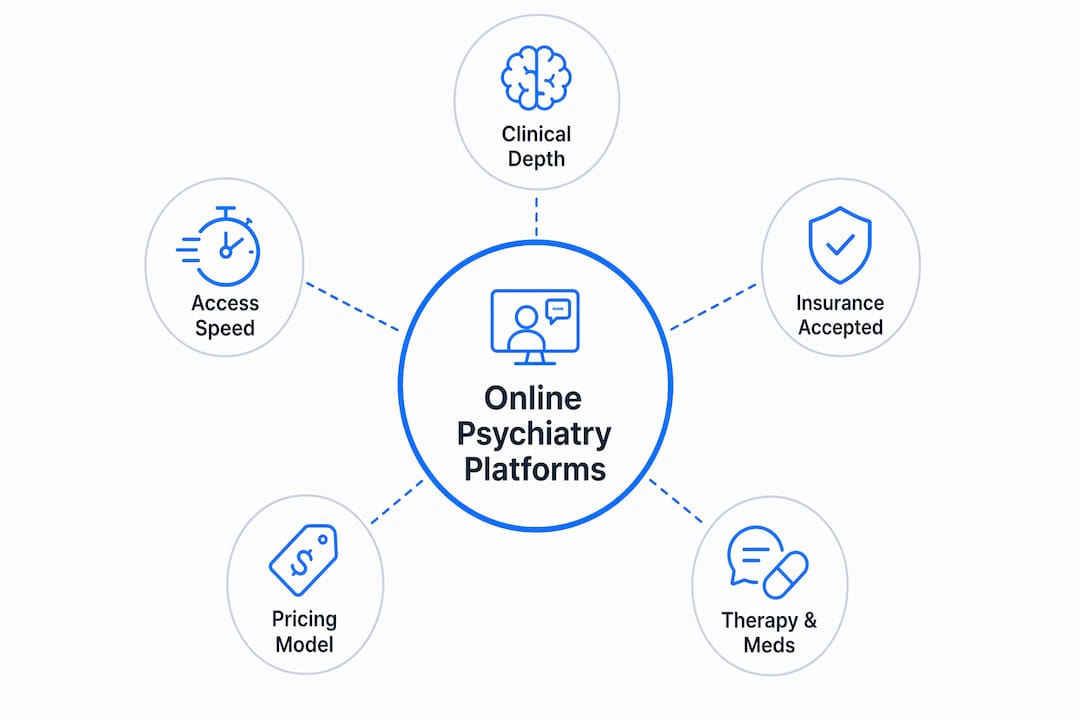
A few things stand out immediately. Circle Medical is the fastest route to a prescription if you need one this week. Cerebral and Brightside Health both offer subscription pricing that makes costs predictable without insurance. Talkspace is the strongest option if you want therapy and medication management under one roof on a single monthly plan. Grow Therapy suits patients who want to choose their own therapist and don’t need direct medication management from the platform itself.

Pro Tip: Before comparing platforms, confirm whether your specific insurance plan is accepted in your state. Coverage varies by region even within the same insurer network.
What does Talkiatry actually offer, and where does it fall short?
Talkiatry built its reputation on one clear commitment: every provider on the platform is a board-certified psychiatrist, not a nurse practitioner or physician assistant. That matters for patients with complex diagnoses like bipolar disorder, treatment-resistant depression, OCD, or ADHD requiring stimulant evaluation. The clinical bar is genuinely higher than most competitors.

On the insurance side, Talkiatry accepts Aetna, BCBS, Cigna, UHC, Humana, and Medicare, making it one of the more accessible platforms for insured patients. In-network copays typically run $20–$80 per session, comparable to seeing a psychiatrist in person. For patients without in-network coverage, out-of-pocket costs climb to roughly $299 for an initial evaluation and $175 for follow-ups.
The platform’s limitations are real, though. Therapy is only available to existing Talkiatry patients who are already receiving medication management through the platform. You can’t join Talkiatry for therapy alone. Wait times for new patients can stretch 1–2 weeks, which is a problem if you need care urgently. And if you’re uninsured, the per-session pricing puts it out of reach for many people.
Here’s what patients consistently praise and flag in reviews:
- Strengths: Psychiatrist-only care model, broad insurance acceptance, integrated medication management, available in all 50 states
- Weaknesses: Therapy restricted to existing patients, higher costs without insurance, wait times for new appointments, no subscription pricing option
“Talkiatry is a psychiatry-first platform that employs board-certified psychiatrists who provide integrated psychiatric evaluation, medication management, and — importantly — therapy. The model emphasizes clinical depth and traditional psychiatric standards delivered via telehealth.” — Simply Psychology, 2026
For a deeper look at how Talkiatry compares from a provider perspective, Helloklarity’s Talkiatry review covers the clinical model in detail.
How do Talkiatry alternatives compare on pricing, access, and clinical depth?
The clearest dividing line among these platforms is the clinical model. Talkiatry employs its psychiatrists directly, which supports consistent clinical oversight and care continuity. Most competitors either use a marketplace model or a care-team approach that mixes psychiatrists, nurse practitioners, and therapists.
Brightside Health
Brightside Health is the strongest alternative for patients who need insurance coverage but want a cash-pay fallback. Its tiered subscription runs from $95/month for medication management up to $349/month for weekly therapy plus medication. After at least 90 days with a prescriber, a maintenance-only plan can drop to $45/month. Brightside also accepts most major insurance plans, so insured patients aren’t forced into the subscription model.
The platform treats depression, anxiety, and related mood disorders. It’s not the right fit for complex ADHD cases requiring stimulant prescriptions or for patients with severe psychiatric presentations.
Circle Medical
Speed is Circle Medical’s defining feature. The platform typically offers same-day or next-day appointments with medical doctors for psychiatric medication management, accepting both insurance and cash-pay. If you need a prescription quickly and can’t wait two weeks for a Talkiatry slot, Circle Medical is the practical answer.
One important caveat: controlled substances like stimulants for ADHD and benzodiazepines for anxiety may not be available depending on your provider. Therapy isn’t offered directly; doctors can refer patients elsewhere for that.
Talkspace
Talkspace takes a different approach by combining talk therapy and medication management under a single monthly subscription, accepted by multiple major insurance plans. It’s the platform to consider when you want both services without managing two separate providers. The subscription model means predictable monthly costs rather than per-session billing.
For a direct comparison of Helloklarity and Talkspace on mental health services, this breakdown covers the key differences.
Teladoc
Teladoc operates as a broad telehealth platform with mental health as one of many specialties. Its strength is availability and scale. Patients who already use Teladoc for primary care or urgent care can add mental health services without switching platforms. Coverage is wide, and the platform handles both therapy and medication management. It’s less specialized than Talkiatry but more convenient for patients who want everything in one place.
Cerebral
Cerebral’s subscription model starts at approximately $85–$100/month for medication management and $160–$200/month for combined therapy and medication. The platform uses a care-team model with prescribers (both psychiatrists and nurse practitioners), therapists, and care counselors who provide between-appointment support. That last piece is genuinely useful for patients who need more touchpoints than a monthly check-in.
Cerebral faced significant federal scrutiny in 2022 related to controlled substance prescribing, particularly stimulants. As of 2026, the platform has substantially rebuilt its clinical protocols, but stimulant prescribing for ADHD remains very limited. Patients who need that specific treatment should look elsewhere.
For more on how Cerebral’s model works from a clinical standpoint, Helloklarity’s Cerebral review covers the prescriber experience in depth.
Grow Therapy
Grow Therapy operates as a marketplace connecting patients to therapists who accept insurance. Medication management isn’t offered directly; instead, the platform can refer patients to prescribers. It’s best suited to patients whose primary need is therapy and who want to choose from a broad network of providers rather than being matched by an algorithm. The insurance-first model keeps costs manageable for insured patients.
Key practical differences across all six platforms:
- Fastest access: Circle Medical (same/next-day), Cerebral (within 1 week)
- Strongest insurance coverage: Talkiatry, Brightside Health, Talkspace
- Most affordable without insurance: Cerebral ($85/month starting), Brightside Health ($95/month)
- Integrated therapy and meds: Talkspace, Cerebral, Brightside Health
- Highest clinical credentials: Talkiatry (board-certified psychiatrists only)
- Broadest therapist choice: Grow Therapy
What do user reviews say about these platforms?
Patient experiences across these platforms reveal consistent patterns. Talkiatry earns strong marks for clinician quality and insurance integration, with patients frequently citing the professionalism of their psychiatrists. The recurring complaint is wait time, particularly for new patients in high-demand states.
Brightside Health users generally report positive experiences with the subscription model’s predictability. The ability to start with medication management and add therapy later resonates with patients who aren’t sure what level of care they need upfront.
Circle Medical’s reviews highlight the speed of access as the standout feature. Patients who needed a prescription quickly and couldn’t get a timely appointment elsewhere consistently mention same-day availability as the deciding factor. The limitation around controlled substances does generate some frustration in reviews, particularly from patients seeking ADHD stimulant treatment.
Talkspace reviews are mixed. The platform’s breadth is praised, but some patients report inconsistency in therapist quality across the marketplace. The subscription model is generally seen as fair value when insurance covers part of the cost.
Cerebral’s review picture is complicated by its 2022 regulatory history. Patients who joined after the platform’s clinical rebuild tend to report more positive experiences, particularly around the care counselor model. Patients who were affected by the earlier prescribing changes are more critical.
Grow Therapy reviews emphasize the value of therapist choice. Patients who had struggled to find a therapist accepting their insurance elsewhere frequently cite Grow Therapy as the solution. Medication management limitations are the most common complaint.
A note on review aggregators: Trustpilot and BBB ratings for telehealth platforms tend to skew toward patients with strong negative experiences, since satisfied patients rarely seek out review sites. Cross-referencing multiple sources gives a more accurate picture than any single rating.
How do you choose the right online psychiatry platform?
The right platform depends on four factors that interact with each other: your insurance situation, the complexity of your condition, how quickly you need care, and whether you want therapy and medication management in one place.
Start with insurance. If you have commercial insurance, check whether Talkiatry, Brightside Health, or Talkspace are in-network before anything else. In-network care at Talkiatry costs $20–$80 per session, which is hard to beat for board-certified psychiatrist access. If you’re uninsured or your plan isn’t accepted, Cerebral’s subscription model or Brightside Health’s cash-pay tiers become the practical options.
Match the platform to your condition. Complex diagnoses like bipolar disorder, treatment-resistant depression, or ADHD requiring stimulant evaluation genuinely benefit from board-certified psychiatrist oversight. Platforms that mix nurse practitioners and psychiatrists handle common anxiety and depression moderately well, but the credential gap matters for harder cases. Talkiatry is the clearest choice for clinical depth. For straightforward depression or anxiety, Cerebral or Brightside Health deliver comparable outcomes at lower cost.
Factor in access speed. If you need care within days, Circle Medical is the most direct path. If a one-to-two-week wait is acceptable, Talkiatry or Brightside Health are worth the wait for the clinical quality.
Decide on therapy integration. Talkspace and Cerebral both offer therapy and medication management on one platform. Talkiatry offers therapy only to existing patients. Circle Medical and Grow Therapy require going elsewhere for therapy. If managing two separate providers feels like too much friction, Talkspace or Cerebral simplify the experience.
Pro Tip: Use each platform’s insurance verification tool before booking. Coverage varies by state and by specific plan, even within the same insurer. A five-minute check prevents a surprise bill.
Additional criteria worth evaluating:
- Provider credentials: Confirm whether your prescriber will be a psychiatrist, nurse practitioner, or physician assistant. For complex cases, the distinction matters clinically.
- Cancellation and rescheduling policies: Most platforms allow rescheduling with 24 hours’ notice, but policies vary. Cerebral’s subscription model means you’re paying monthly regardless of appointment frequency.
- Customer support: Talkiatry and Talkspace have dedicated support teams. Smaller platforms may rely on email-only support, which can be frustrating when you need a quick answer about your prescription.
- App and video quality: All major platforms offer mobile apps with video sessions. Talkspace’s messaging therapy feature is unique and useful for patients who prefer asynchronous communication.
- Privacy and security: All platforms listed here are HIPAA-compliant. Verify that your data isn’t used for advertising purposes, which is a separate question from HIPAA compliance.
What are the real clinical trade-offs between these care models?
The most important distinction in online psychiatry isn’t price. It’s the difference between what industry experts call “practice-first” models and “care-team” models, and understanding that difference changes how you evaluate every platform on this list.
Practice-first models, like Talkiatry’s, employ board-certified psychiatrists directly. The psychiatrist is your primary provider, responsible for evaluation, diagnosis, medication management, and clinical continuity. This mirrors how traditional psychiatric care works. The trade-off is cost and access speed: employed psychiatrists are expensive, and scheduling takes longer.
Care-team models, like Cerebral’s, distribute care across a team. A prescriber handles medication, a therapist handles behavioral work, and a care counselor handles between-session support. The model offers more touchpoints and lower cost, but clinical continuity depends on how well the team coordinates. When coordination is good, patients benefit from more frequent contact. When it isn’t, patients can feel like they’re starting over with each team member.
A third model, the marketplace approach used by Grow Therapy, connects patients to independent providers. Clinical quality varies by individual provider rather than by platform standards. The upside is choice; the downside is inconsistency.
AI-augmented care tools like Wysa are increasingly used between sessions to improve patient engagement and reduce drop-off. These tools don’t replace clinical care, but they do address one of the biggest problems in mental health treatment: the gap between appointments. Platforms that integrate between-session support, whether through AI tools or care counselors, tend to see better adherence.
Key trade-offs to weigh:
- Clinical depth vs. access speed: Board-certified psychiatrist models take longer to access but offer higher clinical standards for complex cases.
- Subscription vs. per-session billing: Subscriptions create predictable costs but mean ongoing fees even during stable periods. Per-session billing suits patients with infrequent needs.
- Integrated vs. separate providers: Single-platform therapy and medication management reduces friction but may limit your choice of therapist or prescriber.
- Employed vs. marketplace providers: Employed providers offer more consistent platform standards; marketplace providers offer more individual choice.
For patients with straightforward depression or anxiety, the care-team and subscription models deliver accessible quality care at lower cost. For complex presentations, the clinical depth of a practice-first model is worth the extra wait and, if necessary, the higher cost.
Key Takeaways
Choosing the right online psychiatry platform in 2026 comes down to three things: your insurance coverage, the complexity of your condition, and how quickly you need care.
| Point | Details |
|---|---|
| Insurance drives the first cut | Talkiatry, Brightside Health, and Talkspace offer the strongest in-network coverage; uninsured patients should start with Cerebral or Brightside Health’s cash-pay tiers. |
| Clinical model matches condition complexity | Board-certified psychiatrist platforms like Talkiatry suit complex cases; care-team models handle common anxiety and depression effectively at lower cost. |
| Access speed varies widely | Circle Medical offers same/next-day appointments; Talkiatry typically takes 1–2 weeks for new patients. |
| Subscription vs. per-session billing | Cerebral ($85–$200/month) and Brightside Health ($95–$349/month) offer predictable subscription pricing; Talkiatry bills per session through insurance. |
| Helloklarity for same-day access | Helloklarity connects patients to licensed providers within 24 hours, with self-pay options starting at $49 and major insurance accepted. |
What I actually think about choosing an online psychiatry platform
The conventional advice in this space is to “find what works for you,” which sounds reasonable and says nothing. Here’s a more useful frame: most people choosing between these platforms are making a decision under uncertainty, and the biggest mistake is optimizing for the wrong variable.
Patients often fixate on price first. That’s understandable, but it leads to a predictable outcome: you sign up for the cheapest option, discover it doesn’t prescribe the medication you need or doesn’t accept your insurance after all, and start over. The two questions that actually narrow the field are whether your specific insurance plan is accepted and whether your condition requires a board-certified psychiatrist or whether a nurse practitioner can manage it competently.
For most people with common anxiety or depression, a care-team model at Cerebral or Brightside Health is genuinely adequate and meaningfully cheaper. The clinical outcome difference between a psychiatrist and a skilled nurse practitioner for uncomplicated cases is smaller than the marketing around “board-certified psychiatrists only” suggests. Where the credential gap becomes clinically significant is in complex cases: treatment-resistant depression, bipolar disorder, ADHD with comorbidities, or any presentation that hasn’t responded to first-line treatments.
The other underrated factor is what happens between appointments. A platform that offers care counselor support or AI-assisted check-ins between sessions keeps patients engaged in a way that monthly appointments alone don’t. Cerebral’s care counselor model and tools like Wysa address this gap. A monthly appointment with a psychiatrist is valuable; what you do in the other 29 days matters too.
One more thing: don’t let wait times push you toward a platform that isn’t right for your condition. Two weeks at Talkiatry is worth it if you have a complex presentation. Settling for a faster but less clinically appropriate platform because you’re impatient is a trade-off that often costs more time in the long run.
Helloklarity: same-day mental health care with insurance
If the platforms above feel like a long wait or a complicated intake process, Helloklarity offers a different entry point. Patients can book a telehealth appointment and see a licensed provider within 24 hours, with self-pay options starting at $49 and major insurance and HSA payments accepted.
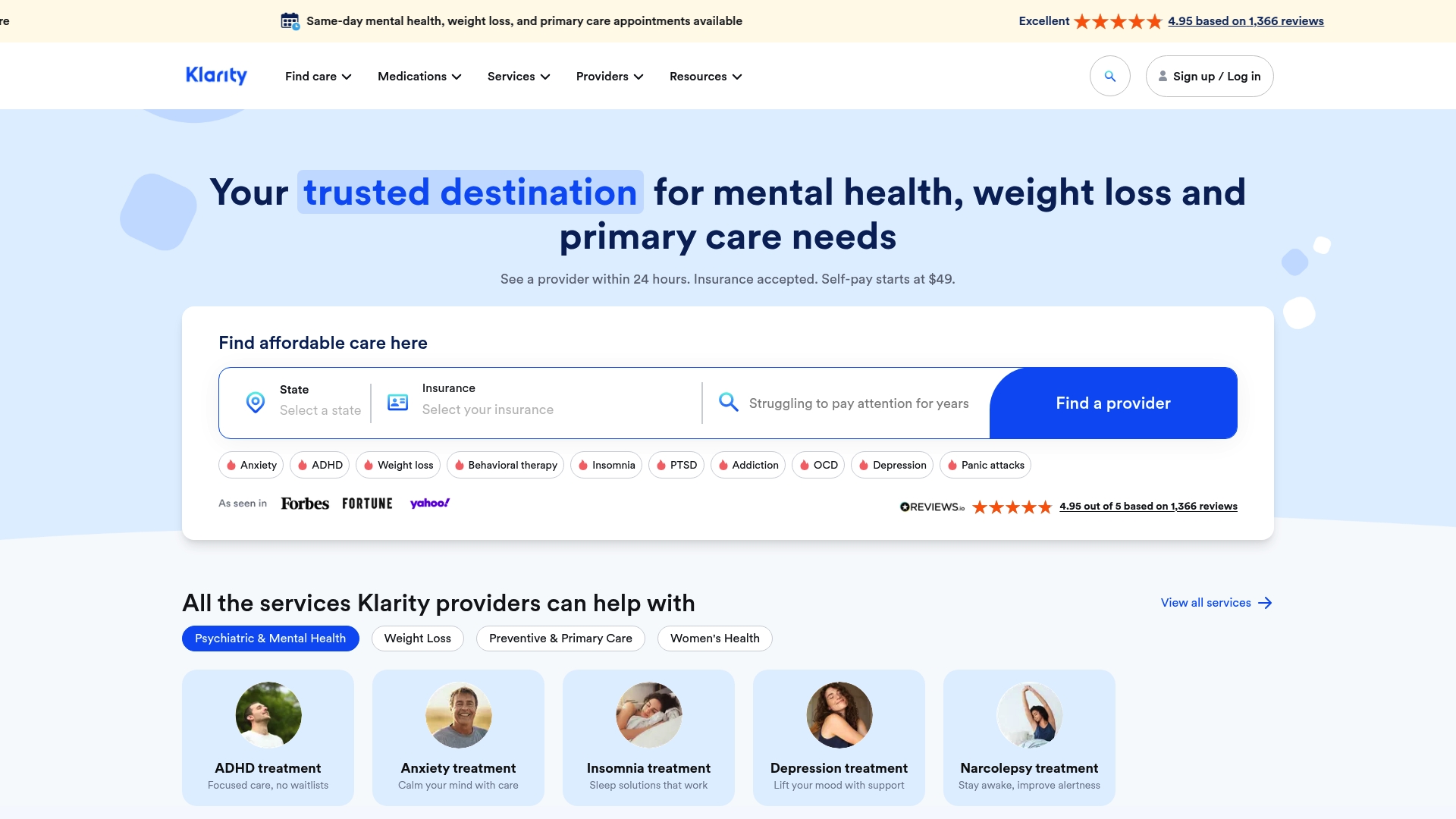
Klarity Health’s network includes 2,000+ licensed providers treating anxiety, ADHD, depression, and related conditions. The platform is built for people who need care quickly and don’t want to navigate a multi-week intake process. You can browse providers by condition or find licensed telehealth providers in your state through the platform’s directory. For patients who’ve spent weeks on a waitlist elsewhere, the 24-hour access model is a concrete difference, not a marketing claim.
Related care: Online ADHD treatment · Online anxiety treatment · Online depression treatment · Online OCD treatment · Browse all conditions
Next step: See if you may qualify for online mental health care →
Recommended
- Is Talkiatry Worth It For Psychiatrists? | Klarity Health, Inc
- Is Talkiatry Worth It For Prescribers? | Klarity Health, Inc
- Is Psychology Today Worth It For Psychiatrists? | Klarity Health, Inc
- Top 5 AdditudeMag.com Alternatives 2026
Get expert care from top-rated providers
Find the right provider for your needs — select your state to find expert care near you.
Related posts






— Monday to Friday, 7:00 AM to 4:00 PM PST
Join our mailing list for exclusive healthcare updates and tips.

— Monday to Friday, 7:00 AM to 4:00 PM PST



