 HSA & FSA accepted; best-value for top quality care
 Same-day mental health, weight loss, and primary care appointments available

 Accept major insurances and cash-payHSA & FSA accepted; best-value for top quality careSame-day mental health, weight loss, and primary care appointments availableAccept major insurances and cash-pay
Same-Day Mental Health Care: What You Need to Know
Written by Klarity Editorial Team
Published: Jun 15, 2026

Same-day mental health care is defined as urgent outpatient assessment, crisis support, or treatment delivered on the day a person seeks help, bypassing the weeks-long waitlists that define traditional psychiatry. This model includes behavioral health urgent care clinics, the 988 Suicide & Crisis Lifeline, hospital-linked EmPATH units, and telehealth platforms that connect patients to licensed providers within hours. If you are searching for what is same day mental health care because you or someone you love needs help right now, this guide explains every pathway available to you in the U.S. in 2026, what to expect at each one, and how to get the most out of your first contact.
What is same-day mental health care?
Same-day mental health care is the industry’s informal term for what clinicians call urgent behavioral health services. It covers any structured mental health support that begins within the same calendar day you request it. That includes crisis stabilization, urgent psychiatric evaluation, same-day counseling sessions, and rapid medication assessments. The defining feature is speed. Traditional outpatient psychiatry in the U.S. carries average wait times of several weeks to months. Same-day services cut that to hours.
The model exists because mental health crises do not schedule themselves. Suicidal ideation, a panic attack that will not stop, or a psychotic episode requires the same urgency as a broken bone. Urgent mental health services are designed to meet that urgency with structured clinical responses rather than a referral to call back in six weeks.

What are the main types of same-day mental health services?
The U.S. currently offers five primary pathways for immediate mental health services. Each one serves a different level of acuity and setting.
988 Suicide & Crisis Lifeline. The 988 Lifeline provides 24/7 access to trained crisis counselors via call, text, or chat. It operates without judgment, does not automatically involve law enforcement, and connects callers to follow-up resources after stabilization. It is the fastest entry point for anyone in acute distress.
Behavioral Health Urgent Care Clinics (BHUCCs). These walk-in clinics function exactly like a physical urgent care center, but for mental health. Nurse triage and same-day clinician evaluation are standard. They do not replace long-term therapy but provide immediate assessment and short-term stabilization, then connect you to the right ongoing care.
EmPATH Units. Emergency Psychiatric Assessment, Treatment, and Healing units are attached to some hospital ERs. EmPATH units offer a calmer alternative to a chaotic general ER waiting room, with specialized psychiatric staff who evaluate, stabilize, and arrange follow-up care. They also reduce ER congestion for non-psychiatric emergencies.
Mobile Crisis Teams. These are community-based teams that come to you. Mobile crisis outreach teams conduct in-person urgent assessments at home, school, or work, reducing unnecessary ER visits and law enforcement contact. They coordinate directly with the 988 Lifeline and can arrange transfers to higher levels of care.
Same-Day Telehealth Appointments. Licensed therapists and psychiatrists available through telehealth platforms can conduct urgent evaluations and initiate treatment the same day. This pathway works well for individuals who are not in immediate physical danger but need quick mental health support for conditions like anxiety, ADHD, or depression.
Pro Tip: If you are unsure whether your distress “qualifies” for urgent care, call or text 988 anyway. The SAMHSA 988 line is specifically designed to help people who are not sure if what they are experiencing rises to a clinical threshold.
How does same-day care improve mental health outcomes?
The evidence for rapid access mental health care is strong and growing. Same-day access to integrated mental health services correlates with better diagnosis rates, faster treatment engagement, and reduced crisis escalation. Getting someone into care the day they ask for it changes the trajectory of their episode.
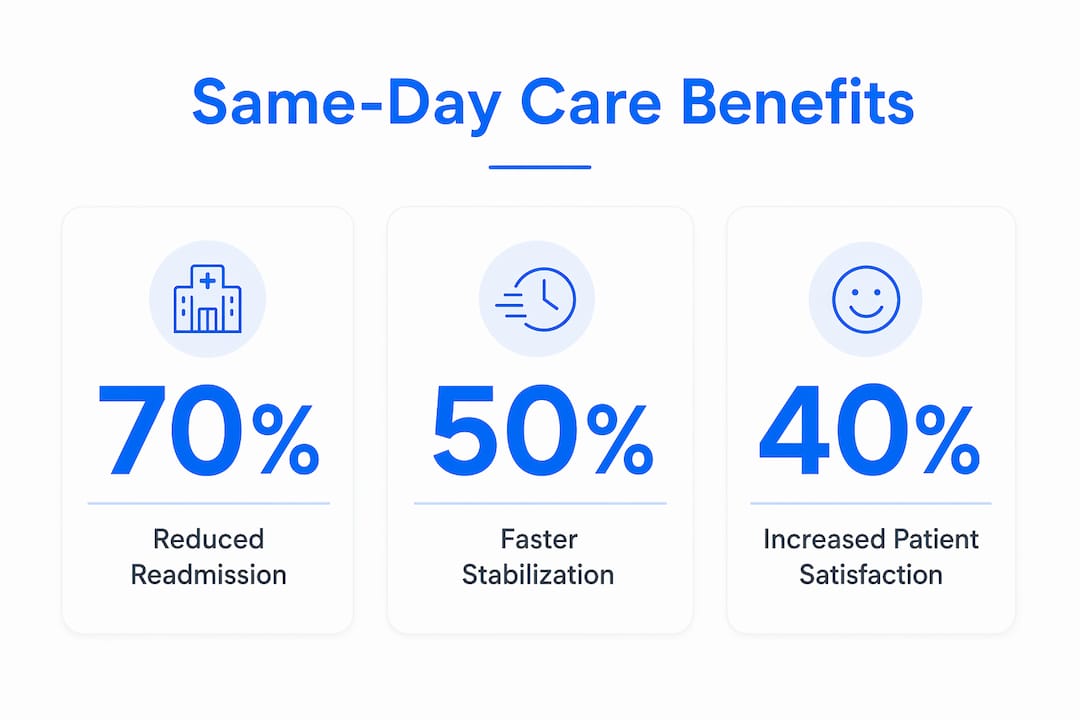
The Ohio State University Behavioral Health Urgent Care program offers one of the clearest examples. Ohio State’s BHUC saw 70% of recently discharged psychiatric inpatients in person within one week of hospital discharge. That rapid follow-up directly reduces suicide risk in the highest-danger window after hospitalization.
Nova Scotia’s Rapid Access and Stabilization Program (RASP) provides another data point. The RASP reduced psychiatric consultation wait times to under 30 days median by staffing psychiatrists to assess patients multiple days per week. That is not same-day care, but it demonstrates what happens when systems prioritize speed: outcomes improve measurably.
“Behavioral urgent care functions like physical urgent care, triaging urgent needs and providing immediate help or referral, not replacing long-term treatment.” — Ohio State BHUC Program Overview
The table below summarizes what the research shows across different same-day care models.
| Care Model | Key Outcome | Evidence Source |
|---|---|---|
| Behavioral Health Urgent Care | 70% post-discharge follow-up within one week | Ohio State BHUC Program |
| 988 Lifeline | 24/7 crisis de-escalation without law enforcement | SAMHSA |
| RASP (Nova Scotia) | Psychiatric wait times under 30 days median | Frontiers in Psychiatry, 2025 |
| Same-Day Telehealth | Faster treatment engagement vs. delayed access | Springer/JGIM, 2025 |
What should you expect when seeking same-day care?
Knowing what happens when you walk in or call removes a major barrier to seeking help. The process varies by setting, but most same-day urgent mental health services follow a predictable structure.
Initial triage. At a BHUC, a nurse or intake clinician assesses your urgency level first. They ask about safety, current symptoms, and recent history. This takes 10–20 minutes and determines your care path.
Immediate evaluation or brief wait. If you are acutely at risk, you see a clinician right away. If your situation is urgent but stable, you may wait 30–90 minutes. Same-day care often includes variable steps based on clinical prioritization and clinic capacity on that day.
Brief treatment or stabilization. The clinician may provide a short counseling session, adjust or initiate medication, or simply help you build a safety plan. This is not the start of weekly therapy. It is stabilization.
Referral and bridging care. Bridging care extends follow-up for weeks or months after the initial urgent visit. This is the step that transitions you from crisis stabilization to sustained mental health care. Ask your provider directly about what comes next before you leave.
Documentation and coordination. If you have an existing provider, the urgent care team will typically send records or make a warm handoff call to maintain continuity.
Pro Tip: Before your visit or call, write down three things: your most pressing symptom, how long it has been happening, and any medications you currently take. This shortens triage time and helps the clinician make faster, better decisions for you.
If you are navigating this for a loved one, understanding when explosive anger or emotional dysregulation crosses into crisis territory can help you decide which pathway to use.
How do telehealth platforms fit into same-day mental health care?
Telehealth has become a primary delivery channel for urgent mental health support, particularly for people who are not in immediate physical danger but need same-day counseling or psychiatric evaluation. The advantages are real and specific.
- No geographic barrier. Rural patients, people without transportation, and those with social anxiety can access a licensed provider from home.
- Faster scheduling. Many telehealth platforms offer same-day or next-day appointments for conditions like anxiety, depression, and ADHD, where in-person clinics may have limited slots.
- Prescription capability. Telehealth psychiatrists can evaluate and prescribe medications during an initial visit in most states, making it a genuine starting point for treatment, not just a referral service. Learn more about telehealth psychiatric prescribing and what is possible in a first appointment.
The challenge telehealth faces is care coordination. Effective same-day telehealth care requires workflow adaptations to enable warm handoffs and ongoing coordination after the initial rapid access visit. A telehealth platform that books you quickly but has no system for follow-up is only solving half the problem. When evaluating a telehealth provider for urgent psychiatric care, ask specifically how they handle care transitions and follow-up scheduling.
Telehealth also works best as part of a broader care plan. If your situation requires in-person stabilization, a telehealth provider should be able to direct you to the right local resource, including BHUCCs, EmPATH units, or the 988 Lifeline. The best platforms treat the initial visit as the beginning of a care relationship, not a one-time transaction. For a deeper look at how Americans are using telehealth for anxiety and depression, the shift toward telehealth mental health care reflects a broader change in how people access support.
Key takeaways
Same-day mental health care is the fastest, most direct path from crisis or urgent distress to clinical support, and using the right entry point determines how quickly you get the help you need.
| Point | Details |
|---|---|
| Know your entry points | Use 988, a BHUC, or a telehealth platform as your first contact for urgent mental health support. |
| Triage determines your path | Expect an initial assessment that matches your care level to the right service, not a one-size-fits-all response. |
| Same-day is stabilization, not cure | Urgent care starts treatment and creates a bridge to ongoing care, not a substitute for it. |
| Telehealth expands access | Same-day telehealth appointments remove geographic and scheduling barriers for non-crisis urgent needs. |
| Follow-up is non-negotiable | Bridging care after an urgent visit is what reduces long-term risk and prevents repeat crises. |
What i have learned about accessing same-day mental health care
People hesitate to use urgent mental health services for one consistent reason: they do not think their situation is “bad enough.” I have seen this pattern repeatedly. Someone waits three days before calling 988 because they were not sure they qualified. Someone drives past a behavioral health urgent care clinic because they thought it was only for people in full psychiatric crisis. That hesitation is the single biggest barrier to getting help quickly.
The 988 Lifeline and BHUCCs are designed for exactly that gray zone. You do not need a diagnosis. You do not need to be in immediate danger. You need to be struggling and want help today. That is the threshold.
The other thing I want you to know: same-day care is not the end of the process. It is the beginning. The follow-up appointment, the bridging care, the referral to a regular therapist or psychiatrist, those steps matter as much as the first contact. If you leave an urgent care visit without a clear next step, ask for one before you walk out the door. Continuity is what turns a crisis intervention into lasting recovery.
If you are supporting someone else through this, knowing when to seek couples therapy or other relational support can be part of the broader care picture after an acute episode.
— Guorui
Get same-day mental health support through Helloklarity
Helloklarity connects you to licensed mental health providers the same day you reach out. The platform works with over 1,000 licensed providers who specialize in anxiety, depression, ADHD, and other conditions that often go untreated because of long wait times in traditional settings.
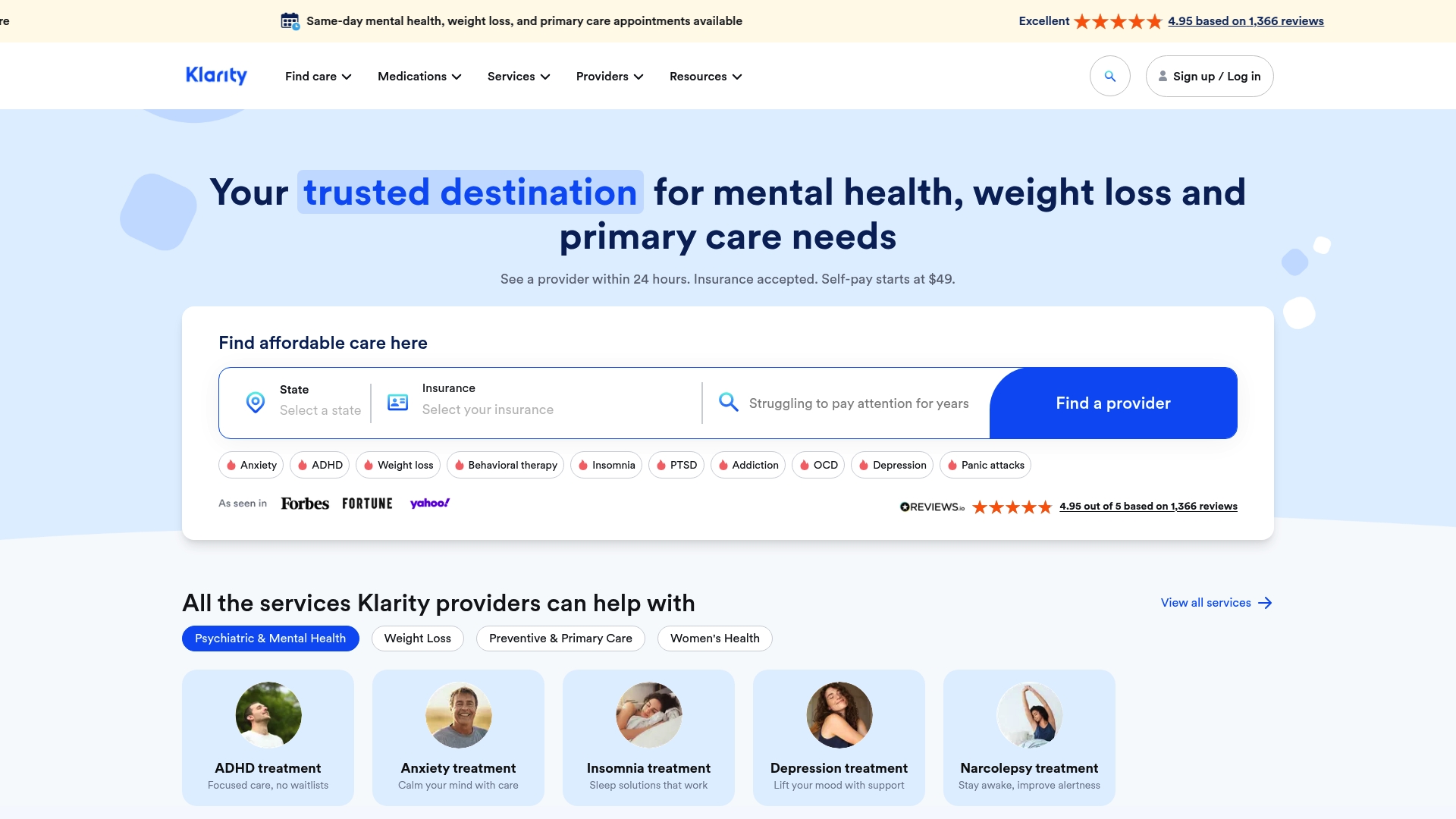
Appointments start at $49 for self-pay, and Helloklarity accepts major insurance plans and health savings accounts. You can see a provider within 24 hours, get a full evaluation, and start treatment in a single visit. Explore the full range of mental health and medical conditions treatable through the platform, or browse telehealth services available online to find the right fit for what you are dealing with right now.
FAQ
What is same-day mental health care exactly?
Same-day mental health care is urgent outpatient assessment or crisis support delivered on the day you seek help. It includes behavioral health urgent care clinics, the 988 Lifeline, EmPATH units, mobile crisis teams, and same-day telehealth appointments.
Is the 988 lifeline only for suicidal crises?
No. The 988 Lifeline supports anyone in mental health distress, including people who are unsure whether their situation qualifies as a crisis. Trained counselors provide judgment-free support and connect callers to follow-up resources.
How is a behavioral health urgent care clinic different from an ER?
A BHUC is a walk-in clinic specifically designed for mental health triage and short-term stabilization. Unlike a general ER, it has dedicated psychiatric staff, a calmer environment, and a direct referral pathway to ongoing mental health care rather than a discharge with no follow-up plan.
Can telehealth provide same-day psychiatric care?
Yes. Many telehealth platforms, including Helloklarity, offer same-day appointments with licensed psychiatrists who can evaluate symptoms and prescribe medication during the first visit. This works best for urgent but non-crisis situations involving anxiety, depression, or ADHD.
What happens after same-day urgent mental health care?
After an urgent visit, providers typically arrange bridging care, which includes follow-up appointments within days or weeks to transition you from crisis stabilization to ongoing treatment. Asking for a clear next step before leaving your first visit is the most important thing you can do.
Recommended
- Same Day Psychiatrist Appointment Explained Simply
- Same Day Therapist Appointment Online: 2026 Guide
- Same-Day Telehealth Appointment: How To See A Doctor Online Today | Klarity Health, Inc
- Mental Health Awareness Month 2026: Why More Americans Are Turning To Telehealth For Anxiety And Depression | Klarity Health, Inc
Get expert care from top-rated providers
Find the right provider for your needs — select your state to find expert care near you.
Related posts






— Monday to Friday, 7:00 AM to 4:00 PM PST
Join our mailing list for exclusive healthcare updates and tips.

— Monday to Friday, 7:00 AM to 4:00 PM PST



