 HSA & FSA accepted; best-value for top quality care
 Same-day mental health, weight loss, and primary care appointments available

 Accept major insurances and cash-payHSA & FSA accepted; best-value for top quality careSame-day mental health, weight loss, and primary care appointments availableAccept major insurances and cash-pay
Asynchronous Primary Care Messaging Explained
Written by Klarity Editorial Team
Published: May 22, 2026

Most people assume healthcare requires real-time contact. Phone calls, in-person visits, video appointments. But asynchronous primary care messaging is rewriting that assumption entirely. It lets patients send questions, images, and updates to their care team without anyone needing to be available at the same moment. Clinicians respond when they can, patients communicate when it works for them, and care keeps moving forward. For busy practitioners and patients who struggle to align schedules, understanding how this model works is genuinely worth your time.
Table of Contents
- Key takeaways
- What is asynchronous primary care messaging
- Benefits of asynchronous messaging in primary care
- Challenges and safety considerations
- Implementation and integration in practice
- Asynchronous vs synchronous: choosing the right method
- My perspective on async messaging in primary care
- Explore flexible telehealth at Helloklarity
- FAQ
Key takeaways
| Point | Details |
|---|---|
| Async messaging is not real-time | Messages are sent, stored, and reviewed later — no simultaneous availability required. |
| Safety requires clear triage rules | Urgent concerns must be escalated immediately; async is not appropriate for emergencies. |
| Encryption is non-negotiable | Secure, compliant platforms protect patient privacy and meet clinical safety standards. |
| Workflow integration drives success | Embedding async messaging into existing staff workflows determines whether it helps or overwhelms. |
| Both audiences benefit differently | Patients gain flexibility; clinicians gain documentation, reduced interruptions, and collaboration. |
What is asynchronous primary care messaging
Asynchronous primary care messaging is exactly what the name describes: communication between patients and their care team that does not require both parties to be present at the same time. A patient sends a message describing their symptoms, uploading a photo of a rash, or asking about a medication refill. Their clinician reviews it later and responds. No one is waiting on hold. No video call needs to be scheduled.
The technical term for this model is store-and-forward. The patient’s message, along with any attached images, documents, or health data, gets stored securely on a platform. The provider retrieves it when they are ready to respond. This is fundamentally different from a phone call or a video visit, where both parties must be simultaneously available.
Here is what a typical asynchronous exchange looks like in practice:
- A patient logs into a secure messaging portal and types a non-urgent question about their blood pressure readings
- They attach recent home monitoring data or a photo if relevant
- The message is stored and flagged for clinical review
- A nurse or triage staff member reviews the message first and routes it appropriately
- The clinician reviews the message, responds with guidance or a prescription update, and the patient receives a notification
The platforms that enable this are secure telehealth tools built to meet HIPAA compliance standards. They are not standard email. They use encrypted channels, role-based access controls, and audit trails to protect sensitive health information. Explicit access controls are especially important in multi-provider settings where only authorized team members should see specific message threads.
Benefits of asynchronous messaging in primary care
Asynchronous healthcare messaging delivers real advantages for both sides of the care relationship, but the benefits work differently depending on whether you are a patient or a clinician.
For patients, the biggest win is flexibility. You do not need to take time off work, coordinate childcare, or wait on hold for 45 minutes to ask a simple question about your medication dosage. You send your message when it is convenient, and you receive a response when your care team has reviewed it. For patients managing chronic conditions, this creates a reliable, low-friction channel for routine updates and clarifications.
For clinicians, the advantages are less obvious but equally significant:
- Reduced interruptions. Clinicians can respond to messages in focused blocks rather than fielding constant phone calls during patient appointments. Secure messaging platforms reduce workflow disruptions while maintaining a documented communication trail.
- Built-in documentation. Every message thread is recorded. This matters for liability, continuity of care, and billing. Store-and-forward encounters have their own documentation and coding expectations, which differ from live visits but carry the same evidentiary weight.
- Multidisciplinary collaboration. Clinicians can communicate across sites and share patient updates when new test results arrive, without needing to coordinate a meeting or phone call with colleagues.
- Support for non-urgent care. Routine prescription renewals, lab result explanations, referral follow-ups, and administrative clarifications are ideal for asynchronous channels. They do not need a real-time appointment.
Pro Tip: If you are a clinician considering asynchronous messaging, designate a specific daily window to review and respond to patient messages rather than treating the inbox as an always-on responsibility. This boundary protects your workflow while still delivering timely responses.
Challenges and safety considerations
Asynchronous messaging is not a universal fix. Its limitations are just as important to understand as its benefits, and ignoring them creates real clinical risk.
The most significant concern is response time for urgent matters. If a patient describes chest pain or a rapidly worsening rash in a message thread and waits hours for a response, the consequences could be serious. This is why clinical safety guardrails are required for any asynchronous virtual care system. Providers must intervene if an encounter is not clinically appropriate for the async format, redirecting patients to emergency services or a same-day appointment when necessary.
Other challenges worth understanding:
- Triage gaps. Without a proper intake process, all messages land with the clinician regardless of urgency. This mirrors the problem of fielding every phone call personally. Triage-to-protocol workflows assign trained staff to review incoming messages first and route them based on clinical priority.
- Integration failures. If the messaging platform does not connect to the electronic health record (EHR), clinicians may be reading messages without access to the patient’s full history. This creates fragmented care.
- Patient misuse. Some patients may use the channel for concerns that genuinely require real-time assessment. Clear patient education upfront, including what types of issues are appropriate for messaging, reduces this problem significantly.
- Staff workload. A 2025 review of asynchronous telemedicine platforms noted that implementation can increase or decrease workload depending on how well the system is designed and integrated into the practice’s context. Without thoughtful design, async messaging adds to an already demanding inbox rather than relieving it.
Pro Tip: Every asynchronous messaging system should include an auto-reply that tells patients what qualifies as an emergency and directs them to call 911 or go to urgent care if their concern is time-sensitive. This one step prevents the most serious misuse cases.
Implementation and integration in practice
Getting asynchronous messaging to work well in a real primary care setting requires more than buying a platform. The research is clear on this point: embedding platforms into existing workflows and building shared understanding among staff and patients is what separates successful implementations from ones that quietly get abandoned.

Here is a practical comparison of what a poorly integrated system looks like versus a well-designed one:
| Factor | Poorly integrated | Well integrated |
|---|---|---|
| Message triage | Clinician handles all incoming messages directly | Trained staff triage and route by urgency |
| EHR connection | Separate platform with no record linkage | Messaging thread synced to patient’s clinical record |
| Patient onboarding | Platform launched with no patient guidance | Patients educated on appropriate use cases at enrollment |
| Response time policy | No defined expectations | Clear service-level agreement communicated to patients |
| Escalation protocol | No clear path for urgent messages | Auto-responses direct urgent concerns to emergency channels |
Training is frequently underestimated. Staff need to understand not just how to use the technology but why the workflows are designed the way they are. Patients need to know what kinds of questions belong in a message thread versus a phone call versus an emergency room visit. When this education is skipped, adoption stalls or the system creates more problems than it solves.
The organizational context matters enormously. A solo practitioner with a small panel has different implementation needs than a large multispecialty group. Piloting async messaging with a subset of patients before full rollout gives teams the opportunity to refine triage protocols and address technology gaps without disrupting an entire practice.
Asynchronous vs synchronous: choosing the right method
Understanding asynchronous communication means understanding what it replaces and what it does not. The distinction between asynchronous and synchronous telehealth is not just technical. It is clinical.
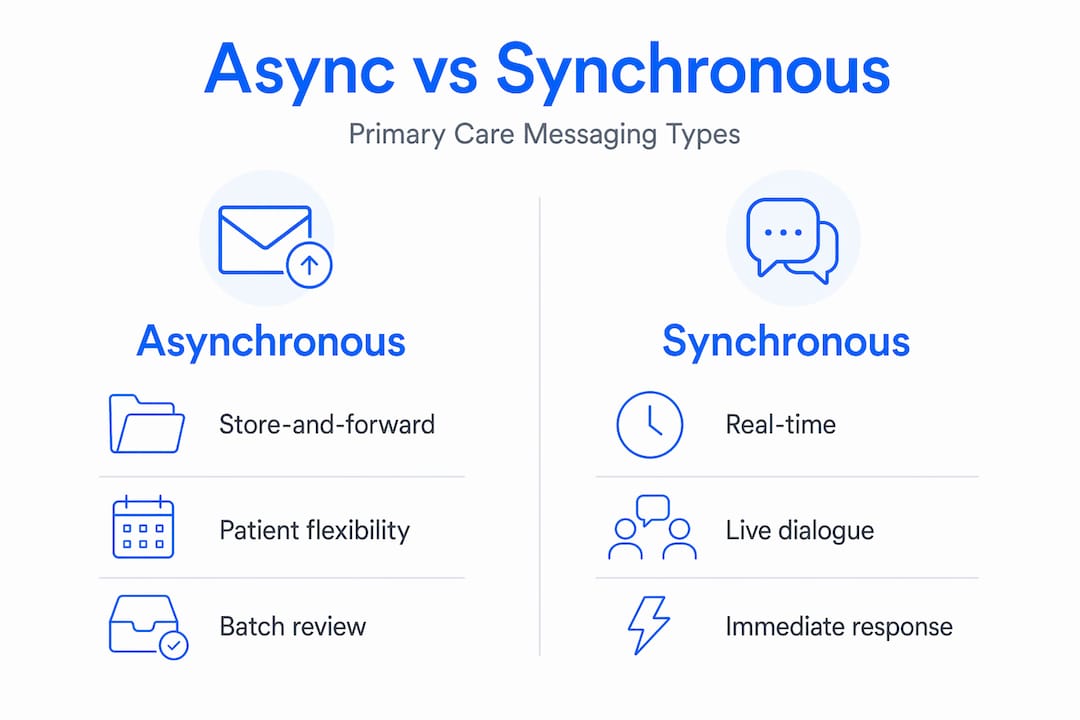
| Feature | Asynchronous messaging | Synchronous (live) telehealth |
|---|---|---|
| Timing | Store-and-forward, delayed response | Real-time, both parties present |
| Best use cases | Routine updates, refills, lab questions | Acute concerns, mental health check-ins, complex decisions |
| Interruption level | Low | High |
| Documentation | Automatic, full thread | Clinician-documented summary |
| Patient access | Flexible, any time | Scheduled appointment required |
Synchronous telehealth includes video visits, live phone consultations, and real-time chat. It is the right choice when a clinician needs to observe a patient visually, ask rapid follow-up questions, or assess something that cannot be adequately described in text. Asynchronous primary care messaging fills a different lane entirely.
The most effective primary care practices do not choose one over the other. They use both, with clear protocols for which channel fits which situation. Telehealth services that offer both modalities give patients and providers the flexibility to match the communication method to the actual clinical need.
My perspective on async messaging in primary care
I have followed the adoption of asynchronous healthcare messaging closely, and my honest assessment is that it is one of the most underutilized tools in primary care. Not because it lacks proof of value, but because implementations are almost always rushed.
What I see repeatedly is this: a practice adopts a messaging platform, turns it on, and expects the workflow benefits to appear automatically. They do not. The technology is the easy part. The hard part is redesigning how messages flow through a team, who is responsible for triage, and how patients learn to use the channel appropriately. When those things are skipped, clinicians end up with a second inbox that feels like a burden rather than a relief.
I also think the framing of “convenience” undersells what async messaging actually does at its best. It creates a documented, structured, private channel between patient and provider that captures clinical intent in writing. That is not just convenient. It changes accountability, transparency, and the quality of follow-through in a care relationship. The practices that understand this are the ones that invest in training and workflow design upfront, and their outcomes reflect it.
The risk I worry about most is not the technology. It is the clinician who is already overwhelmed treating async messaging as just one more real-time demand. Boundaries around response windows are not optional. They are what makes the model sustainable.
— Guorui
Explore flexible telehealth at Helloklarity
If you are looking for primary care that works around your schedule rather than the other way around, Helloklarity connects you with licensed providers through a platform built for modern, flexible care delivery.
Helloklarity’s network of over 1,000 licensed providers offers same-day access with self-pay options starting as low as $49, and the platform accepts major insurance and health savings accounts. Whether you need a routine consultation, prescription support, or ongoing primary care communication, you can explore available telehealth services to find the right fit. For current savings on appointments and care plans, check out the latest telehealth deals available through the platform.
FAQ
What is asynchronous primary care messaging?
Asynchronous primary care messaging is patient-to-clinician communication that does not require both parties to be available at the same time. It uses a store-and-forward model where messages, images, and documents are sent, stored, and reviewed later by the provider.
How does asynchronous messaging work in a clinical setting?
A patient sends a message through a secure platform, which is then triaged by staff and routed to the appropriate clinician for review and response. The entire exchange is documented and synced to the patient’s clinical record in well-integrated systems.
Is asynchronous messaging safe for all medical concerns?
No. Asynchronous messaging is appropriate for non-urgent, routine concerns like medication questions or lab result follow-ups. Urgent or emergency concerns require real-time care, and properly designed systems include escalation pathways to direct patients accordingly.
What are the main benefits of asynchronous messaging for patients?
Patients gain the flexibility to communicate with their care team without scheduling a real-time appointment, reducing wait times and making it easier to address routine questions around their own schedule.
How does asynchronous messaging differ from a standard telehealth video visit?
A video visit is synchronous, meaning both the patient and clinician are present simultaneously. Asynchronous messaging allows each party to participate at different times, making it better suited for non-urgent, text-based communication rather than real-time clinical assessment.
Recommended
- Telehealth Narcolepsy Prescribing: What Psychiatric NPs Can Do In New York | Klarity Health, Inc
- Klarity Health Promotions | Telehealth Discounts & Savings
- Telehealth Narcolepsy Prescribing: What Psychiatric NPs Can Do In California | Klarity Health, Inc
- Telehealth Narcolepsy Prescribing: What Psychiatric NPs Can Do In Texas | Klarity Health, Inc
Get expert care from top-rated providers
Find the right provider for your needs — select your state to find expert care near you.
Related posts






— Monday to Friday, 7:00 AM to 4:00 PM PST
Join our mailing list for exclusive healthcare updates and tips.

— Monday to Friday, 7:00 AM to 4:00 PM PST



