 HSA & FSA accepted; best-value for top quality care
 Same-day mental health, weight loss, and primary care appointments available

 Accept major insurances and cash-payHSA & FSA accepted; best-value for top quality careSame-day mental health, weight loss, and primary care appointments availableAccept major insurances and cash-pay
Affordable Telehealth Plans for Families in 2026
Written by Klarity Editorial Team
Published: May 22, 2026

Finding affordable telehealth plans for families sounds simple until you actually try it. You need coverage that works for a 7-year-old’s ear infection, a teenager’s anxiety, and a parent managing high blood pressure, all without draining your bank account. With average family healthcare costs hitting $37,824 annually in 2026, the pressure to find smarter, lower-cost options has never been greater. This guide walks you through what to look for, which plans deliver real value, and how to match the right option to your family’s specific situation.
Table of Contents
- Key takeaways
- Affordable telehealth plans for families: what to look for first
- Top affordable telehealth plans for families
- Comparison of top family telehealth subscription services
- Situational recommendations for different family needs
- My honest take on choosing telehealth for your family
- How Helloklarity makes family telehealth genuinely affordable
- FAQ
Key takeaways
| Point | Details |
|---|---|
| Cost isn’t just the monthly fee | Factor in per-visit charges, hidden fees, and whether the plan covers mental health and pediatrics. |
| Mental health access matters | Virtual pediatric therapy reduces wait times from months to days, making it a critical feature to prioritize. |
| HSAs stretch your dollar further | Pairing a high-deductible plan with an HSA can significantly offset telehealth costs for families with chronic needs. |
| Subscription vs. pay-per-visit | Subscriptions work best for frequent users; pay-per-visit models suit families with occasional care needs. |
| Provider network depth counts | Look for multidisciplinary networks that include pediatric specialists, not just general practitioners. |
Affordable telehealth plans for families: what to look for first
Before comparing specific plans, you need a clear framework. Without one, you end up choosing based on price alone and discovering the hard way that your plan doesn’t cover your child’s therapist or your spouse’s follow-up visit.
Coverage scope is your starting point. A genuinely useful family telehealth plan covers primary care, mental health, pediatrics, and at minimum some chronic condition management. Plans that only offer urgent care visits for colds and rashes will leave major gaps.
Cost structure matters more than the headline price. Here’s what to examine:
- Monthly subscription fee vs. pay-per-visit pricing
- Whether mental health visits cost extra or are bundled
- Pediatric visit pricing vs. adult visit pricing
- Cancellation fees or annual commitment requirements
- Whether self-pay visits are available without insurance
Provider network depth is non-negotiable for families. A plan with 50 general practitioners serves you differently than one with child psychiatrists, psychologists, and adolescent counselors. Multidisciplinary networks that include pediatric specialists are the standard you should hold every plan to.
Convenience features that actually affect daily use:
- 24/7 access or at minimum same-day appointments
- Mobile app quality and ease of scheduling
- Average wait time from booking to seeing a provider
- Whether you can message providers between visits
Pro Tip: Before signing up for any plan, call their support line and ask specifically whether child psychiatry and adolescent therapy are included in the base price. Many plans advertise “mental health coverage” but charge separately for pediatric behavioral services.
Finally, check whether the plan integrates with your existing insurance or operates as a standalone service. Employer telehealth benefits have expanded significantly, so you may already have partial coverage you can layer with a supplemental plan.
Top affordable telehealth plans for families
Here are the strongest options available in 2026, evaluated against the criteria above.
Helloklarity
Helloklarity stands out for families dealing with mental health conditions like ADHD, anxiety, and depression. With over 1,000 licensed providers and same-day access, the platform is built for situations where waiting weeks for an appointment isn’t acceptable. Self-pay options start at $49, and the platform accepts major insurance and HSAs.
Strengths: Fast access, strong mental health and primary care focus, transparent pricing, HSA-compatible.
Limitations: Primarily focused on mental health, weight management, and primary care rather than pediatric specialty care.
Teladoc Health (general telehealth tier)
Teladoc offers one of the broadest general telehealth networks in the country. Their family plans cover primary care, dermatology, and mental health with per-visit or subscription pricing. Mental health visits typically run between $70 and $90 per session without insurance.

Strengths: Wide provider availability, established platform, good app experience.
Limitations: Mental health services often cost extra; pediatric psychiatry availability varies by state.
MDLive
MDLive offers a solid family option with a focus on urgent care and behavioral health. Their subscription tiers make it practical for families who anticipate regular visits. They cover pediatric care and have therapists available for adolescents.
Strengths: Strong urgent care coverage, behavioral health included, pediatric-friendly.
Limitations: Specialist access is more limited compared to in-network insurance options.
Amazon Clinic / One Medical
One Medical (now part of Amazon) offers a $9 per month membership with same-day in-person and virtual visits. For families already in the Amazon ecosystem, this is one of the most cost-effective entry points into primary care telehealth.
Strengths: Very low monthly cost, same-day access, good primary care experience.
Limitations: Mental health services are limited; not designed for chronic condition management.
Pro Tip: If your family’s primary need is mental health support, don’t default to a general telehealth plan just because it’s cheaper. A mental-health-focused platform like Helloklarity will give you faster access to the right providers at a comparable or lower per-visit cost than a general platform charging add-on fees.
Budget-friendly honorable mentions
For families on tight budgets, self-pay telehealth visits can start as low as $19 on some platforms. These are best for occasional urgent care needs, not ongoing chronic or behavioral health management. Platforms offering transparent, no-insurance pricing are worth bookmarking for one-off situations.
Comparison of top family telehealth subscription services
| Plan | Monthly cost | Mental health | Pediatric focus | Wait time | Insurance/HSA |
|---|---|---|---|---|---|
| Helloklarity | From $49/visit | Yes, core focus | Primary care | Same day | Yes, both |
| Teladoc Health | $0 to $20+ | Add-on fee | Limited specialty | 1 to 3 days | Yes |
| MDLive | $0 to $10.99 | Included | Moderate | Same to 2 days | Yes |
| One Medical | $9/month | Limited | Primary care | Same day | Insurance only |
| Low-cost self-pay | $19 to $100/visit | Rarely included | Minimal | Varies | No |
This table reflects general pricing tiers and may vary by state, insurance status, and plan tier. Always verify current pricing directly with the provider before enrolling.
Situational recommendations for different family needs
Not every family needs the same plan. Here’s how to match your situation to the right option.
Families prioritizing mental health. If anxiety, ADHD, or depression affects any family member, especially a child or teenager, go with a platform that has mental health as its core service, not an add-on. Helloklarity’s same-day access to licensed mental health providers makes it the strongest option here. Virtual care has cut pediatric therapy wait times from 6 to 12 months down to days in many cases.
Families with a budget under $50 per month. One Medical at $9 per month covers primary care well. For mental health on a tight budget, Helloklarity’s self-pay visits starting at $49 are competitive with what most plans charge as add-on fees. Combine one low-cost primary care subscription with a mental health platform and you often spend less than a single bundled plan.
Families with adolescents needing behavioral support. Look specifically for platforms that offer parent coaching programs alongside individual therapy. Parent coaching is a clinically validated part of childhood behavioral intervention, and most general telehealth plans skip it entirely.
Families who need flexibility. If your family rarely gets sick but wants a safety net, a pay-per-visit model beats a monthly subscription. Bookmark two or three platforms with transparent self-pay pricing so you can access care without a commitment when you need it.
Families managing chronic conditions. HSA-compatible plans paired with a high-deductible health plan can make ongoing telehealth visits significantly more affordable through pre-tax dollars. Helloklarity’s Care Commitment Cards are worth exploring for families with ongoing psychiatry or therapy needs. You can review the chronic care savings options to see how the math works out over a year.
My honest take on choosing telehealth for your family
I’ve spent a lot of time looking at how families actually use telehealth versus how they think they’ll use it when they sign up. The gap is significant.
Most families sign up for a general plan, use it once for a sinus infection, and then discover it doesn’t cover the thing they actually needed: a therapist for their 12-year-old, a psychiatrist who can manage their teenager’s ADHD medication, or a provider who understands pediatric behavioral health well enough to do more than refer out.
The mental health gap is the one I see families regret most. They overlook it at enrollment because no one is in crisis yet. Then someone is, and they find out their plan’s “mental health coverage” means a 3-week wait for a general counselor who doesn’t specialize in adolescents.
My contrarian view on subscription-only plans: they’re often the wrong default for families. A subscription makes sense if you’re using the service at least twice a month. For most families, a hybrid approach works better. Use a low-cost primary care subscription for routine visits and a specialized platform for mental health, where speed and provider quality matter most.
The other thing I’d push back on is treating telehealth as a backup system. Families who get the most value use it proactively. Scheduling a mental health check-in before a stressful school year, not after a crisis, is where telehealth actually changes outcomes.
— Guorui
How Helloklarity makes family telehealth genuinely affordable
If your family needs fast, reliable access to mental health and primary care without the runaround of traditional insurance timelines, Helloklarity is worth a serious look. The platform connects you with over 1,000 licensed providers, and you can typically see someone within 24 hours. Self-pay options start at $49, and the platform works with major insurance plans and HSAs.
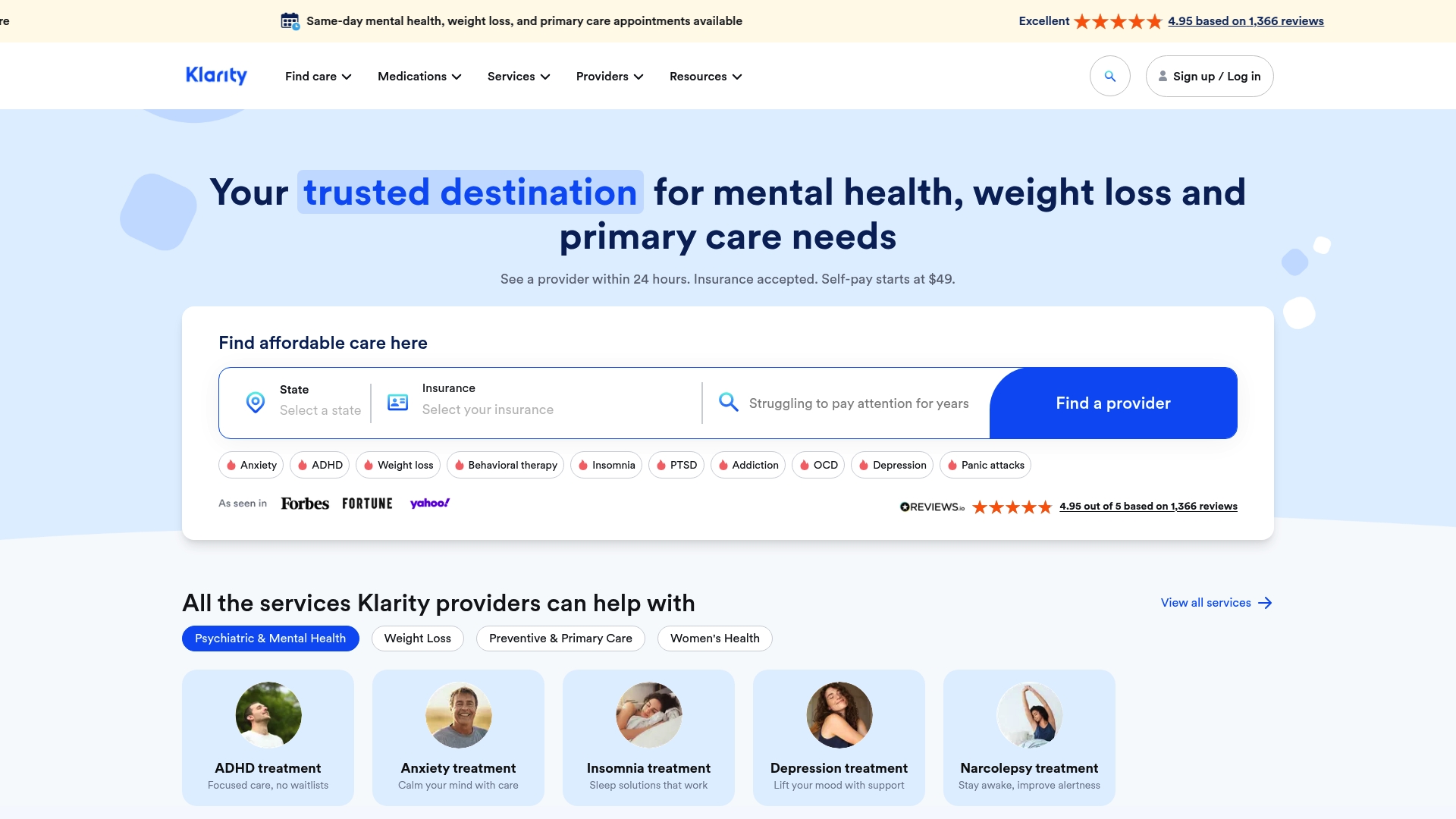
For families just getting started, the Klarity Starter Pass is a low-commitment way to try the service at $109 for your first visit. If ongoing mental health or primary care is what you need, explore the full range of telehealth services available to find the right fit. Helloklarity also runs regular promotions and discounts that can bring costs down further for families managing multiple members’ care.
FAQ
What is the average cost of a family telehealth plan?
Monthly costs range from $9 for basic primary care subscriptions to $20 or more for broader coverage. Per-visit self-pay rates typically run from $19 to over $100 depending on the platform and service type.
Are telehealth plans good for kids and teens?
Yes, especially platforms with dedicated pediatric and adolescent mental health providers. Virtual therapy has reduced wait times for pediatric care from months to days, making it one of the most practical options for families with younger members.
Can I use an HSA to pay for telehealth visits?
Yes. Many telehealth platforms, including Helloklarity, accept HSA payments. Pairing an HSA with a high-deductible health plan is one of the most effective ways to reduce out-of-pocket telehealth costs for families.
What services should a family telehealth plan include?
At minimum, look for primary care, mental health services, and pediatric coverage. The strongest plans also include chronic condition management, parent coaching for behavioral health, and 24/7 or same-day access to providers.
Is a subscription or pay-per-visit model better for families?
It depends on how often you use it. Subscriptions save money for families with frequent care needs. Pay-per-visit works better for families who need occasional access without a monthly commitment.
Recommended
- Klarity Health Promotions | Telehealth Discounts & Savings
- Klarity Starter Pass | Get Telehealth Visit for $109
- Best Online Clinics For Wellbutrin | Klarity Health, Inc
- Klarity: Safe, Affordable and Personalized Healthcare
Get expert care from top-rated providers
Find the right provider for your needs — select your state to find expert care near you.
Related posts






— Monday to Friday, 7:00 AM to 4:00 PM PST
Join our mailing list for exclusive healthcare updates and tips.

— Monday to Friday, 7:00 AM to 4:00 PM PST



