 HSA & FSA accepted; best-value for top quality care
 Same-day mental health, weight loss, and primary care appointments available

 Accept major insurances and cash-payHSA & FSA accepted; best-value for top quality careSame-day mental health, weight loss, and primary care appointments availableAccept major insurances and cash-pay
Why Is Urgent Care Cheaper Than the Emergency Room?
Written by Klarity Editorial Team
Published: Jul 15, 2026

Urgent care centers cost 5 to 10 times less than emergency rooms for treating comparable non-emergency conditions. That gap exists because urgent care clinics operate with lower overhead, simpler billing, and a narrower scope of services. A sprained ankle treated at urgent care runs $150–$250, while the same condition at an ER costs $1,000–$2,200. Insurance copays follow the same pattern: urgent care copays typically land at $25–$75, while ER copays for identical conditions range from $150–$500. Knowing why urgent care is cheaper than the emergency room puts real money back in your pocket.
Why is urgent care cheaper than the emergency room?
The core reason is structural. Emergency rooms are built to handle life-threatening crises around the clock, and that readiness costs a fortune whether or not anyone walks through the door. Urgent care clinics are built for a narrower job: treating common illnesses and minor injuries during regular hours.

ERs carry costs that never go away. They maintain 24/7 trauma readiness with specialized surgical teams, trauma bays, intensive care units, and expensive imaging equipment. Every patient who walks in for a sinus infection helps pay for all of that infrastructure. Urgent care clinics skip those costs entirely.
The billing structure compounds the price gap. An ER visit generates multiple separate invoices: one for the facility, one for the physician, one for radiology, and sometimes one for a specialist. Each line item carries its own copay or coinsurance charge. Urgent care visits typically produce a single all-inclusive charge, which makes costs predictable and far lower.
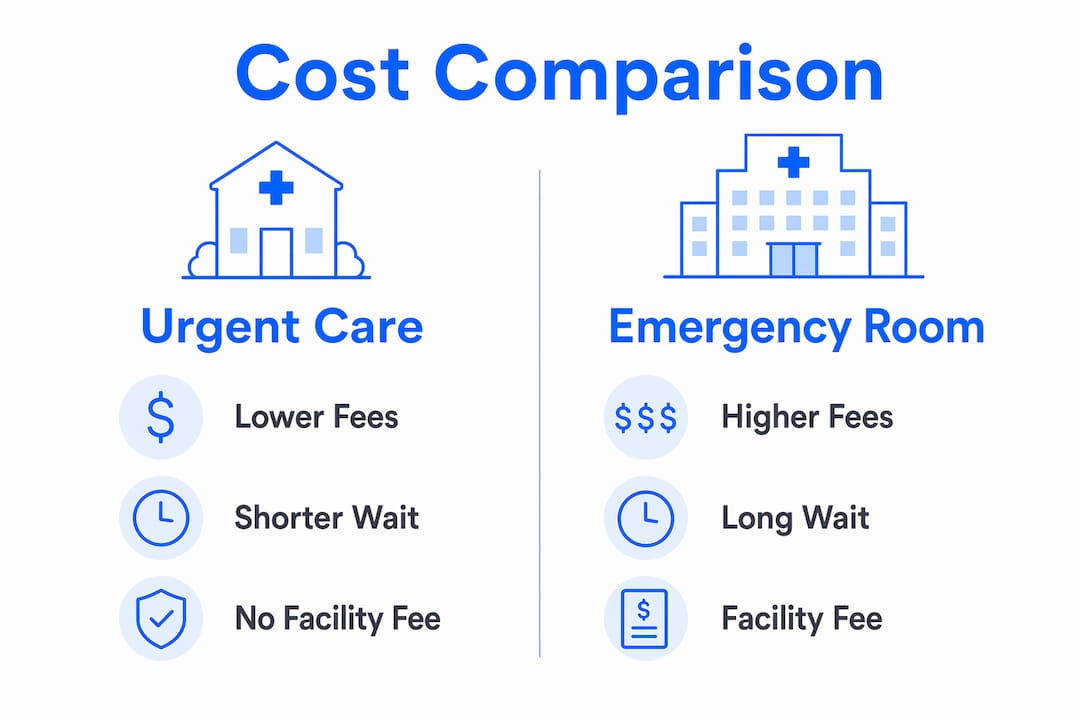
- Facility fees: ERs charge $500–$1,500 in facility fees alone, covering building upkeep, equipment, and around-the-clock staffing. Urgent care centers do not bill facility fees at this scale.
- Specialized staff: ERs employ trauma surgeons, cardiologists, and critical care nurses on standby. Urgent care clinics staff general practitioners and nurse practitioners focused on common conditions.
- Equipment overhead: CT scanners, surgical suites, and ventilators sit ready in every ER. Urgent care clinics use basic diagnostic tools suited to minor injuries and infections.
- Operating hours: ERs never close. That 24/7 commitment means permanent staffing costs that get distributed across every patient bill.
Pro Tip: Ask the front desk whether the facility charges a separate facility fee before you check in. That one question can save you hundreds of dollars in billing surprises.
How do urgent care and ER costs compare for common conditions?
The price difference becomes concrete when you look at specific conditions. Average ER visit costs run $1,000–$3,000 or more without insurance. Urgent care visits for the same conditions typically cost $100–$250.
| Condition | Urgent care cost | ER cost |
|---|---|---|
| Strep throat | $100–$175 | $800–$1,500 |
| Sprained ankle | $150–$250 | $1,000–$2,200 |
| UTI | $100–$175 | $700–$1,400 |
| Minor laceration | $150–$300 | $800–$1,800 |
| Flu or respiratory infection | $100–$200 | $700–$1,500 |
With insurance, the gap narrows but stays significant. Urgent care copays average $25–$75 per visit. ER copays run $150–$500 for the same non-emergency conditions. In some states, ER copays are 200%–400% higher than urgent care copays for identical treatments.
Labs and imaging add cost at both settings, but the ER multiplies those charges. A urinalysis at urgent care might add $30–$60 to your bill. The same test at an ER arrives on a separate invoice with its own coinsurance. X-rays follow the same pattern. Urgent care clinics bundle many of these services into a single visit charge, while ERs bill each component separately.
Surprise bills are a real risk at ERs. You may visit an in-network ER but receive care from an out-of-network specialist who happened to be on duty. That specialist’s bill arrives weeks later and carries no network discount. Urgent care billing is far more transparent because the scope of services is limited and predictable.
What insurance factors affect your final out-of-pocket cost?
Insurance coverage shapes your final bill more than the list price does. The type of plan you carry, whether the facility is in-network, and how your deductible applies all determine what you actually pay.
Federal law provides a specific protection for ER visits. ACA-compliant plans must cover emergency stabilization at any ER, in-network or out-of-network, at in-network cost-sharing rates. That protection does not extend to urgent care centers. An out-of-network urgent care visit can generate unexpectedly high bills with no federal backstop.
ER billing complexity creates a second layer of cost exposure. Multiple separate invoices mean multiple copays and coinsurance calculations. A single ER visit for a minor injury can produce four or five separate bills arriving over several weeks. Each one draws from your deductible independently, making it nearly impossible to predict your total cost upfront.
- Verify network status before visiting any urgent care clinic. Call your insurer or check the provider directory on your plan’s website.
- Ask about facility fees at urgent care centers. Some hospital-affiliated urgent care clinics charge facility fees similar to ERs.
- Check your deductible status. If you have not met your deductible, you pay the full negotiated rate at either setting. Urgent care’s lower negotiated rates still save you money.
- Confirm what services are included in the urgent care visit charge. Labs and imaging may be billed separately at some clinics.
Pro Tip: If you have a Health Savings Account (HSA) or Flexible Spending Account (FSA), use it at urgent care. The lower base cost means your tax-advantaged dollars stretch further than they would at an ER.
When should you choose urgent care over the ER?
The right choice depends on the severity of your condition, not your comfort level with the setting. Using the ER for non-emergencies costs you money and takes a bed from someone who needs it. Up to 60% of ER visits involve non-emergency cases that urgent care centers handle more efficiently.
Urgent care is the right call for these conditions:
- Minor cuts and lacerations that need stitches but are not life-threatening
- Sprains and minor fractures without suspected nerve or vascular damage
- Infections including UTIs, strep throat, ear infections, and sinus infections
- Flu and respiratory illness including COVID-19 testing and treatment
- Rashes, allergic reactions that are uncomfortable but not causing breathing problems
- Minor burns covering a small area without deep tissue involvement
- Eye irritation from foreign objects or mild infections
Go to the ER for chest pain, difficulty breathing, signs of stroke (face drooping, arm weakness, speech difficulty), severe abdominal pain, major trauma, or any condition where you believe your life is at risk. No cost consideration outweighs a genuine emergency.
Wait times reinforce the cost argument. Urgent care wait times average 15–45 minutes. ER waits run 2–6 hours for non-critical cases. Time has real value, and spending half a day in an ER waiting room for a UTI treatment is a cost most people do not calculate.
Telehealth and primary care providers extend your options further. Many conditions that seem to require an in-person visit can be assessed and treated remotely. Establishing care with a primary care provider also reduces the likelihood that you end up in an ER for a condition that could have been managed earlier. Learning how telehealth cuts costs can help you build a full picture of your affordable care options.
Key Takeaways
Urgent care costs 5 to 10 times less than the ER for non-emergency conditions because of lower overhead, single-charge billing, and a focused scope of services.
| Point | Details |
|---|---|
| Cost gap is structural | ERs charge facility fees of $500–$1,500 plus separate physician, lab, and specialist bills. |
| Copay difference is significant | Urgent care copays run $25–$75; ER copays for the same conditions run $150–$500. |
| Insurance protections differ | ACA protections cover out-of-network ER stabilization but do not apply to urgent care centers. |
| Most ER visits are avoidable | Up to 60% of ER visits involve non-emergency cases that urgent care handles at a fraction of the cost. |
| Telehealth extends savings | Virtual visits for eligible conditions cost less than urgent care and eliminate travel time entirely. |
The cost confusion I see most often
Patients consistently underestimate how much an ER visit will cost them. They see a $250 copay and assume that covers everything. Then the radiology bill arrives. Then the specialist bill. Then the facility fee. By the time all the invoices land, a “minor” ER visit for a sprained wrist has cost $900 out of pocket.
The deeper problem is that most people do not know they had a choice. They went to the ER at 9 PM because they assumed urgent care was closed or could not handle their condition. In most cases, that assumption is wrong. Urgent care clinics handle a wide range of conditions including fractures, lacerations, and infections with on-site diagnostics. Many are open until 8 or 9 PM on weekdays and offer weekend hours.
What I find most useful to tell people is this: build your care plan before you need it. Know where your nearest in-network urgent care clinic is. Know your insurer’s telehealth line. Know which conditions require an ER. That 10 minutes of planning can save you $1,000 or more the next time you get sick. Patients who establish primary care early are far less likely to end up in an ER for something preventable. Proactive decisions are almost always cheaper than reactive ones.
— Guorui
Affordable care without the ER price tag
For conditions that do not require an in-person visit, telehealth appointments through Helloklarity offer a direct path to licensed providers at a fraction of urgent care costs. Helloklarity connects patients with over 1,000 licensed providers for same-day appointments, with self-pay options starting at $49.
Helloklarity accepts major insurance plans and health savings accounts, making it accessible whether you are insured or paying out of pocket. Common urgent care conditions including infections, respiratory illness, and medication questions can often be handled through a telehealth appointment without leaving home. For patients who want to know exactly what conditions are covered, Helloklarity’s platform lists every treatable condition clearly before you book. No surprise bills, no waiting room, and no ER markup.
FAQ
Why is urgent care so much cheaper than the ER?
Urgent care clinics operate with lower overhead, no trauma readiness requirements, and simpler billing structures. ER costs include facility fees of $500–$1,500 plus separate charges for physicians, labs, and specialists.
What is the average cost difference between urgent care and the ER?
Without insurance, ER visits average $1,000–$3,000 compared to $100–$250 at urgent care for the same conditions. With insurance, ER copays run $150–$500 versus $25–$75 at urgent care.
Does insurance cover urgent care the same way it covers the ER?
Not exactly. ACA-compliant plans must cover ER stabilization at in-network rates even at out-of-network facilities. That federal protection does not apply to urgent care centers, so out-of-network urgent care visits can result in higher unexpected charges.
What conditions can urgent care treat?
Urgent care clinics treat infections, sprains, minor fractures, lacerations, flu, UTIs, rashes, and minor burns. They are not equipped for chest pain, stroke symptoms, severe trauma, or any life-threatening emergency.
Can telehealth replace urgent care for some conditions?
Yes. Many conditions treated at urgent care, including UTIs, respiratory infections, and medication questions, qualify for telehealth visits. Telehealth appointments typically cost less than in-person urgent care and eliminate travel and wait time.
Recommended
- Why Primary Care Reduces Emergency Visits: 2026 Guide
- How Telehealth Cuts Your Out-of-Pocket Healthcare Costs
- Why Primary Care Is Your First Line Of Defense
- Same Day Primary Care Appointments: Real Examples And Tips
Get expert care from top-rated providers
Find the right provider for your needs — select your state to find expert care near you.
Related posts




— Monday to Friday, 7:00 AM to 4:00 PM PST
Join our mailing list for exclusive healthcare updates and tips.

— Monday to Friday, 7:00 AM to 4:00 PM PST



