 HSA & FSA accepted; best-value for top quality care
 Same-day mental health, weight loss, and primary care appointments available

 Accept major insurances and cash-payHSA & FSA accepted; best-value for top quality careSame-day mental health, weight loss, and primary care appointments availableAccept major insurances and cash-pay
Examples of Telehealth Therapy Formats: 2026 Guide
Written by Klarity Editorial Team
Published: Jul 13, 2026

Telehealth therapy is defined as the delivery of mental health care through electronic communication, with formats distinguished by whether interaction happens in real time or on a time-delayed basis. The Health Resources and Services Administration (HRSA), the American Telemedicine Association (ATA), and HIPAA compliance standards all shape how these formats operate in clinical practice. Telehealth therapy formats commonly include synchronous live sessions, asynchronous store-and-forward models, and hybrid or program-based care. Understanding the differences helps you choose the option that fits your schedule, privacy needs, and clinical situation.
1. Examples of telehealth therapy formats: the core categories
Telehealth delivery models differ mainly in timing and communication type, not in the therapeutic content they deliver. A cognitive behavioral therapy session conducted over live video uses the same clinical approach as one delivered through asynchronous messaging. The format is the vehicle; the therapy is the destination. Recognizing this distinction helps you evaluate options without assuming one format is clinically inferior to another.

2. Synchronous live video therapy
Synchronous live video therapy is real-time, two-way interaction between a patient and a licensed clinician over a HIPAA-compliant video platform. The session mirrors an in-person appointment in structure: you log in at a scheduled time, and the provider observes your verbal and nonverbal cues throughout. Live video is often considered the closest telehealth equivalent to in-person care because it preserves the clinician’s ability to read body language and facial expression.
Common clinical applications include:
- Individual psychotherapy for anxiety, depression, and trauma
- Psychiatric evaluation for diagnosis and medication decisions
- Medication management follow-ups for conditions like ADHD
- Group therapy sessions with multiple participants in separate locations
The main challenges are bandwidth requirements and finding a private space at home. A dropped connection mid-session disrupts therapeutic flow in ways that asynchronous formats avoid.
Pro Tip: If you have a strong internet connection and a private room, live video gives your provider the richest clinical picture. If either is unreliable, phone-only may serve you better.
3. Synchronous phone-only therapy
Phone-only therapy is a synchronous format that uses audio without video, conducted over a standard or internet-based phone call. Audio-only sessions carry distinct billing modifiers from video sessions, which affects insurance reimbursement. Clinically, phone therapy loses nonverbal cues but remains effective for talk-based approaches like supportive counseling and cognitive behavioral therapy.
Phone-only sessions work well for patients with limited bandwidth, those in rural areas, or individuals who feel more comfortable speaking without being seen. Some people find the absence of a camera reduces self-consciousness and allows them to open up more freely. The format also requires no app downloads or device setup beyond a working phone.
The primary limitation is that providers cannot observe physical signs of distress, fatigue, or dissociation. For psychiatric evaluations or complex assessments, most clinicians prefer video when it is available.
4. Asynchronous message-based therapy
Asynchronous therapy is a store-and-forward model in which patients submit messages, voice notes, or structured questionnaires, and a licensed clinician reviews and responds within a set window. Asynchronous store-and-forward telehealth transmits patient data for later clinician review, often within 24–72 hours. No live interaction occurs during the review itself.
Common examples of this format include:
- Text message exchanges between sessions for reflection and check-ins
- Voice message submissions describing mood, symptoms, or events
- Journaling-style prompts reviewed by a therapist with written feedback
- Structured questionnaire workflows for mild-to-moderate condition monitoring
The benefits are real. Asynchronous formats remove scheduling barriers entirely and suit people with unpredictable work hours or caregiving responsibilities. They also scale more easily across large patient populations.
The limitations are equally real. Asynchronous therapy is not appropriate for crisis situations, active suicidal ideation, or conditions requiring immediate clinical judgment. The pacing is slower, and feedback loops are longer.
Pro Tip: Before starting asynchronous therapy, ask your provider directly: “What is your typical response time, and what should I do if I need support before you reply?” A clear answer tells you whether the format fits your needs.
5. Hybrid telehealth therapy formats
Hybrid therapy combines scheduled in-person visits with virtual check-ins, creating a flexible care structure that adapts to clinical complexity. Hybrid care mixes modalities to balance the depth of face-to-face sessions with the convenience of remote access. This format is particularly useful for patients managing long-term conditions or transitioning between levels of care.
Examples of hybrid and program-based formats include:
- Virtual Intensive Outpatient Programs (IOP): structured group and individual therapy delivered primarily via video, several hours per day, multiple days per week
- Virtual Partial Hospitalization Programs (PHP): higher-intensity virtual care for patients stepping down from inpatient settings
- EMDR with hybrid delivery: trauma processing sessions conducted in person, with virtual integration sessions between appointments
- Family therapy with hybrid scheduling: in-person sessions for complex family dynamics, with virtual follow-ups for continuity
Insurance coverage for hybrid formats varies significantly. Some payers reimburse both modalities within the same treatment episode; others require prior authorization for the virtual component. Verifying billing before starting a hybrid program saves significant frustration later.
6. Comparing telehealth therapy formats
Modality selection comes down to matching communication timing and interaction style to your clinical and practical needs. The table below summarizes the key differences.
| Format | Timing | Interaction | Technology needed | Best suited for |
|---|---|---|---|---|
| Live video | Real-time | Two-way audio and video | Stable internet, camera, app | Psychotherapy, psychiatric eval, group therapy |
| Phone-only | Real-time | Audio only | Phone or internet call | Low bandwidth, comfort-focused talk therapy |
| Asynchronous messaging | Time-delayed | Text, voice, or questionnaire | Basic smartphone or computer | Mild-to-moderate conditions, busy schedules |
| Hybrid (virtual + in-person) | Mixed | Both real-time and in-person | Varies by component | Complex cases, long-term care, step-down programs |
| Virtual IOP/PHP | Real-time, structured | Group and individual video | Stable internet, full-day availability | Intensive structured treatment |
Telehealth format choice should account for privacy, bandwidth, and device reliability because a mismatch between format and environment reduces care quality. For example, video requires both a stable connection and a private space. Phone-only works with lower connectivity but loses visual clinical data.
7. How to choose the right telehealth therapy format
The right format depends on five factors: your need for real-time clinician interaction, your scheduling flexibility, your technology access, your privacy at home, and whether your situation could involve a crisis. Matching modality to clinical needs is the core operational decision, and it should be made with your provider, not in isolation.
Practical guidance by situation:
- Busy professionals with unpredictable hours: asynchronous messaging or phone-only sessions with flexible scheduling
- Patients managing ADHD, anxiety, or depression: live video for initial evaluation and medication management, with telehealth psychiatric prescribing available through platforms like Helloklarity
- Low bandwidth or rural settings: phone-only synchronous sessions
- Complex or long-term cases: hybrid formats combining in-person depth with virtual convenience
- Intensive support needs: virtual IOP or PHP programs
Understanding provider cadence and response times is critical before committing to a format. Ask your provider how sessions are structured, how prescriptions or referrals are handled, and whether your insurance covers the specific modality. Helloklarity, for example, connects patients with over 1,000 licensed providers and offers same-day appointments with self-pay options starting at $49, making it practical to trial a format before committing long-term.
Pro Tip: Start with one format for two to four sessions, then evaluate whether the pacing and interaction style are working for you. Switching formats early is far easier than continuing with a poor fit.
For additional context on how primary care telehealth services integrate with mental health delivery, Helloklarity’s resource library covers the full range of virtual care options.
Key takeaways
Telehealth therapy formats differ by communication timing and method, and matching the right format to your clinical needs and lifestyle is the single most important decision you will make when starting virtual care.
| Point | Details |
|---|---|
| Synchronous formats offer real-time care | Live video and phone sessions deliver immediate clinician interaction and suit most therapy types. |
| Asynchronous formats prioritize convenience | Message-based therapy works best for mild-to-moderate conditions with flexible response windows of 24–72 hours. |
| Hybrid formats suit complex cases | Combining virtual and in-person care supports long-term treatment and intensive programs like IOP and PHP. |
| Format choice affects billing | Audio-only, video, and asynchronous sessions carry different insurance coding and reimbursement rules. |
| Trial periods reduce mismatch risk | Testing a format for two to four sessions before committing helps align expectations with clinical outcomes. |
What I’ve learned from watching patients choose the wrong format first
Most people pick a telehealth format based on convenience alone, and that is where things go sideways. I have seen patients choose asynchronous messaging because it felt low-pressure, only to realize weeks later that they needed the real-time feedback loop that only live sessions provide. The format felt accessible; it just was not clinically right for them.
Live video remains the most clinically rich remote option. The ability to observe someone’s posture, eye contact, and hesitation before answering a question carries real diagnostic weight. Phone-only therapy is genuinely effective for talk-based work, but it asks more of both the patient and the clinician to compensate for the missing visual channel.
Asynchronous therapy has done something important for mental health access. It has normalized the idea that you do not need to carve out a scheduled hour to engage with your mental health. That shift in framing matters, especially for people who have never sought care before. The format lowers the entry barrier in a way that synchronous sessions simply cannot.
Hybrid models are where I see the most promise for complex, long-term cases. The combination of in-person depth and virtual flexibility is not a compromise. It is a genuinely better structure for many patients. The challenge is that most people do not know to ask for it.
My consistent advice: tell your provider what your life actually looks like, not what you think they want to hear. The right format follows from honest information.
— Guorui
Helloklarity’s telehealth options for every format and schedule
Helloklarity connects patients with over 1,000 licensed providers across mental health, primary care, and weight management, all through HIPAA-compliant video and telephone sessions. Same-day appointments are available, and self-pay pricing starts at $49, with major insurance and HSA payments accepted.
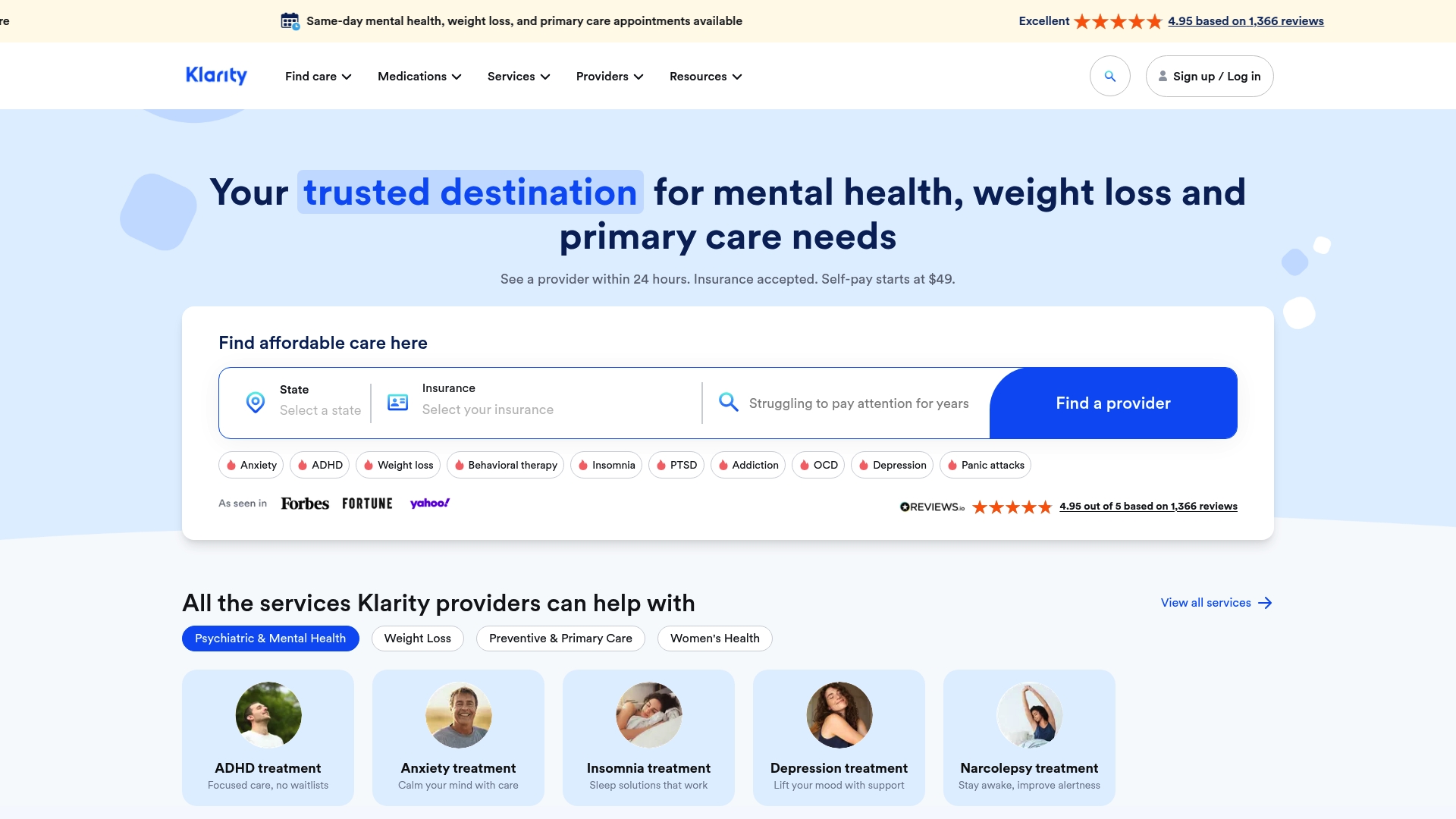
Whether you need a live psychiatric evaluation for anxiety or ADHD, ongoing medication management, or a flexible care structure that fits around your schedule, Helloklarity’s telehealth services cover the full range of virtual therapy formats. Patients can see a licensed provider within 24 hours without the wait times common in traditional clinic settings. Browse conditions treated on the platform to find the right starting point for your care.
FAQ
What are the main types of teletherapy formats?
The three core types are synchronous live sessions (video or phone), asynchronous store-and-forward models (message or questionnaire-based), and hybrid formats that combine virtual and in-person care. Each differs in timing, interaction style, and clinical suitability.
Is live video therapy better than phone-only therapy?
Live video preserves nonverbal clinical cues and is generally preferred for psychiatric evaluations and complex assessments. Phone-only therapy is equally effective for talk-based approaches and suits patients with limited bandwidth or privacy concerns.
How does asynchronous telehealth therapy work?
A patient submits messages, voice notes, or questionnaires through a secure platform, and a licensed clinician reviews and responds within a set window, typically 24–72 hours. No live interaction occurs during the review itself.
Can telehealth therapy replace in-person care for serious mental health conditions?
Telehealth delivers the same therapeutic approaches as in-person care for most conditions, but complex or crisis-level situations may require in-person assessment or emergency services. Hybrid formats that combine both settings are often the best fit for high-complexity cases.
How do I know which telehealth format is right for me?
Match the format to your scheduling flexibility, technology access, privacy at home, and clinical needs. Ask your provider about response times, session structure, and insurance coverage before committing to a specific modality.
Recommended
- What Telehealth Services Can I Get Online? Medical Guide
- What Is Telehealth Mental Health? Your 2026 Guide
- Telehealth Primary Care Checklist For Families In 2026
- Your Telehealth Mental Health First Visit: What To Expect
Get expert care from top-rated providers
Find the right provider for your needs — select your state to find expert care near you.
Related posts


— Monday to Friday, 7:00 AM to 4:00 PM PST
Join our mailing list for exclusive healthcare updates and tips.

— Monday to Friday, 7:00 AM to 4:00 PM PST



