 HSA & FSA accepted; best-value for top quality care
 Same-day mental health, weight loss, and primary care appointments available

 Accept major insurances and cash-payHSA & FSA accepted; best-value for top quality careSame-day mental health, weight loss, and primary care appointments availableAccept major insurances and cash-pay
Types of Online Mental Health Providers: 2026 Guide
Written by Klarity Editorial Team
Published: Jul 10, 2026

Online mental health providers are licensed clinicians who deliver psychological care through digital platforms using live video, phone, or asynchronous text formats. The types of online mental health providers available today span licensed therapists, psychiatric prescribers, and counselors, each serving a distinct clinical role. Knowing which provider type fits your needs is the fastest way to get effective care. Platforms like Helloklarity connect patients with over 1,000 verified clinicians, often within 24 hours, making credential-matched access more practical than ever.
1. What are the types of online mental health providers?
Online mental health care divides into two primary clinical roles: talk therapists and psychiatric prescribers. Talk therapists deliver behavioral and psychological treatment. Psychiatric prescribers evaluate, diagnose, and manage medication. Understanding this split before you book an appointment saves time and prevents mismatched care.
Virtual care formats shape how each provider type delivers treatment. The three main formats are live video, phone-only, and asynchronous text messaging. Each format suits different symptom levels, schedules, and privacy needs.

2. Licensed therapists and counselors
Licensed therapists are the most common type of online mental health provider. They hold credentials such as LCSW (Licensed Clinical Social Worker), LMHC (Licensed Mental Health Counselor), LMFT (Licensed Marriage and Family Therapist), or a doctoral degree such as PhD or PsyD in psychology. Their scope of practice covers assessment, diagnosis of behavioral conditions, and evidence-based talk therapies.
The most widely used treatment methods include Cognitive Behavioral Therapy (CBT), Dialectical Behavior Therapy (DBT), and Eye Movement Desensitization and Reprocessing (EMDR). CBT is the most researched approach for anxiety and depression. DBT is the standard treatment for emotional regulation disorders. EMDR is the leading trauma-processing method.
Therapists do not prescribe medication. If you need medication alongside therapy, you will need a separate psychiatric provider or a platform that coordinates both roles. What a mental health provider does in practice depends heavily on their license type and specialty.
Key advantages of online therapists:
- Available for weekly or biweekly sessions via live video or phone
- Treat anxiety, depression, trauma, grief, relationship issues, and more
- No prescription authority, so no medication side effect monitoring required
- Often lower cost per session than psychiatric appointments
Limitations to know:
- Cannot prescribe or adjust medications
- Complex psychiatric conditions may require a prescriber referral
Pro Tip: Ask any prospective therapist which evidence-based modality they use for your specific concern. A therapist who specializes in CBT for anxiety will produce better outcomes than a generalist, even online.
3. Online psychiatric providers: psychiatrists and nurse practitioners
Psychiatric providers are the prescribers of the mental health world. Psychiatrists hold an MD or DO degree with a psychiatric residency. Psychiatric nurse practitioners (PMHNPs) hold a master’s or doctoral nursing degree with a psychiatric specialty. Both can diagnose mental health conditions and prescribe medication.
Psychiatrists and therapists serve distinct roles. Psychiatrists manage medication and clinical evaluations. Therapists deliver talk-based psychological care. Integrated care, where both work together, produces the best outcomes for conditions like major depression, bipolar disorder, or ADHD.
Online psychiatric care works well for medication initiation, titration, and ongoing management. The main risk is fragmented care when your prescriber and therapist do not communicate. Stable prescriber relationships reduce the risk of side effects and dosage errors. Choosing a platform that coordinates both roles in one place addresses this directly.
What online psychiatric appointments typically cover:
- Initial diagnostic evaluation (45–60 minutes)
- Medication selection and dosage planning
- Follow-up visits for monitoring and adjustment
- Referrals to therapy when needed
Pro Tip: Before your first psychiatric appointment, write down every medication you currently take, including supplements. Drug interactions are a primary safety concern in psychiatric prescribing, and your provider needs the full picture.
For a detailed breakdown of what to expect, online psychiatrist appointments follow a structured evaluation process that mirrors in-person psychiatric care.
4. Online therapy delivery formats and who they suit
The format of your sessions matters as much as the provider type. Three delivery formats define most virtual mental health services today.
Live video therapy
Live video is the gold standard for online therapy. Video therapy produces a therapeutic alliance indistinguishable from in-person care by session 3 or 4. That finding matters because therapeutic alliance is the single strongest predictor of treatment outcomes across all modalities. Video suits complex cases, trauma processing, and any condition requiring close observation of emotional responses.
Phone-only sessions
Phone sessions work for patients with limited internet bandwidth, privacy concerns at home, or mild to moderate symptoms. The tradeoff is real. Telephone sessions produce significantly lower connection and agreement on therapy goals compared to video or in-person formats. Phone is a practical backup, not a first choice for complex mental health needs.
Asynchronous text messaging
Asynchronous mental health care lets you send messages to a provider who responds within a set window, often 24 hours. This format suits mild symptoms, flexible schedules, and patients who process thoughts better in writing. The limitation is response lag. Crisis situations and complex diagnoses require real-time communication, not a messaging queue.
| Format | Best for | Main limitation |
|---|---|---|
| Live video | Complex cases, trauma, medication monitoring | Requires stable internet and private space |
| Phone only | Low bandwidth, mild symptoms | Weaker emotional engagement |
| Asynchronous text | Mild anxiety, flexible schedules | Slow response, not for crisis care |
Pro Tip: Set up your video session space before your first appointment. A private room, headphones, and a stable Wi-Fi connection are not optional extras. Patients report that privacy and technical stability directly affect their comfort and engagement during virtual sessions.
5. How to verify credentials and protect your privacy
Credential verification is non-negotiable when choosing any online mental health provider. Every licensed therapist and psychiatrist in the United States is listed on their state licensing board’s public database. Search your provider’s name before your first appointment. A platform that does not display named, licensed providers is a red flag.
Platforms without named licensed providers should be treated as unverified services. State licensing compacts like PSYPACT allow psychologists and counselors to practice telehealth across multiple states, but you still need to confirm that your specific provider holds an active license in your state.
The gap between clinical telehealth platforms and wellness apps is significant. Many mental health wellness apps lack HIPAA compliance, regulatory oversight, and licensing requirements. Some have faced Federal Trade Commission enforcement actions for mishandling user data. A wellness app that tracks your mood is not the same as a HIPAA-covered clinical session.
“Beware of wellness apps that market mental health support but don’t comply with clinical safety and privacy standards present in licensed telehealth platforms.” Clinical platforms are legally required to verify provider licenses and protect your health data under HIPAA. Wellness apps are not.
Credential verification checklist:
- Search the provider’s name on your state licensing board website
- Confirm the platform states HIPAA compliance explicitly
- Check that the platform lists provider credentials and license numbers
- Avoid platforms that use anonymous or unlicensed “coaches” as primary care contacts
- Ask whether your prescriber and therapist can communicate directly if you use both
Virtual care accessibility has expanded options for patients in rural areas, those with mobility limitations, and anyone with a demanding schedule. That access is only valuable when the provider behind the screen is properly licensed and your data is protected.
Key takeaways
The most effective approach to online mental health care is matching your provider type and delivery format to your specific clinical needs, then verifying credentials before your first session.
| Point | Details |
|---|---|
| Know your provider type | Therapists deliver talk therapy; psychiatrists and PMHNPs prescribe and manage medication. |
| Match format to need | Live video suits complex cases; phone works for mild symptoms; asynchronous text fits flexible schedules. |
| Verify credentials first | Check every provider against your state licensing board before booking. |
| Watch for app vs. platform gaps | HIPAA-covered clinical platforms protect your data; wellness apps often do not. |
| Coordinate care when using both | Prescribers and therapists must communicate to prevent fragmented treatment. |
What I’ve learned from watching patients choose the wrong provider first
Most people who struggle with online mental health care made one mistake at the start. They chose a provider based on price or availability, not clinical fit. A patient with untreated ADHD books a therapist who specializes in grief. A person with major depression signs up for an asynchronous messaging app and waits 48 hours for a response during a hard week. The mismatch costs time, money, and trust in the process.
The coordination gap between prescribers and therapists is the most underreported problem in virtual psychiatric care. When your medication manager and your talk therapist work on separate platforms with no shared records, you become the messenger between two clinicians who cannot see each other’s notes. That is not integrated care. It is fragmented care with extra steps.
My honest recommendation is to start with a clear question: do you need medication, therapy, or both? If you are unsure, book a diagnostic evaluation first, not a therapy session. A qualified psychiatric provider can assess whether medication is appropriate and refer you to the right therapy type. Going in the other direction, starting with a therapist who then refers you to a prescriber, adds weeks to your timeline.
Verify qualifications every time. Licensing board searches take three minutes. The providers who resist transparency about their credentials are the ones worth avoiding. The providers who list their license numbers publicly are the ones worth trusting.
— Guorui
Mental health care through Helloklarity
Helloklarity connects patients with over 1,000 licensed mental health providers across the United States, with appointments available within 24 hours. Every clinician on the platform carries verified state licensure, and the service covers both therapy and psychiatric care under one roof.
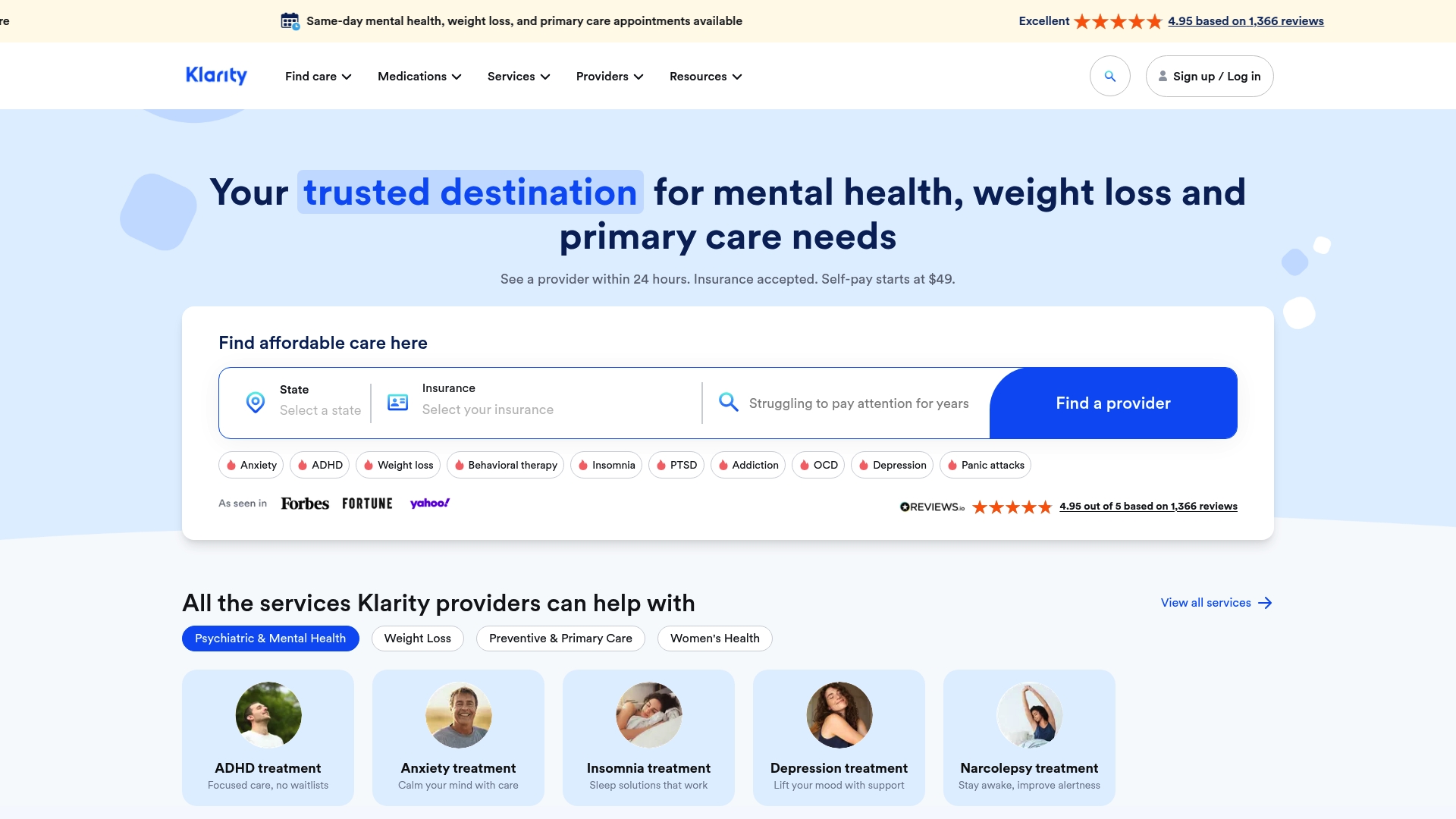
Self-pay options start at $49, and Helloklarity accepts major insurance plans and health savings accounts. Whether you need a licensed therapist for anxiety or a psychiatric nurse practitioner for medication management, you can browse available telehealth services and book directly. Patients who need help finding a provider in their state can also search by location to confirm coverage before scheduling.
FAQ
What types of online mental health providers can prescribe medication?
Psychiatrists (MD or DO) and psychiatric nurse practitioners (PMHNPs) are the only online mental health providers licensed to prescribe medication. Licensed therapists, counselors, and psychologists cannot prescribe.
Is video therapy as effective as in-person therapy?
Yes. Research shows that video therapy produces a therapeutic alliance matching in-person care by session 3 or 4, making it the most effective virtual format for complex mental health conditions.
How do I verify that an online therapist is licensed?
Search the provider’s name on your state’s public licensing board database. Every licensed therapist, counselor, and psychiatrist in the United States is listed there with their active license status.
Are mental health apps the same as online therapy platforms?
No. Many wellness apps lack HIPAA compliance and do not employ licensed clinicians. Clinical telehealth platforms are legally required to verify provider credentials and protect your health data under federal privacy law.
What is the best online therapy format for anxiety?
Live video therapy is the best format for anxiety treatment because it preserves the therapeutic alliance and allows the provider to observe emotional and behavioral responses in real time. Asynchronous text messaging suits only mild symptoms.
Recommended
- What Does A Mental Health Provider Do: 2026 Guide
- Mental Health Awareness Month 2026: Why More Americans Are Turning To Telehealth For Anxiety And Depression | Klarity Health, Inc
- What Telehealth Services Can I Get Online? Medical Guide
- What Is Telehealth Mental Health? Your 2026 Guide
Get expert care from top-rated providers
Find the right provider for your needs — select your state to find expert care near you.
Related posts



— Monday to Friday, 7:00 AM to 4:00 PM PST
Join our mailing list for exclusive healthcare updates and tips.

— Monday to Friday, 7:00 AM to 4:00 PM PST



