 HSA & FSA accepted; best-value for top quality care
 Same-day mental health, weight loss, and primary care appointments available

 Accept major insurances and cash-payHSA & FSA accepted; best-value for top quality careSame-day mental health, weight loss, and primary care appointments availableAccept major insurances and cash-pay
How Telehealth Prescriptions Work in 2026
Written by Klarity Editorial Team
Published: Jun 3, 2026

Telehealth prescriptions are medications issued by a licensed clinician after a remote clinical evaluation conducted entirely through electronic means, such as video or audio. The telehealth prescription process follows the same legal and clinical standards as an in-person visit, meaning a doctor cannot simply send you a prescription because you filled out a form online. Platforms like Helloklarity connect patients with licensed providers who conduct real evaluations before prescribing. Understanding how online prescriptions work protects you from unregulated services and helps you get the care you actually need.
How the telehealth prescription process works step by step
The steps for telehealth prescriptions mirror a traditional clinic visit more closely than most people expect. Here is exactly what happens from the moment you book an appointment to the point your medication reaches your hands.
You schedule a virtual visit. You select a licensed provider through a telehealth platform and choose a time slot. Most platforms, including Helloklarity, offer same-day or next-day appointments.
You complete intake paperwork. Before the visit, you submit your medical history, current medications, allergies, and the name and address of your preferred pharmacy. Having this ready shortens the appointment and gives the clinician the context needed to prescribe safely.
The clinician conducts a live evaluation. The provider meets with you via synchronous video or audio. Most states require this real-time interaction rather than a questionnaire alone. The clinician asks about symptoms, reviews your history, and applies the same standard of care used in a physical office.
The provider verifies your location and their licensure. Your physical location at the time of the visit determines which state’s laws apply. The clinician must hold a valid license in that state to legally prescribe to you. This step is not optional; it is a legal requirement.
The clinician documents the clinical justification. Before transmitting any prescription, the provider records the assessment, diagnosis, and rationale. Equal duty of care applies in telehealth, meaning the documentation must support the prescription just as it would in person.
The prescription is sent electronically. The provider transmits the prescription directly to your pharmacy using an e-prescribing system. For controlled substances, most states require the DEA’s Electronic Prescriptions for Controlled Substances (EPCS) program, which adds an extra layer of security and verification.
You pick up or receive your medication. Standard prescriptions are available at your pharmacy within hours. Some pharmacies also offer prescription delivery services, so you can have medications shipped directly to your door.
For refills, the process is shorter but still requires a licensed provider to assess whether the medication remains appropriate. Stable, ongoing conditions like hypertension or anxiety are well suited to telehealth refill visits.
Pro Tip: Before your appointment, write down every medication you currently take, including over-the-counter drugs and supplements. Clinicians use this list to check for interactions and to make faster, safer prescribing decisions.
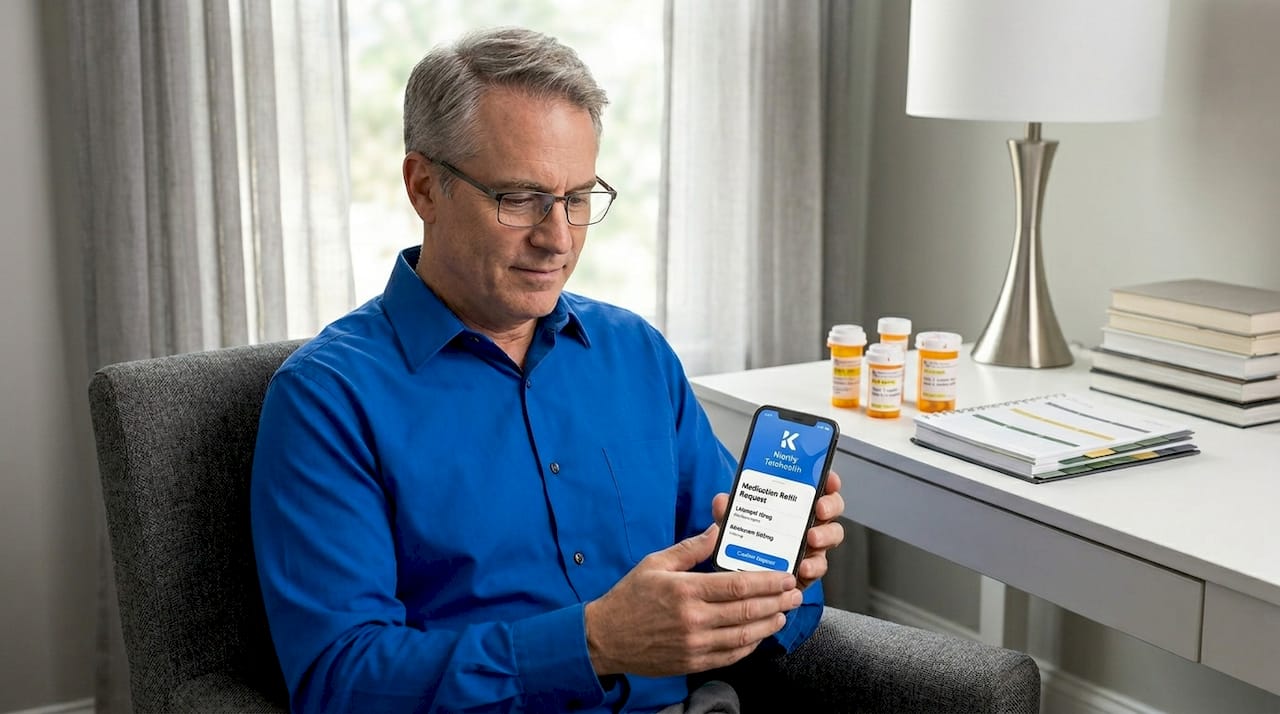
Legal and regulatory requirements for telehealth prescribing in the U.S.
Telehealth prescribing in the United States sits at the intersection of state law, federal law, and professional licensing standards. Getting a prescription online is legal, but only when specific conditions are met.
The foundation of any valid telehealth prescription is the patient-provider relationship. A clinician cannot prescribe to someone they have never evaluated. Telehealth prescribing is defined as issuing prescriptions after a clinical encounter conducted entirely electronically, and that encounter must meet the standard of care for the condition being treated.
State licensure is the most common compliance issue patients overlook. The law that governs your prescription is the law of the state where you are physically located during the visit, not where the provider practices. If you are in Texas and your provider is licensed only in California, that prescription is not valid. Platforms operating across multiple states must maintain a network of providers licensed in each state they serve.
At the federal level, the Ryan Haight Online Pharmacy Consumer Protection Act sets the baseline rules for prescribing controlled substances remotely. It generally requires at least one in-person evaluation before a controlled substance can be prescribed via telehealth. However, temporary DEA flexibilities introduced during the COVID-19 pandemic created exceptions to this rule.
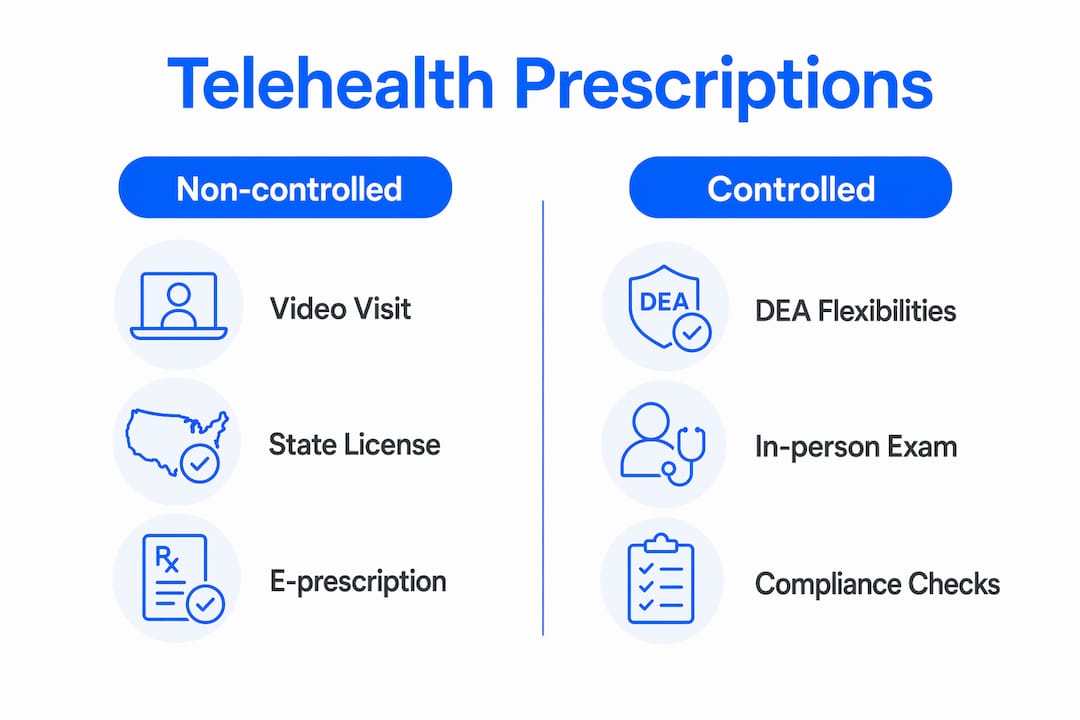
The table below summarizes the key differences between non-controlled and controlled substance prescribing under current telemedicine medication guidelines.
| Category | Non-controlled substances | Controlled substances (Schedule II–V) |
|---|---|---|
| In-person exam required? | No, if a valid telehealth evaluation occurs | Not currently, under temporary DEA flexibilities |
| Federal law governing | State medical practice acts | Ryan Haight Act + DEA registration |
| E-prescribing required? | Encouraged in most states | Mandated in most states via EPCS |
| Flexibility expiration | No sunset date | December 31, 2026 |
| Provider licensure | Must match patient’s state | Must match patient’s state + DEA registration |
The temporary DEA flexibilities window runs from May 12, 2023 to December 31, 2026. After that date, stricter rules are expected to return unless Congress or the DEA acts to extend or revise them. Patients currently receiving controlled substances via telehealth should discuss continuity of care with their provider well before that deadline.
Controlled vs. non-controlled substances: what changes for patients
The distinction between controlled and non-controlled substances is the single biggest variable in the telehealth prescription process. Understanding it prevents surprises and helps you choose the right provider.
What counts as a controlled substance? The DEA classifies drugs into five schedules based on their potential for abuse and accepted medical use. Schedule II includes medications like Adderall (amphetamine), Vyvanse (lisdexamfetamine), and oxycodone. Schedule III through V covers drugs like Tylenol with codeine, Xanax (alprazolam), and certain sleep aids. Authorized providers can prescribe these medications via telehealth only when they meet DEA registration, state licensure, and telemedicine communication requirements simultaneously.
Key facts patients need to know about controlled substance telehealth prescriptions:
- The temporary federal exceptions allowing remote controlled substance prescribing without a prior in-person exam expire December 31, 2026. After that date, the rules revert unless changed.
- Not every telehealth platform is authorized to prescribe controlled substances. The provider must hold an active DEA registration in addition to state licensure.
- State laws vary significantly. Some states impose additional restrictions on top of federal rules, such as requiring a mental health diagnosis to be confirmed before stimulants can be prescribed via telehealth.
- ADHD medications like Adderall and Vyvanse are Schedule II. Patients seeking telehealth ADHD prescriptions must confirm their provider holds the correct credentials in their state.
- Non-controlled medications, including most antidepressants, blood pressure drugs, and antibiotics, face fewer restrictions and are generally easier to obtain through telehealth.
Pro Tip: Do not assume a telehealth platform can prescribe any medication you need. Before booking, confirm the provider holds a DEA registration and is licensed in your state. Platforms that are transparent about their prescribing scope are the ones worth trusting.
Compliance monitoring matters here too. Providers prescribing controlled substances via telehealth are required to check state Prescription Drug Monitoring Programs (PDMPs) before issuing a prescription. This database tracks controlled substance prescriptions across providers to prevent overprescribing and misuse.
What to expect as a patient: practical scenarios and preparation
Telehealth prescriptions work well for a defined set of situations. Knowing where they fit and where they do not saves you time and frustration.
Good candidates for telehealth prescriptions:
- Refills for stable, ongoing conditions such as anxiety, depression, hypothyroidism, or high blood pressure
- New prescriptions for straightforward conditions like urinary tract infections, sinus infections, or mild skin conditions
- Mental health medications for diagnosed conditions where the provider can assess symptom history remotely
- Weight management medications when a provider can review labs and health history electronically
Situations that typically require an in-person visit:
- New prescriptions for high-risk medications that require physical examination or lab work
- Conditions where the provider cannot adequately assess severity without direct observation
- Certain controlled substance prescriptions in states with stricter rules than the federal baseline
To prepare for your telehealth visit, gather your current medication list, your pharmacy’s name and address, your insurance information, and any recent lab results. If you are seeking a prescription refill, note the medication name, dosage, and how long you have been taking it. Providers use this information to assess whether the medication is still working and whether the dose needs adjustment.
After the visit, the prescription goes directly to your pharmacy via e-prescribing. You will typically receive a confirmation from your pharmacy within a few hours. Many pharmacies now offer prescription delivery services, so you can skip the trip entirely if same-day pickup is not necessary.
Always verify that your provider is licensed in your state. You can check a provider’s license status through your state’s medical board website. Reputable platforms like Helloklarity make this easy by only connecting patients with credentialed providers who are already verified for their state.
Key takeaways
Telehealth prescriptions are legally valid when a licensed clinician conducts a real-time clinical evaluation, verifies patient location, and transmits the prescription electronically through a compliant system.
| Point | Details |
|---|---|
| Real evaluation required | A live video or audio visit is required; questionnaire-only prescribing is not legally sufficient in most states. |
| State licensure governs validity | The provider must be licensed in the state where the patient is physically located during the visit. |
| Controlled substance rules expire | DEA flexibilities allowing remote controlled substance prescribing without prior in-person exams end December 31, 2026. |
| E-prescribing is standard | Prescriptions are transmitted electronically to your pharmacy, with EPCS required for controlled substances in most states. |
| Preparation speeds the process | Having your medication list, pharmacy details, and health history ready before the visit leads to faster, safer prescribing. |
The regulatory cliff most patients do not see coming
I have spent years watching patients get blindsided by the gap between what telehealth platforms promise and what the law actually permits. The December 31, 2026 expiration of DEA controlled substance flexibilities is the most consequential regulatory event in telehealth prescribing since the Ryan Haight Act passed in 2008. Most patients receiving stimulants or benzodiazepines via telehealth have no idea it is coming.
Here is what concerns me most: the platforms with the loudest marketing are often the least transparent about their prescribing limitations. A platform that tells you it can prescribe anything you need, without clearly explaining the state licensure and DEA registration requirements, is a platform that will leave you without medication when the rules tighten. The complex interaction of state and federal laws governing controlled substance telehealth prescriptions is not a footnote. It is the entire story.
My advice is direct: if you are currently receiving a controlled substance through telehealth, have a conversation with your provider now about what happens after December 2026. Ask whether they plan to apply for a DEA telemedicine registration if the new rule framework requires it. Ask whether they are licensed in your state specifically. These are not uncomfortable questions. They are the questions a provider worth trusting will answer without hesitation.
Telehealth has genuinely expanded medication access for people who could not get timely care through traditional channels. That is real and worth protecting. But protecting it means choosing platforms that operate within the law, not around it. The providers who will still be prescribing to you in 2027 are the ones who are building compliant practices today, not the ones racing to prescribe before the deadline closes.
— Guorui
Get your prescription through a provider you can trust
If you are ready to see a licensed clinician and get a prescription without the wait, Helloklarity connects you with over 1,000 credentialed providers specializing in mental health, weight loss, and primary care. Every provider on the platform is verified for licensure in your state, and prescriptions are sent electronically to your pharmacy the same day.
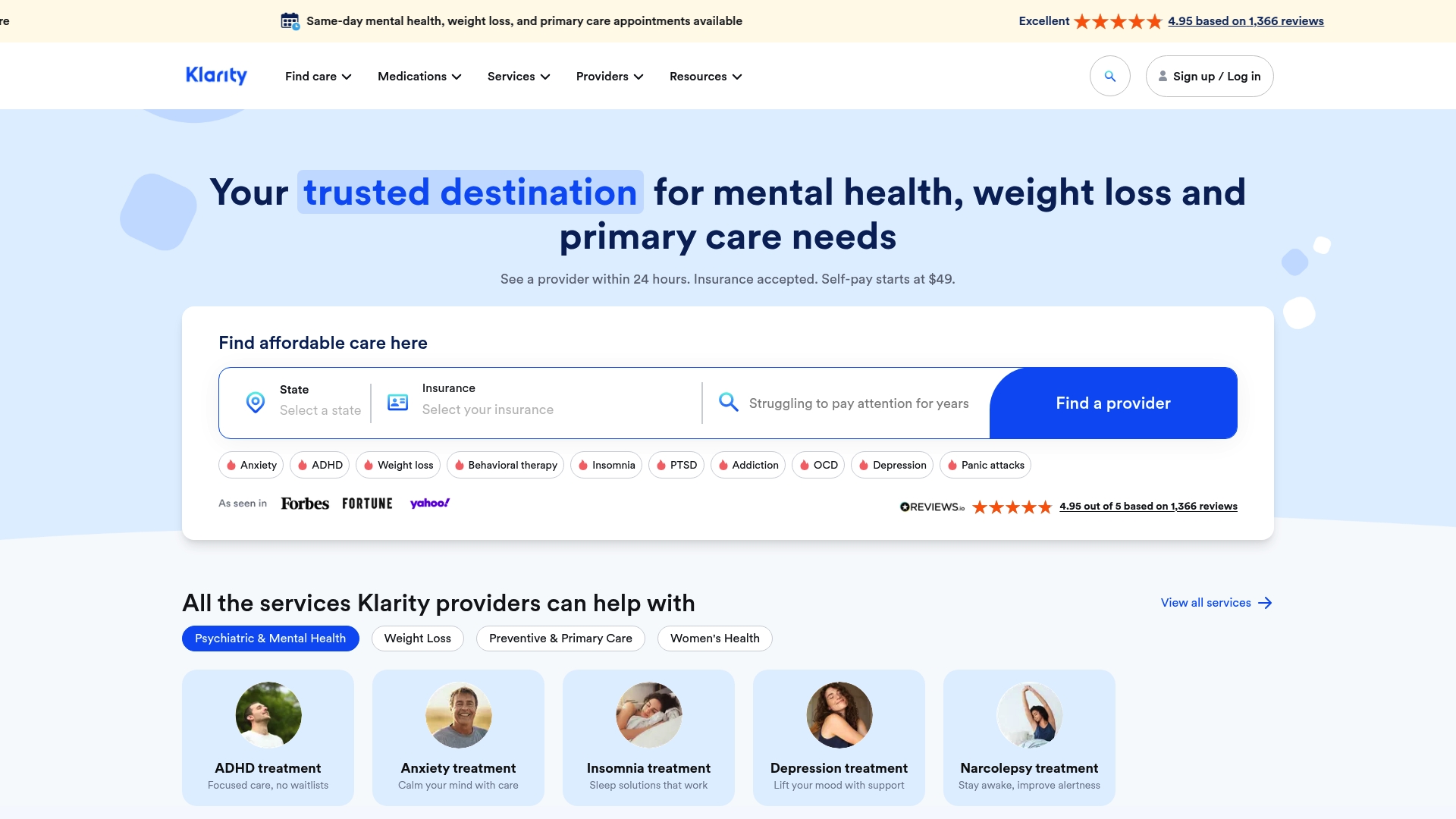
Appointments are available within 24 hours, with self-pay options starting at $49. Helloklarity accepts major insurance and HSA payments, so cost is rarely a barrier. Whether you need a refill for an ongoing condition or a first evaluation for anxiety, ADHD, or depression, you can explore available telehealth services and book directly online. No referral required.
FAQ
What is a telehealth prescription?
A telehealth prescription is a medication order issued by a licensed clinician after a remote clinical evaluation conducted via video or audio. It carries the same legal weight as an in-person prescription when all state and federal requirements are met.
Can a doctor prescribe controlled substances via telehealth?
Yes, under current DEA temporary flexibilities, authorized providers can prescribe Schedule II–V substances via telehealth without a prior in-person exam through December 31, 2026. After that date, stricter rules are expected to apply unless the DEA or Congress acts.
Does my provider need to be licensed in my state for a telehealth prescription?
Yes. The provider must hold a valid license in the state where you are physically located during the visit. A prescription issued by an out-of-state provider who is not licensed in your state is not legally valid.
How does my prescription get to the pharmacy?
The clinician transmits the prescription electronically using an e-prescribing system. For controlled substances, most states require the DEA’s EPCS program. Your pharmacy typically receives the prescription within minutes of the visit ending.
What conditions are best suited for telehealth prescriptions?
Stable chronic conditions, mental health diagnoses, and straightforward acute illnesses are the strongest candidates. Conditions requiring physical examination or diagnostic testing may still need an in-person visit before a prescription can be issued.
Recommended
- Does Insurance Cover Telehealth? What Every Major Plan Actually Covers In 2026 | Klarity Health, Inc
- Prescriber Scope Of Practice For General Psychiatry | Klarity Health, Inc
- Telehealth General Psychiatry Prescribing: What Prescribers Can Do | Klarity Health, Inc
- Telehealth Depression Prescribing: What Psychiatrists Can Do | Klarity Health, Inc
Get expert care from top-rated providers
Find the right provider for your needs — select your state to find expert care near you.
Related posts






— Monday to Friday, 7:00 AM to 4:00 PM PST
Join our mailing list for exclusive healthcare updates and tips.

— Monday to Friday, 7:00 AM to 4:00 PM PST



