 HSA & FSA accepted; best-value for top quality care
 Same-day mental health, weight loss, and primary care appointments available

 Accept major insurances and cash-payHSA & FSA accepted; best-value for top quality careSame-day mental health, weight loss, and primary care appointments availableAccept major insurances and cash-pay
How Lab Test Orders Work in Telehealth: 2026 Guide
Written by Klarity Editorial Team
Published: Jun 1, 2026

Telehealth lab test ordering is the process by which a licensed provider, during a virtual visit, electronically submits a lab requisition to a network lab so you can complete testing without an in-person clinic visit. Understanding how lab test orders work in telehealth removes the guesswork from virtual care and helps you act faster on results. Providers on platforms like Helloklarity, LifeMD, and BioReference Direct use this model to connect patients with labs like Labcorp and Quest Diagnostics within hours of a consultation. The process is more structured than most patients expect, and knowing each step puts you in control.
How does the telehealth lab test ordering process work?
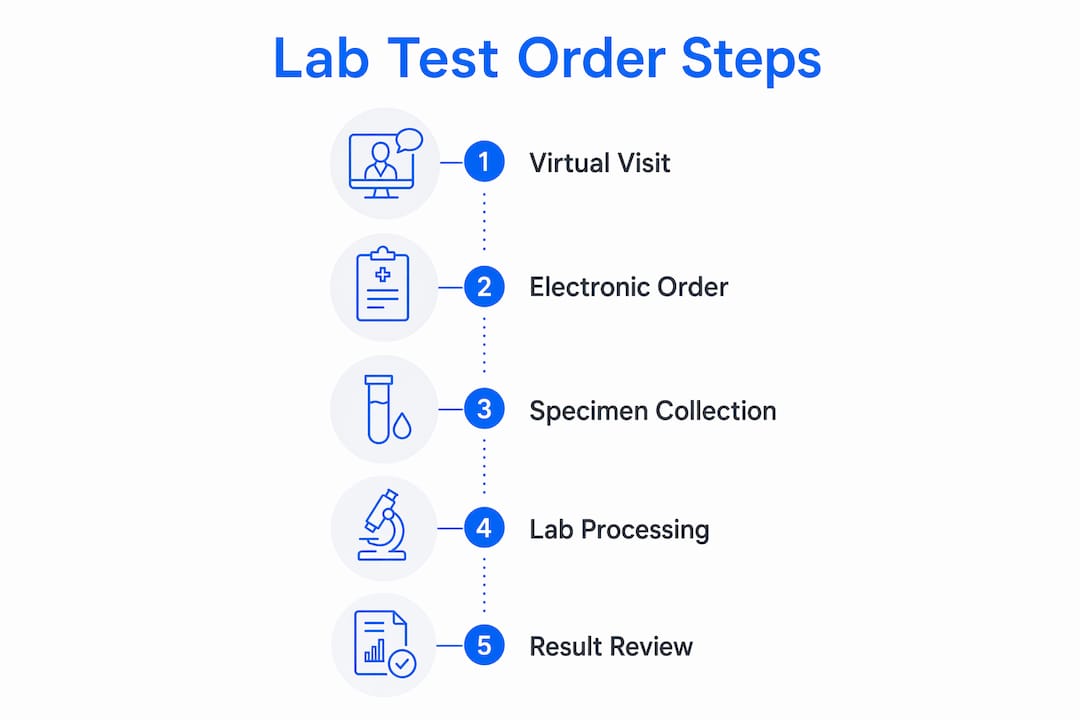
The telehealth lab test process follows a clear sequence from virtual visit to result review. Understanding each step prevents delays and helps you prepare.
Your provider evaluates your symptoms and history. During the video or asynchronous visit, the clinician reviews your current complaints, medications, and any recent lab data you’ve uploaded. Uploading prior results before the visit can eliminate redundant blood draws entirely, which saves you time and money.
The provider generates an electronic lab order. The requisition is sent directly to a partner lab network. Labcorp’s telemedicine toolkit describes this as a digital order that routes to the nearest patient service center, so no paper form changes hands.
You receive order instructions. You get an email or portal notification with the lab name, order number, any fasting requirements, and the nearest collection site. Some platforms also offer mobile phlebotomy scheduling at this stage.
You complete the specimen collection. Options include walking into a Labcorp or Quest Diagnostics location, scheduling a mobile phlebotomist to come to your home, or using an at-home collection kit for eligible tests.
The lab processes and transmits results. Turnaround times vary from same-day to 72 hours depending on the test. Results route back to your provider’s portal and, in most cases, directly to your patient account.
Your provider reviews and follows up. The clinician interprets results in the context of your visit notes and contacts you with next steps, adjusted prescriptions, or referrals.
Pro Tip: Before your telehealth visit, gather any lab results from the past 12 months and upload them to your patient portal. Providers who can see recent values are far less likely to order duplicate panels, which means fewer needles and lower out-of-pocket costs.
Which lab tests are commonly ordered through telehealth?

Telehealth providers order a wide range of tests, but the most clinically appropriate ones share a common trait: results directly change the treatment plan. Rational test selection means every order should meaningfully impact diagnosis or management. Ordering tests without that logic increases false positives, delays real diagnoses, and raises costs.
Common lab test referrals in telehealth include:
- Blood glucose and HbA1c panels for diabetes monitoring and management, frequently ordered by platforms specializing in chronic disease care
- Lipid panels to assess cardiovascular risk, often paired with weight loss or primary care consultations
- Thyroid function tests (TSH, T3, T4) for fatigue, weight changes, or mood concerns
- Hormone panels including testosterone, estrogen, and progesterone for reproductive health or hormone replacement therapy management
- STI and STD screening panels, which telehealth platforms handle with particular discretion given the privacy advantages of at-home collection
- Complete blood count (CBC) and comprehensive metabolic panel (CMP) as baseline assessments for new patients or medication monitoring
- Vitamin D, B12, and iron studies for fatigue workups, especially in primary care telehealth
Some tests cannot be completed remotely. Cultures requiring immediate processing, certain imaging-guided biopsies, and tests needing real-time specimen handling require in-person collection. A good telehealth provider will tell you upfront when an in-person visit is the right call rather than ordering a test that will produce unreliable results.
The preanalytical phase of lab testing, which covers specimen collection, handling, and transport, accounts for the majority of errors in any lab result. This is why your provider’s instructions about fasting, hydration, and sample timing are not optional details. They are clinical requirements.
How do insurance and prior authorization affect telehealth lab orders?
Insurance coverage for lab tests ordered through telehealth follows the same general rules as in-person orders, but the coordination layer is more complex. Your insurer, your telehealth provider, and the lab must all communicate correctly for a claim to process without delays.
Prior authorization is the biggest friction point. CMS 2026 interoperability guidance identifies prior authorization as a practical barrier that creates coordination and approval time issues for both patients and providers. This means a lab your provider orders on Monday may not be approved until Thursday, delaying care by days.
Here is what you can do to reduce that friction:
- Confirm your lab is in-network before you go. Labcorp and Quest Diagnostics are in-network for most major insurance plans, but specialty labs may not be.
- Ask your provider to document medical necessity clearly. Insurers deny prior authorization most often when the clinical rationale is vague. A specific diagnosis code tied to the order dramatically improves approval rates.
- Check whether your plan requires a referral. Some HMO plans require a primary care referral before a specialist-ordered telehealth lab is covered.
- Request expedited review for time-sensitive tests. Most insurers have a process for urgent prior authorization that compresses the timeline from days to hours.
Insurance prior authorization is not just paperwork. It directly affects when you get your lab results and whether your care plan can move forward on schedule. Knowing this in advance lets you push for faster approvals rather than waiting passively.
The 2026 CMS proposed rule on interoperability standards is pushing payers toward faster electronic prior authorization responses, which should reduce delays for telehealth lab orders over the next 12 to 24 months. Until those standards are fully enforced, proactive communication with your insurer remains your best tool.
In-lab, mobile, and at-home: which testing option fits you?
Once your provider sends the electronic order, you choose how to complete it. Each method has real tradeoffs worth understanding before you book.
| Option | Cost | Convenience | Insurance acceptance | Best for |
|---|---|---|---|---|
| In-lab (Labcorp, Quest Diagnostics) | Lowest with insurance | Moderate (travel required) | Highest | Most test types, insured patients |
| Mobile phlebotomy | Moderate to high | Highest (comes to you) | Partial, varies by provider | Mobility-limited patients, busy schedules |
| At-home collection kits | Low to moderate | High (mail-in) | Limited, often self-pay | STI screening, hormone panels, wellness checks |
In-lab testing at Labcorp or Quest Diagnostics remains the most insurance-compatible option. Both networks have thousands of patient service centers nationwide, and turnaround times for standard panels run 24 to 48 hours. The tradeoff is that you have to travel and schedule around their hours.
Mobile phlebotomy services send a certified phlebotomist to your home or office. This model works well for patients with mobility limitations, those managing chronic conditions requiring frequent draws, or anyone who finds clinic visits genuinely difficult to schedule. Costs without insurance coverage can run $50 to $150 above the lab fee itself.
At-home blood collection kits offer discreet, HIPAA-compliant access to a growing list of tests, though they are not suitable for every panel. Fingerstick collection works well for lipid panels, glucose, and hormone levels. Tests requiring larger venous samples or immediate processing are not good candidates. The preanalytical accuracy of at-home kits depends heavily on how carefully you follow the collection and shipping instructions, so read them twice before you start.
Platforms like BioReference Direct have taken this further by integrating telehealth evaluation directly into the consumer lab ordering experience. You consult with a provider, get the order, and complete testing through a single digital platform. This model is expanding rapidly in 2026 and represents where the industry is heading.
Pro Tip: If you are ordering STI screening or hormone panels and privacy is a priority, at-home collection kits are the strongest option. Results go directly to your patient portal without passing through a shared clinic check-in desk.
Key takeaways
Telehealth lab test orders follow a defined electronic workflow from virtual visit to result review, and knowing each step gives you real control over your care timeline.
| Point | Details |
|---|---|
| Electronic ordering is standard | Providers send requisitions directly to Labcorp, Quest Diagnostics, or partner labs after your virtual visit. |
| Upload prior labs before your visit | Recent results reduce duplicate testing and give your provider better clinical context from the start. |
| Prior authorization causes delays | Insurance approval can add days to your lab timeline; confirm medical necessity documentation upfront. |
| Three collection methods exist | In-lab, mobile phlebotomy, and at-home kits each suit different needs, budgets, and test types. |
| Test selection must be clinically justified | Providers should order only tests that directly change your diagnosis or treatment plan. |
What I’ve learned about getting the most from telehealth lab orders
After working closely with telehealth care workflows, the single biggest mistake I see patients make is treating the lab order as the finish line. It is actually the starting point. A result sitting in your portal unreviewed does nothing for your health. Active follow-up, whether that means messaging your provider, scheduling a results review visit, or asking for a written interpretation, is what converts a lab number into a care decision.
The second thing I would tell anyone navigating labs in virtual care is to treat your insurance prior authorization like a project with a deadline. Most patients assume approval is automatic. It is not. I have seen patients wait a week for a lipid panel because no one confirmed the order was approved before they drove to the lab. One phone call to your insurer the day after your telehealth visit can prevent that entirely.
At-home testing gets underused, and I think that is partly because patients assume it is less accurate. For the right test types, the accuracy is clinically equivalent to in-lab collection when instructions are followed correctly. If you are managing a chronic condition and need quarterly hormone or glucose monitoring, at-home kits can make that routine genuinely sustainable rather than a logistical burden every three months.
Finally, understanding what a telehealth visit covers before you book helps you arrive prepared. Providers who see a patient with organized history, recent labs, and clear symptom descriptions make better ordering decisions faster. You are not just a passive recipient of care in this model. You are an active participant, and the quality of your preparation directly affects the quality of your results.
— Guorui
Get lab orders and follow-up care through Helloklarity
Helloklarity connects you with licensed providers across primary care, mental health, and weight management who can order labs electronically during your virtual visit. Through Helloklarity’s network of over 1,000 providers, you can book an appointment within 24 hours and receive your lab requisition the same day. Orders route to nationwide lab networks, and providers follow up on results directly through the platform. Self-pay options start at $49, and Helloklarity accepts major insurance and HSA payments. If you are ready to skip the waiting room and get the testing you need, explore Helloklarity’s telehealth services and book your visit today.
FAQ
How does a telehealth provider send a lab order?
Telehealth providers send lab orders electronically through integrated lab networks like Labcorp or Quest Diagnostics. You receive the order details via your patient portal or email, along with instructions for completing the test.
Can I use insurance for lab tests ordered through telehealth?
Most major insurance plans cover lab tests ordered through telehealth the same way they cover in-person orders. Prior authorization may be required for certain panels, so confirm coverage with your insurer before visiting the lab.
What is the difference between at-home kits and in-lab testing?
In-lab testing at sites like Labcorp or Quest Diagnostics covers the widest range of test types and has the highest insurance acceptance. At-home collection kits work well for specific panels like hormone levels and STI screening but are not suitable for tests requiring large venous samples or immediate processing.
How long does it take to get lab results from a telehealth order?
Standard panels processed at Labcorp or Quest Diagnostics typically return results within 24 to 72 hours. At-home kits may take slightly longer due to shipping time, while some specialty tests can take up to a week.
What should I do if my insurance denies prior authorization for a lab test?
Contact your insurer and ask your telehealth provider to resubmit with a specific diagnosis code and documented medical necessity. The CMS 2026 interoperability rule is pushing for faster electronic authorization responses, but appeals with clear clinical documentation remain the most reliable path to approval today.
Recommended
- What Telehealth Services Can I Get Online? Medical Guide
- How To Transfer My Clomid Prescription To | Klarity Health, Inc
- What Is Telehealth Mental Health? Your 2026 Guide
- Do Online Doctors Check PMP For Clomid? | Klarity Health, Inc
Get expert care from top-rated providers
Find the right provider for your needs — select your state to find expert care near you.
Related posts






— Monday to Friday, 7:00 AM to 4:00 PM PST
Join our mailing list for exclusive healthcare updates and tips.

— Monday to Friday, 7:00 AM to 4:00 PM PST



