 HSA & FSA accepted; best-value for top quality care
 Same-day mental health, weight loss, and primary care appointments available

 Accept major insurances and cash-payHSA & FSA accepted; best-value for top quality careSame-day mental health, weight loss, and primary care appointments availableAccept major insurances and cash-pay
Controlled Substance Prescription Online: 2026 Guide
Written by Klarity Editorial Team
Published: May 27, 2026

Understanding what is a controlled substance prescription online is one of the most misunderstood topics in modern healthcare. Many people assume telehealth makes it easy to get medications like Adderall, Xanax, or opioids with just a few clicks. That assumption is wrong, and acting on it can lead to serious legal consequences. This guide breaks down exactly how controlled substance prescriptions work through online platforms, what federal law currently allows, and how you can safely get the care you need without crossing a legal line.
Table of Contents
- Key takeaways
- What controlled substances are and how they’re classified
- Legal framework for controlled substance prescribing online
- How to safely get a controlled substance prescription online
- Risks, restrictions, and common pitfalls
- What comes after 2026
- My take on access versus responsibility
- Get legitimate controlled substance care through Helloklarity
- FAQ
Key takeaways
| Point | Details |
|---|---|
| Controlled substances are federally regulated | The DEA classifies controlled substances in five schedules based on abuse potential and medical use. |
| Telehealth prescribing is temporarily allowed | DEA flexibilities allow online prescriptions for Schedule II-V substances through December 31, 2026, with strict criteria. |
| Video visits are required | An internet questionnaire alone cannot establish the valid patient-provider relationship needed for a controlled substance prescription. |
| Not all online providers can prescribe | Only DEA-registered practitioners who meet federal and state requirements may prescribe controlled substances via telehealth. |
| Rules may tighten after 2026 | The current telemedicine flexibilities are temporary. Patients should monitor regulatory updates closely. |
What controlled substances are and how they’re classified
A controlled substance is any drug or chemical whose manufacture, possession, and use is regulated by the federal government because of its potential for abuse, dependence, or both. The Drug Enforcement Administration places controlled substances into five schedules based on two factors: medical utility and potential for harm.
Here is a quick breakdown of each schedule:
- Schedule I: No accepted medical use and high abuse potential. Examples include heroin and LSD. These cannot be prescribed.
- Schedule II: High abuse potential but accepted medical use with severe restrictions. Examples include oxycodone, Adderall, and fentanyl.
- Schedule III: Moderate abuse potential. Examples include anabolic steroids and ketamine.
- Schedule IV: Lower abuse potential. Examples include Xanax, Valium, and Ambien.
- Schedule V: Lowest abuse potential. Examples include certain cough preparations containing codeine.
The schedule matters enormously when it comes to online prescribing. Schedule II prescriptions cannot be refilled. Schedule III and IV medications may have up to five refills within six months. These rules apply whether the prescription comes from an in-person visit or a telehealth appointment.
Pro Tip: If you are unsure which schedule your medication falls under, ask your provider directly before your appointment. It affects how your prescription is written, filled, and renewed.
Why do these regulations exist? Because substances in Schedules II through IV carry real risks. The opioid crisis made this unmistakably clear. Prescribers should exhaust nonopioid therapies before turning to controlled substances, and patients deserve providers who take that responsibility seriously.
Legal framework for controlled substance prescribing online
The foundation of all controlled substance prescribing in the United States is the Controlled Substances Act, or CSA. It requires that any practitioner who prescribes a controlled substance hold a valid DEA registration. That registration must be current and issued in the state where the patient is located at the time of the telehealth visit.
Here is how the current legal pathway for online prescribing works in 2026:
- Federal authority: The CSA sets baseline requirements. No prescription can be issued for a controlled substance without a valid practitioner-patient relationship and a legitimate medical purpose.
- DEA telemedicine flexibilities: The DEA extended COVID-era telemedicine rules through December 31, 2026, allowing DEA-registered practitioners to prescribe Schedule II through V substances without a prior in-person evaluation, under specific conditions.
- Real-time video required: The visit must use real-time two-way audio-video telehealth, not a simple phone call or online form.
- Legitimate medical purpose: Prescriptions must be issued for a genuine clinical reason, consistent with the provider’s scope of practice and professional standards.
- State law on top of federal law: States add their own layers of regulation. Some require in-person evaluations for certain substance categories regardless of federal flexibility.
“No controlled substance may be dispensed by means of the Internet without a valid prescription.” — Center for Connected Health Policy
This quote matters because it clarifies something many patients misread. Even under current flexibilities, online prescribing is not a workaround. It is a regulated pathway with its own set of strict requirements. You can review prescriber scope of practice rules by state to understand what your provider is legally authorized to do.
Pro Tip: Always confirm your telehealth provider is DEA-registered in your state before your appointment. You can verify a provider’s DEA registration through the DEA’s official online registration tool.
The DEA also announced new telemedicine rules in January 2025 that established a national Prescription Drug Monitoring Program, known as a PDMP, to protect against medication abuse and diversion. Platforms operating without compliance with these rules are operating outside the law.
How to safely get a controlled substance prescription online
The practical steps for getting a controlled substance prescription online are more involved than most people expect. Here is what a legitimate process looks like.
First, you need to establish a real patient-provider relationship. An internet questionnaire alone is insufficient to meet this standard. You will need a synchronous video appointment where the provider can conduct a clinical evaluation, review your history, and make a diagnosis. This is not a formality. It is a federal requirement.
What types of substances can be prescribed online right now? With the current DEA flexibilities in place through the end of 2026, providers can prescribe substances from Schedules II through V via telehealth if they are DEA-registered and the visit meets the real-time video standard. That includes medications for ADHD, anxiety, and certain pain conditions. You can learn more about what telehealth ADHD prescribing looks like in practice to understand what to expect.
Here is what to look for when verifying a legitimate online provider:
- The platform employs licensed, DEA-registered practitioners in your state
- Your appointment involves a live video call, not just a questionnaire or chat
- The provider reviews your medical history and asks specific clinical questions
- You receive a diagnosis and a documented treatment plan, not just a prescription
- The pharmacy filling your prescription is a licensed U.S. pharmacy
Pro Tip: If a telehealth platform promises a prescription before you’ve even spoken to a provider, that is a red flag. Legitimate services require a clinical evaluation first.
Online doctors can prescribe controlled substances when the patient’s diagnosis, medical history, and health status justify it, but only when the provider complies with all applicable regulations. The PDMP requirement also means your prescription history will be checked. That protects you as much as it protects the public.
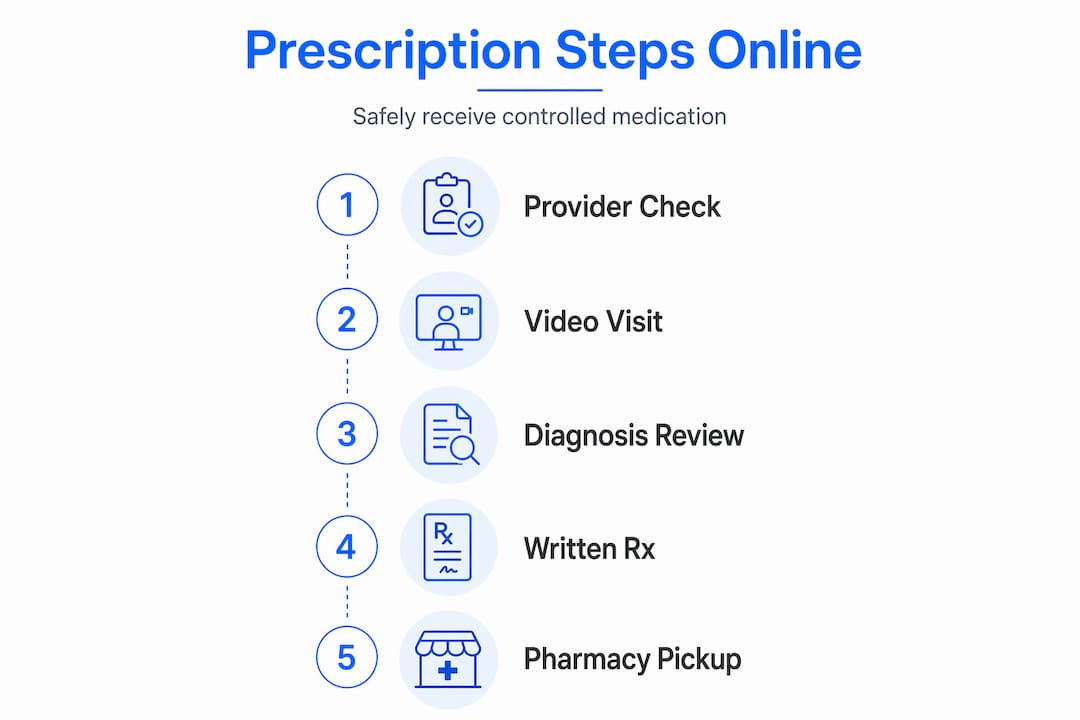
For prescription renewals, understand that the process does not get shorter just because you’ve been seen once. Check out what online prescription refills typically require so you are not caught off guard.
Risks, restrictions, and common pitfalls
The biggest mistake people make when searching for how to get controlled substances online is not recognizing the difference between a legitimate telehealth service and an unlicensed operation. That distinction has real legal weight.
| Feature | Legitimate telehealth | Illegitimate online source |
|---|---|---|
| Provider DEA registration | Required and verified | Absent or falsified |
| Video evaluation | Conducted before prescribing | Skipped or replaced with a form |
| PDMP check | Performed routinely | Not performed |
| Licensed U.S. pharmacy | Used exclusively | May ship from overseas |
| Legal risk to patient | Minimal when compliant | Potential federal charges |
Obtaining controlled substances from an unauthorized source is not a gray area under federal law. It can result in criminal charges for drug possession or procurement fraud, not just for the seller but potentially for the patient.

Refill restrictions also catch people off guard. Because Schedule II prescriptions cannot be refilled, you will need a new prescription each time, which means returning to your provider regularly. For Schedule III and IV medications, up to five refills are allowed within a six-month window. Build that into your planning so you do not run out.
A few other pitfalls worth knowing:
- Some states do not recognize the federal telemedicine flexibilities for certain drug classes, meaning your online prescription may not be fillable in your home state even if the provider is legitimate
- Pharmacies are independently governed by the CSA, so dispensing must comply with DEA rules regardless of where the prescription originated
- If you’re traveling across state lines, the rules in your destination state apply at the point of dispensing
What comes after 2026
The telemedicine flexibilities that currently make online controlled substance prescriptions possible are not permanent. The flexibilities are temporary and subject to rollback after December 31, 2026. No one knows yet whether Congress or the DEA will act to extend them again, create permanent rules, or allow the stricter Ryan Haight Act requirements to take full effect.
Here is what patients should watch for going into 2027:
- Whether the DEA finalizes a permanent special registration pathway for telemedicine prescribers
- How state-level laws evolve in response to federal changes
- Whether the national PDMP becomes more integrated across pharmacy and prescribing systems
- How telehealth platforms adapt their services if in-person visit requirements return
The smartest thing you can do right now is work with a provider who already operates within a rigorous compliance framework. If the rules tighten, patients who have established documented clinical relationships with legitimate providers will be in a far better position than those who have relied on shortcut platforms.
My take on access versus responsibility
I’ve worked closely enough with telemedicine prescribing environments to know that the biggest misconception patients carry into this process is that telehealth equals easy access. It doesn’t. Not when controlled substances are involved.
What I’ve seen is that the providers doing this work responsibly take more time and ask harder questions than many in-person visits. They know their DEA registration is on the line. They know the PDMP is watching. And frankly, that is how it should be.
The patients who struggle most are the ones who have been burned by platforms that promised fast prescriptions and delivered legally questionable care. When that platform shuts down or the prescription can’t be filled, those patients end up worse off than when they started.
My honest advice: stop optimizing for speed and start optimizing for legitimacy. The extra step of a real video evaluation with a real licensed provider is not an obstacle. It is the thing that makes your prescription legal, fillable, and safe. A 24-hour wait for a qualified clinician beats a 5-minute questionnaire that puts you at legal risk.
Telehealth prescribing for controlled substances works. It works well when the rules are followed. But treating those rules as optional is the fastest way to end up without the care you need.
— Guorui
Get legitimate controlled substance care through Helloklarity
If you are looking for a telehealth platform that takes compliance as seriously as it takes patient care, Helloklarity is built for exactly this. Klarity Health connects you with over 1,000 licensed, DEA-registered providers who specialize in mental health, ADHD, anxiety, and primary care conditions that often involve controlled substance prescriptions.
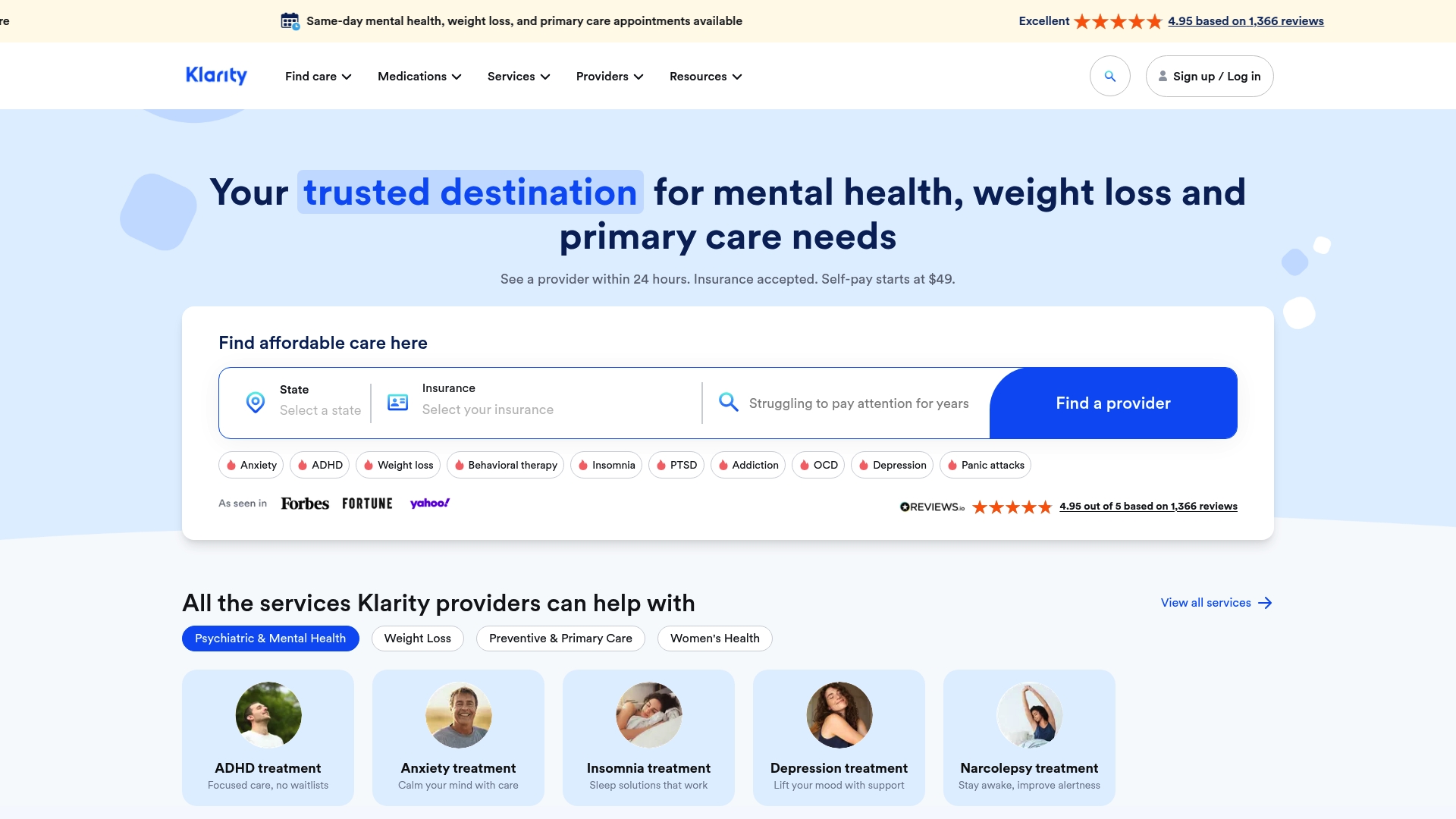
Every appointment on the Helloklarity platform begins with a real, live video evaluation, not a form. Providers review your medical history, conduct a clinical assessment, and prescribe only when medically appropriate. Klarity operates in full compliance with DEA telemedicine rules and state licensing requirements, so you can be confident that any prescription you receive is legally valid and pharmacist-fillable. Appointments are available within 24 hours, with self-pay options starting at $49. You can also explore the full range of telehealth services available or find a licensed provider in your state today.
FAQ
What is a controlled substance prescription online?
A controlled substance prescription online is a written order issued by a DEA-registered provider through a telehealth visit, authorizing a pharmacy to dispense a federally regulated medication. It must meet the same legal standards as an in-person prescription, including a valid patient-provider relationship and a legitimate medical purpose.
Can a doctor prescribe controlled substances without an in-person visit?
Yes, through December 31, 2026, DEA-registered practitioners can prescribe Schedule II through V controlled substances via telehealth without a prior in-person visit, provided the appointment uses real-time two-way video and meets all federal and state requirements.
What medications count as controlled substances?
Controlled substances include opioids like oxycodone, stimulants like Adderall, sedatives like Xanax and Ambien, and other regulated drugs classified in DEA Schedules II through V. Schedule I substances have no accepted medical use and cannot be prescribed.
How do I know if an online pharmacy for controlled substances is legitimate?
A legitimate platform employs licensed, DEA-registered providers, requires a live video evaluation before prescribing, checks the PDMP, and fills prescriptions through licensed U.S. pharmacies. If a service offers controlled substances without a clinical visit, it is operating outside federal law.
Will I be able to get controlled substance prescriptions online after 2026?
Possibly, but the current rules are temporary. The DEA may extend flexibilities, create permanent telemedicine registration pathways, or reimpose stricter in-person requirements. Patients should monitor DEA announcements and work with providers who maintain rigorous compliance regardless of how the rules change.
Recommended
- Online Prescription Refill: Can A Telehealth Doctor Renew Your Medication? | Klarity Health, Inc
- Prescriber Scope Of Practice For General Psychiatry | Klarity Health, Inc
- How To Transfer My Lexapro Prescription To Illinois | Klarity Health, Inc
- Who Can Prescribe Prozac? NP Vs MD | Klarity Health, Inc
Get expert care from top-rated providers
Find the right provider for your needs — select your state to find expert care near you.
Related posts






— Monday to Friday, 7:00 AM to 4:00 PM PST
Join our mailing list for exclusive healthcare updates and tips.

— Monday to Friday, 7:00 AM to 4:00 PM PST



