 HSA & FSA accepted; best-value for top quality care
 Same-day mental health, weight loss, and primary care appointments available

 Accept major insurances and cash-payHSA & FSA accepted; best-value for top quality careSame-day mental health, weight loss, and primary care appointments availableAccept major insurances and cash-pay
What Is a Medication Management Appointment?
Written by Klarity Editorial Team
Published: Jun 7, 2026

A medication management appointment is a structured healthcare visit where a licensed provider reviews every medication you take, including prescriptions, over-the-counter drugs, and supplements, to confirm each one is safe, necessary, and working as intended. The formal industry term for this service is medication therapy management (MTM), though “medication management appointment” is the phrase most patients use when searching for care. These visits are conducted by clinical pharmacists, psychiatrists, primary care physicians, and nurse practitioners, and they apply to anyone managing chronic conditions, mental health treatment, or complex multi-drug regimens. The goal is not just to renew prescriptions. It is to optimize your entire treatment plan.
What is a medication management appointment and why does it matter?
Medication nonadherence is one of the most preventable drivers of poor health outcomes in the United States. Nonadherence causes increased hospital admissions, lost work productivity, and avoidable healthcare costs. That single fact explains why regular medication management appointments exist: they catch problems before those problems become emergencies.
The risks multiply when patients take multiple medications at once, a situation clinicians call polypharmacy. Without a structured review, drug interactions can go undetected for months. A medication management appointment creates a dedicated checkpoint where a provider maps every substance in your body and flags conflicts, redundancies, or dosages that no longer fit your current health status.
These appointments carry particular weight in mental health care. Psychiatric medications for conditions like anxiety, ADHD, and depression often require careful titration and ongoing monitoring because their effects shift over time. A psychiatrist managing anxiety medications, for example, needs regular feedback from you to know whether a current dose is therapeutic or causing side effects that erode your quality of life.

The benefits extend beyond individual safety. Pharmacist-led medication management improves patient satisfaction and adherence through education and counseling, and it bridges the gap between inpatient and outpatient care. When your providers communicate and coordinate, your treatment stays consistent even across care settings.
How does medication management work during an appointment?
A typical medication management appointment runs between 20 and 45 minutes and can take place in person or via telehealth. The format is conversational but structured, and it covers far more ground than a standard prescription refill visit.
Here is what the appointment typically includes:
- Comprehensive medication review. Your provider goes through every drug you take, including dosage, frequency, and how long you have been on it. This includes vitamins and herbal supplements, which patients frequently omit but which can interact with prescription drugs.
- Effectiveness assessment. The provider asks whether each medication is doing what it is supposed to do. If your blood pressure medication is not controlling your readings, that conversation happens here.
- Side effect screening. You discuss any symptoms you have noticed since starting or changing a medication. Side effects are a leading reason patients stop taking medications without telling their provider.
- Adherence check. The provider asks how consistently you take your medications and whether cost, complexity, or forgetfulness creates gaps. Validated tools like 15-STARS allow providers to identify specific adherence barriers and tailor their response accordingly.
- Therapy adjustments. Based on everything discussed, the provider may change a dose, discontinue a medication, substitute a drug, or add a new one. In MTM settings, these recommendations go back to your prescribing physician for approval.
The appointment also involves collaboration. A clinical pharmacist conducting an MTM review, for instance, does not act in isolation. Their written recommendations feed directly into your physician’s treatment decisions.
Pro Tip: Bring a physical or digital list of every substance you take to the appointment, including the exact dose and how often you take it. Non-prescription items are a frequent source of overlooked interactions, and having the list ready saves time and reduces the chance of missing something.
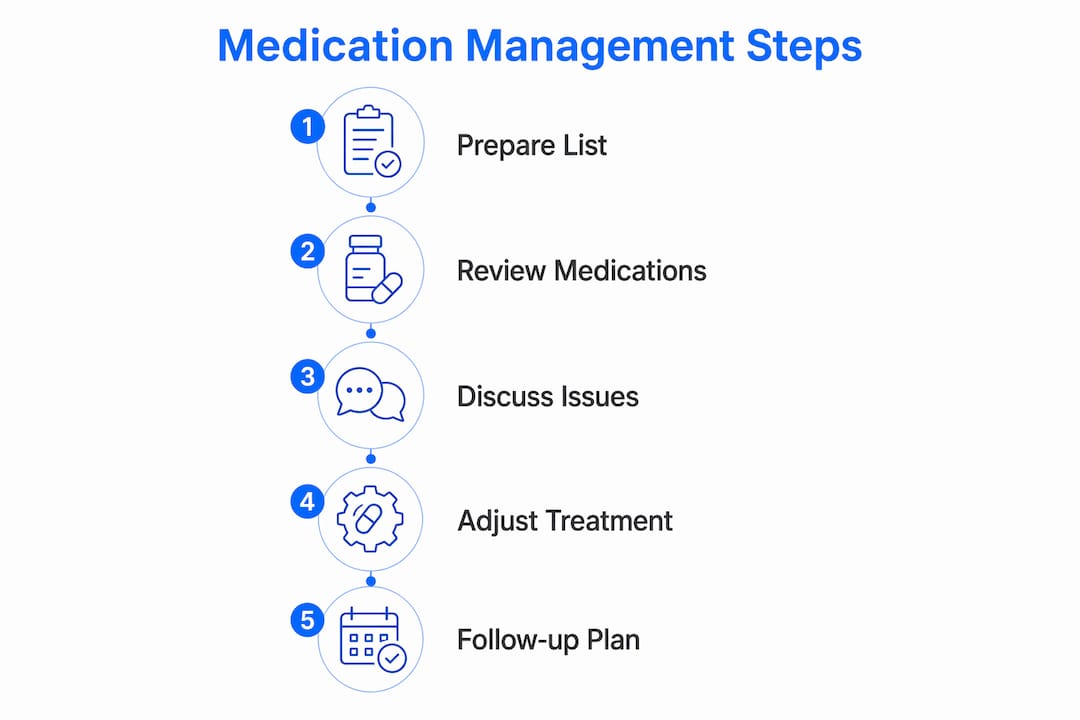
How to prepare for a medication management appointment
Preparation is the single biggest factor separating a productive medication appointment from a generic one. Providers can only optimize what they know about, and most patients underreport what they are actually taking.
Before your appointment, gather the following:
- A complete medication list. Write down every prescription drug, over-the-counter medication, vitamin, supplement, and herbal product. Include the name, dose, and how often you take it.
- Recent changes. Note any medications you started, stopped, or changed in the past three to six months, including any hospitalizations that resulted in new prescriptions.
- Side effect notes. If you have experienced anything unusual, write it down with an approximate date of onset. Providers find patterns in timing that patients often miss.
- Missed doses. Be honest about how often you skip doses and why. Cost, side effects, and forgetting are the three most common reasons, and each has a different solution.
- Your questions. Bring at least two or three specific questions. “Is there a cheaper alternative?” and “Can I take this with grapefruit juice?” are both fair game.
Annual medication reviews are recommended at minimum, with additional reviews after any significant health change or new prescription. Treating the appointment as a routine part of your care, rather than a reaction to a problem, produces better outcomes over time.
Pro Tip: Consider wearing a medication allergy ID bracelet if you have known drug allergies. It provides critical safety information in emergencies and signals to your provider that you take medication safety seriously.
Honest communication is the most underrated preparation tool. Patient proactivity during these visits leads directly to improved adherence and more personalized therapy adjustments. Your provider cannot tailor your care to your life if you present an idealized version of your medication habits.
What types of medication management services exist?
Not every medication-related appointment is the same. The term covers several distinct service types, each with a different scope, provider, and purpose.
| Service type | Typical duration | Primary purpose | Who provides it |
|---|---|---|---|
| Medication review appointment | 20 to 45 minutes | Review current regimen for safety and effectiveness | Clinical pharmacist, primary care physician |
| Medication Therapy Management (MTM) | 30 to 60 minutes | Optimize regimen, reduce costs, provide written recommendations | Clinical pharmacist |
| Psychiatric medication management | Ongoing, 15 to 30 minutes per follow-up | Monitor and adjust psychiatric medications | Psychiatrist, PMHNP |
| Chronic disease medication management | Ongoing | Manage medications for conditions like diabetes or hypertension | Primary care physician, clinical pharmacist |
MTM services go beyond a single review. They include ongoing monitoring, written therapy recommendations approved by the patient’s physician, and specific strategies to reduce side effects and lower medication costs. Medicare Part D and many private insurers cover MTM for patients who meet eligibility criteria, typically those with multiple chronic conditions and high medication costs.
Clinical pharmacists play a central role in both MTM and chronic disease management, particularly for older adults managing polypharmacy. Their training focuses specifically on drug interactions, dosing, and pharmacokinetics, which makes them uniquely equipped to catch problems that generalist providers may miss.
For mental health care, psychiatric medication management is its own subspecialty. A PMHNP managing general psychiatry prescriptions monitors not just whether a medication works, but how it affects mood, cognition, sleep, and daily function over time. These follow-up visits are shorter than initial evaluations but no less important. Skipping them is one of the most common reasons psychiatric treatment stalls.
Adherence tools like pillboxes, digital reminders, and pharmacy apps increasingly support what happens between appointments. Behavioral support from providers during visits reinforces consistent medication-taking over the long term.
Key takeaways
Medication management appointments work because they combine clinical review, behavioral support, and provider collaboration into a single, structured visit that addresses both the science and the reality of taking medications consistently.
| Point | Details |
|---|---|
| Core definition | A medication management appointment reviews all medications for safety, effectiveness, and adherence. |
| Who conducts them | Clinical pharmacists, psychiatrists, PMHNPs, and primary care physicians all provide these services. |
| MTM vs. standard review | MTM includes written recommendations and ongoing monitoring; a standard review is typically a one-time assessment. |
| Preparation matters | Bringing a complete medication list, including OTCs and supplements, directly improves appointment outcomes. |
| Mental health relevance | Psychiatric medication management requires regular follow-ups to monitor efficacy and adjust treatment over time. |
Why I think patients underestimate these appointments
Most people walk into a medication management appointment expecting a quick check-in. They walk out realizing their provider just caught a drug interaction they had been living with for two years, or discovered that a medication they assumed was helping had stopped being effective months ago.
What I have observed, both through research and through conversations with patients navigating mental health care, is that the biggest barrier to getting value from these appointments is not access. It is the assumption that the provider already knows everything they need to know. They do not. Your provider sees you for a fraction of your week. The behavioral patterns you bring to the appointment, how often you actually take your medications, what you skip and why, are data points that no lab test can capture.
The introduction of tools like the 15-STARS adherence questionnaire is a meaningful development because it gives providers a structured way to ask the questions patients often do not volunteer. But the tool only works if patients answer honestly. That requires trust, and trust requires patients to see these appointments as partnerships rather than evaluations.
My honest recommendation: treat your next medication management visit the way you would treat a financial review with an advisor. Come prepared, be transparent about what is not working, and ask direct questions about alternatives. The providers who conduct these appointments are trained to solve exactly the problems you are embarrassed to mention.
— Guorui
Managing your medications with Helloklarity
If you are ready to schedule a medication management appointment but are not sure where to start, Helloklarity makes the process direct and accessible.
Helloklarity connects you with over 1,000 licensed providers, including psychiatrists and PMHNPs who specialize in mental health medication management, often within 24 hours of booking. Appointments are available via telehealth, so you can complete your medication review online from home without waiting weeks for an in-person slot. Self-pay options start at $49, and Helloklarity accepts major insurance and health savings accounts. Whether you are managing anxiety, ADHD, depression, or a chronic condition, you can find a provider near you and get the structured medication oversight your treatment plan requires.
FAQ
What is the difference between a medication review and MTM?
A medication review appointment is a one-time assessment of your current regimen for safety and effectiveness. Medication Therapy Management (MTM) is a broader, ongoing service that includes written recommendations, provider collaboration, and regular monitoring, typically covered by Medicare Part D for eligible patients.
How often should you have a medication management appointment?
Annual reviews are the standard recommendation, with additional appointments after any new diagnosis, hospitalization, or significant medication change. Patients on psychiatric medications typically benefit from follow-up visits every one to three months.
Who can conduct a medication management appointment?
Clinical pharmacists, psychiatrists, primary care physicians, and psychiatric mental health nurse practitioners (PMHNPs) all conduct medication management appointments. The provider type depends on whether the focus is chronic disease, mental health, or general medication safety.
What should I bring to a medication management appointment?
Bring a complete list of every medication you take, including over-the-counter drugs, vitamins, and supplements, with the dose and frequency for each. Also note any recent side effects, missed doses, and questions you want answered.
Can I get a medication management appointment through telehealth?
Yes. Telehealth platforms like Helloklarity offer medication management appointments with licensed providers, including same-day or next-day availability. Virtual visits cover the same scope as in-person appointments and are particularly convenient for ongoing psychiatric medication follow-ups.
Recommended
- How To Transfer My Lamictal Prescription To California | Klarity Health, Inc
- How To Transfer My Prozac Prescription To Pennsylvania | Klarity Health, Inc
- How To Transfer My Strattera Prescription To Pennsylvania | Klarity Health, Inc
- How To Transfer My Prozac Prescription To Florida | Klarity Health, Inc
Get expert care from top-rated providers
Find the right provider for your needs — select your state to find expert care near you.
Related posts
— Monday to Friday, 7:00 AM to 4:00 PM PST
Join our mailing list for exclusive healthcare updates and tips.

— Monday to Friday, 7:00 AM to 4:00 PM PST



